

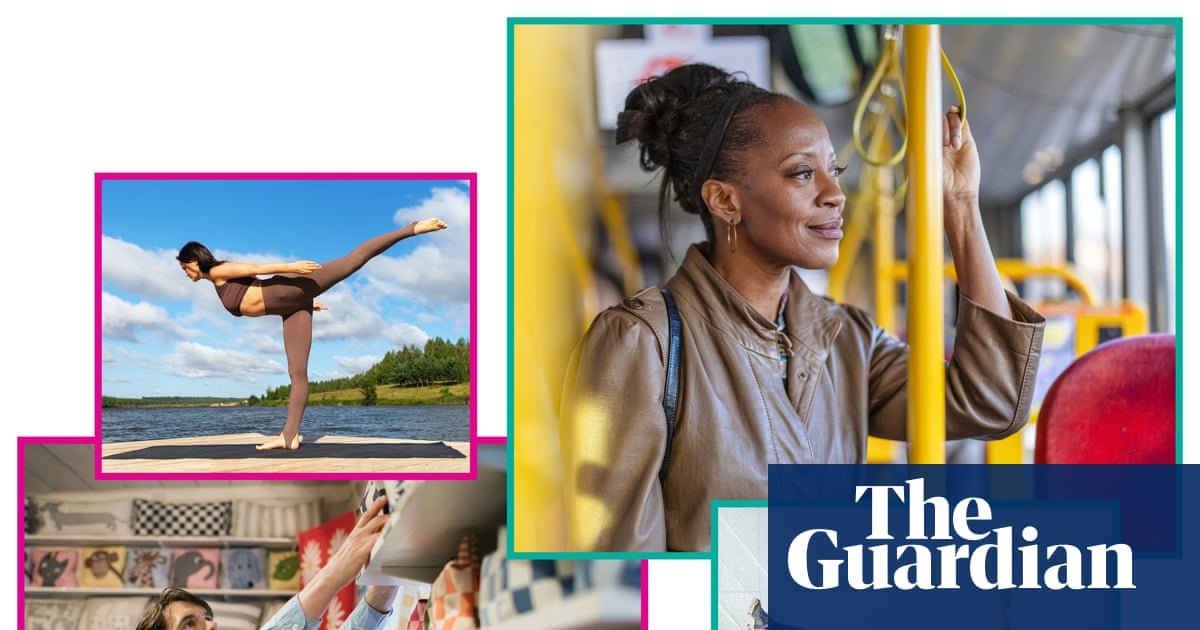
There are lots of movements that make you stronger and more physically capable – press-ups, squats and kettlebell swings build strength and muscle that help in a huge variety of situations. But can you get more specific? Well, yes: there are exercises that target the challenges of everyday life, whether that’s playing on the floor with your kids or bringing in the big shop. Here are the moves you may want to consider, presented by a dozen movement coaches, personal trainers and strength specialists.
To stay upright on public transport … do side planks with a twist
Plenty of people think planks are just for abs, but they’re a full-body stability exercise that helps us brace against other movements, from carrying a toddler on one hip while unlocking the front door to standing on the deck of a ship (or, er, the No 12 bus).
“Side planks with extra movement – hip dips or leg lifts, for example – teach your body to stay strong when something is trying to pull you sideways,” says Callum Roberts, the head coach at the gym Results Inc. “They train your obliques, hips, glutes and shoulder stability all at once.”
To begin, start in a classic side plank – one forearm on the floor, feet slightly staggered – then move one leg up and down.
To simplify the big shop … do the suitcase carry
Heavy bags? No problem. Photograph: Posed by model; andresr/Getty Images
Lots of coaches will tell you to do the farmers’ walk – a heavy weight in each hand – but this one-sided variation will help you carry groceries, luggage or a toolbox without leaning unnecessarily to one side, explains the trainer Jacob Siwicki. “Hold a heavy weight such as a dumbbell or a kettlebell in one hand and walk tall,” he says. “It will teach your core and body to resist tipping over sideways; almost nothing else trains this specifically.”
To entertain the kids on car journeys … work on your thoracic rotations
If you regularly occupy the passenger seat on long road trips with children, then you probably know that constantly turning around to deliver snacks, fix tablets or address arguments takes its toll – especially on your spine. “Most people are really stuck in the mid-back, so the spine ends up rotating as one stiff block rather than moving segment by segment,” says the posture and pilates expert Kerrie-Anne Bradley. “Rotating and moving the middle thoracic spine – the middle section of your back, made up of the 12 vertebrae between the neck and the lower ribs – helps to restore rotational range without loading a stiff spine.”
For a simple way to prepare, try thoracic twists: “Sit up on your sit bones [at the base of your pelvis] on your chair, with your feet flat on the floor, and imagine your head being pulled up by an invisible thread,” says Bradley. “Bring your middle fingers to touch at the centre of your chest, elbows lifted in line with shoulders, keeping the tops of shoulders down. Keep your pelvis, legs and arms fixed in this position, breathe in through your nose and rotate to the right. Let your head move with your chest, not ahead of it, and rotate only as far as you can without your hips shifting.
“Once that feels controlled, extend your arms straight out in line with your shoulders once in the rotation and turn a little further, doing a full breath in and out. Return to the centre with your arms straight out to the sides before bending them to start the rotation on the other side.”
To always win at tag … learn the Cossack squat
‘You’re it!’ Photograph: Posed by model; Dusan Stankovic/Getty Images
“This variation of a side lunge develops lateral strength, hip mobility, ankle mobility and the ability to shift your weight confidently from side to side, which are qualities that often get neglected in traditional fitness programmes,” says Autumn Noble, a personal trainer at Genesis Health Club. “Practising this lunge will help with movements such as scrambling over rocks on a hike, stepping sideways on to a crowded train or recovering from a misstep on uneven ground.”
Squat down with most of your weight on one flat foot, with your other leg extended, toes pointing up and heel on the floor. Slowly shift your weight across to hit the same position on the other side, feeling the stretch in your groin and hamstrings.
To safely put bags in the overhead locker … do wood chops
“Twisting is one of the most underrated movement patterns,” says the wellness coach Nikkii Behrens, the founder of Rare Street Pilates. “We rotate constantly in everyday life, whether we’re unloading the dishwasher, putting luggage into an overhead compartment or lifting and turning with a child. Wood chops help build strength through the core while improving mobility through the upper back. They also teach the body how to create and control rotation safely, which is something many people lose as they get older.”
You can do these with a cable or a resistance band tied to a solid anchor – or, for a slight variation, a kettlebell or dumbbell. Hold the handle low on one side of your body, then bring it upwards and across your body, twisting as you do it. Pause, then return to the start.
To mow the lawn more easily … get into bridging
Strong glutes are essential for all sorts of everyday tasks. Photograph: Posed by model; Carrastock/Getty Images
“Bridging is one of my favourite exercises, because it strengthens the glutes, the hamstrings and the back of the body, which are muscles many people underuse due to spending so much time sitting – it can take time for the muscles to actually wake up and engage properly,” says Behrens. “Strong glutes are essential for all sorts of everyday tasks and they’re crucial for supporting the lower back.”
For the simplest version, lie on your back with your feet close to your bottom. Push through your heels to “bridge” your hips up in the air until your upper thighs form a straight line with the rest of your body, then pause and repeat.
To prepare for parenthood … do loaded carries
“I love variations of the loaded carry for my clients who are parents or parents-to-be – they’re great for the awkward unilateral loading involved in holding a child, a bag or a pram,” says Brian Abell, a coach at Fit Happens personal training.
Start with the “front rack” – hold a kettlebell in one hand, resting the bell part on your forearm with your elbow tucked against your ribs. Practise walking or even lunging like this and consider adding a second kettlebell – especially if you’re having twins.
To make rambling easier … learn the step vault
Full-bore parkour may feel like a bit much to take on, but the “step vault” – among its most beginner-friendly movements – is one of the safest and easiest ways to clear an obstacle that is below your chest height. “The step vault is a very natural movement and can be one of the fastest ways to vault,” says Dan Edwardes, the founder of Parkour Generations. “Take the time to train it and you’ll find it becomes an invaluable part of your basic movement skills, letting you glide over low walls, handrails or gates.” As long as you’ve got right of way, obviously.
Move towards the obstacle at a comfortable speed. Avoid taking small steps as you approach. As you get close, push off from one leg and reach out with the same hand to place it on top of the obstacle at the same time as your opposite leg comes up to step on top of the obstacle (with either the ball or the heel of the foot). Bring your trailing leg up and through the space that has been created between your body and the top of the obstacle. Keep your momentum going forward. The trailing leg then becomes the leg to touch the ground first on the other side, landing softly on the ball of the foot. Keep moving!
To get something off that high shelf … master the tree-to-three
And … relax. Photograph: Posed by model; FG Trade/Getty Images
“This yoga transition builds balance that doesn’t leave you frozen in one place – it’s about control as your centre of gravity moves forward,” says Bassanti Pathak, the co-founder of Pathak Yoga. “It’s just what you need to lean forward to pick something off a high shelf.” Start in a “tree” pose with one foot tucked against the opposite leg and your hands high. Then, without putting your foot down, straighten the tucked leg behind you as you bend forward at the waist, keeping your supporting leg as straight as possible and bringing your torso and arms parallel to the ground. This pose is known as “warrior three”. If you like, you can go back to your starting position for the tree-to-three-to-tree.
To catch falling crockery … use the chest expansion
“There’s a perception that pilates is just a boutique workout for wealthy women, but that misses the entire point,” says Lesley Logan, a pilates teacher and mindset coach. “Joseph Pilates originally developed the method for men recovering from illness and war injuries. It’s not about doing pilates instead of your life or other sports – it’s about doing pilates to make everything else you do better.”
It’s also underrated for preparing you for unexpected physical tasks such as twisting to catch a falling mug. Use the chest expansion to open up your tight shoulder and chest muscles and add a neck turn to challenge your balance. With your arms by your side, hold a pair of light weights (or cans of beans, say). Bring them slightly behind you to stretch your shoulders, then look left and right. Repeat by bringing the weights ahead of you before reaching back again, trying to stretch slightly further each time.
To recapture your childhood … train slow step-downs
Remember the joys of running downhill at top speed as a child, knowing that the worst-case scenario was losing your balance and tumbling giddily through a cloud of daffodils? If that thought made your knees twinge, it’s time to take action. “Lots of people train going uphill, but nobody trains the brakes,” says Siwicki. “Training step-downs helps in situations such as running down a steep hill at full speed, or walking up and down stairs with a laundry basket and no free hand for the rail.”
This one couldn’t be simpler: just step on to a lowish box at normal speed, then lower your trailing foot to the floor slowly ahead of you (you can also do variations where you lower your trailing leg behind or to the side). Do a few reps and repeat on the other side.
To avoid embarrassment at soft play … do the bear crawl
Ready to go. Photograph: Posed by model; rbkomar/Getty Images
“Crawling reconnects shoulders, hips, trunk, hands and feet in one coordinated pattern,” says Oscar Trelles, the founder of the training company Breathing Flame. “It builds strength and control in positions adults often lose access to, without needing heavy equipment or complicated technique.” And if you’re chasing an errant toddler through a brightly coloured tunnel, it will allow you to match their pace without ending up too red-faced.
In the classic bear crawl, you keep your knees an inch or two off the ground and move each hand and its opposite foot forward simultaneously; it’s surprisingly fast once you get the hang of it. Put it into your warm-up or try it in the garden.
To prepare for five-a-side season … start skipping
“Skipping is something that lots of us stop doing after school, but it’s the perfect way to warm up our lower body and all of our jumping, sprinting and dancing muscles,” says Steve Kamb, the author of How to Try Again and the founder of Nerd Fitness. “Plus, it’s basically impossible not to smile while you do it.” If you haven’t skipped in a while, start simply, trying to keep your jumps low and quiet – then move to bouncing from one foot to the other, figure-eights – and eventually the punishing double-under, where the rope passes under your feet twice every time you jump.
To look good at the garden centre … try sandbag bear hugs
“Real life doesn’t look like the gym,” says Brian Murray, the founder of Motive Training. “Sandbags and stones – like the atlas stones you’ll see in World’s Strongest Man – are bulky, often asymmetrical and awkward to pick up and hold. For beginners who have never used one before, a bear hug carry is a good place to start.”
The bear hug carry involves holding the weight in front of you with your arms squeezed around it and one hand holding the other wrist. You could try carrying bags of compost or gravel, but if you’re after something more portable, try duct-taping together bags of builders’ sand, then throwing them in a rucksack or duffel bag. Hold the bag in a bear hug while you do squats, lunges or just walk around the house.
To get off the floor with ease … learn the Turkish get-up
If a kettlebell is too much, start with a shoe. Photograph: Posed by model; SrdjanPav/Getty Images
“This trains the ability to move from the ground to standing with strength, motor control, balance and adaptability,” says Noble. “Getting on to and off the floor while playing with a toddler or grandchild, getting down to recover something from under the bed and crouching low to scoop cat litter all incorporate parts of the Turkish get-up.”
You can do it with a weight – the world record is nearly 119kg – but for control and balance, a clean shoe balanced on your upraised fist works just as well. Start lying down with one hand high, roll on to the opposite elbow, and use it to prop yourself up while you bring your other leg underneath you. From there, stand up, and then reverse the whole process to lie down again.
Also helpful is the no-hands get-up. This isn’t a specific movement – just practise standing up without using your hands, any way you like.
“Forward or reverse lunges where you use a tool or an obstacle to push yourself beyond your usual range of motion build strength while improving mobility, balance and dynamic control,” says Roberts. “They’re perfect for getting up from the floor without using your hands, climbing stairs or catching yourself when you stumble.”
Start with the forward version. Lunge forward on to a small step such as a kerb or a weight-plate; this will give you a better stretch through the hips as your trailing knee brushes the ground. Push off your front heel to stand back up, then repeat on the other side.
To carry the kids in from the car … do Zercher exercises
The Zercher squat – a variation of the barbell where you hold the weight in the crook of your arms – is a favourite of Olympic wrestlers, as it mimics the positions that occur in a heated grappling exchange. But it’s also good for carrying a baby in a car seat, an older sleeping child or a very full laundry basket, says Roberts: “Any form of Zercher exercise trains awkward real-life strength – forcing your upper back, core, legs and arms to work together.” Try it with squats, lunges or even just a brisk walk.
To be ready for anything … work on your cartwheel
Find your inner child. Photograph: Posed by model; amriphoto/Getty Images
“Many people haven’t done one of these since childhood,” says Lara Heimann, the creator of LYT Yoga, who combines yoga, strength training and functional training in her own training system. “The practice of the cartwheel restores qualities such as lateral movement, inversion, play and whole-body coordination that many adults unknowingly lose. But these qualities are what make us remarkably capable and responsive during other physical challenges,” she says. “Plus, weight-bearing through the hands is an excellent motor skill for improving scapular [shoulder] strength and upper-body vitality – key areas that are often neglected.”
You can start very simply, with a mini-cartwheel, where your feet barely leave the floor and your hands only briefly support your weight. From there, it’s all about building confidence – and shoulder strength.
Do you have an opinion on the issues raised in this article? If you would like to submit a response of up to 300 words by email to be considered for publication in our letters section, please click here
