

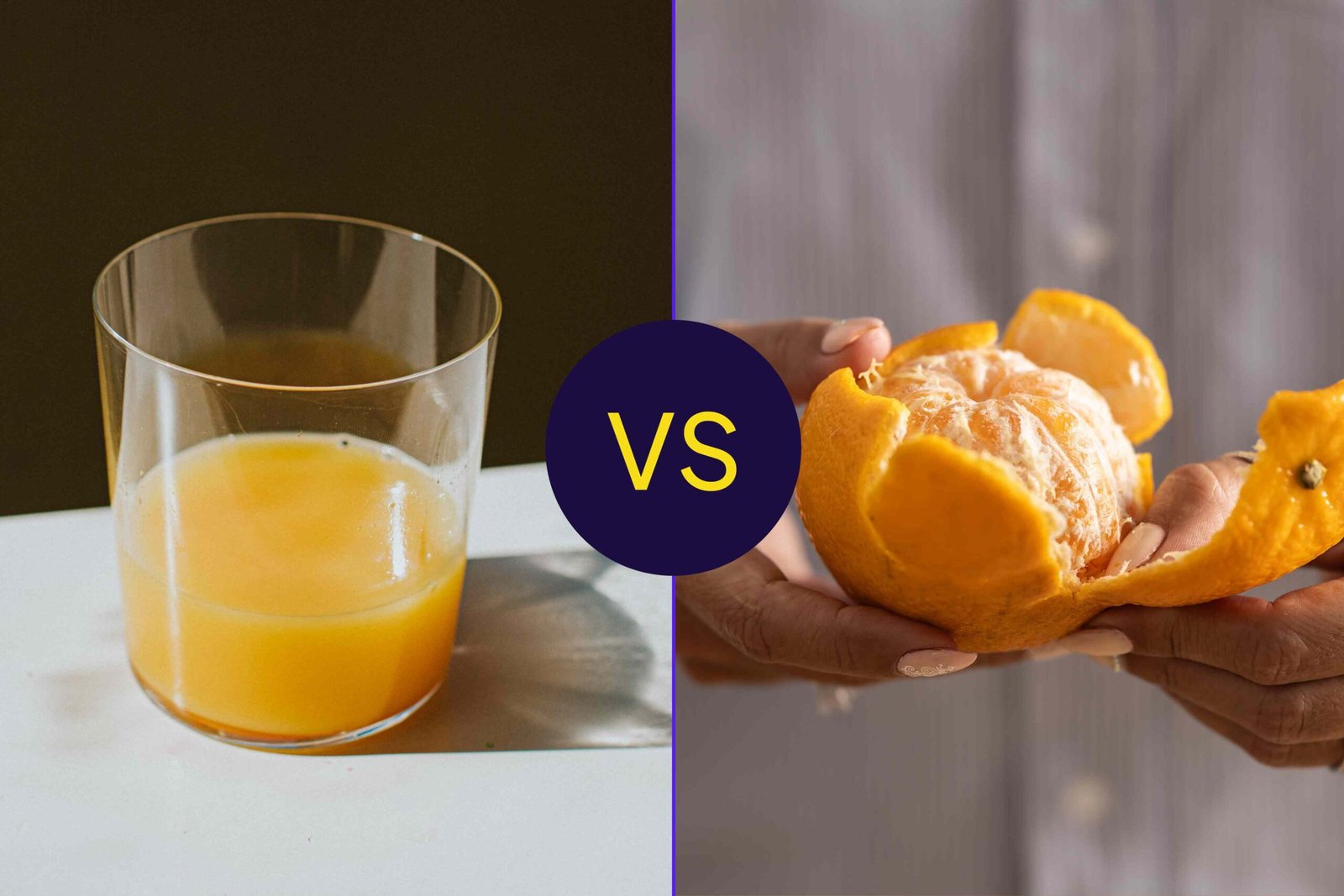
With their tart citrus flavor, orange juice and whole oranges are both healthy, nutrient-dense options to add to your diet. But if you’re looking to boost your immune system and manage your weight, whole oranges may be the better choice.
Oranges and orange juice are known for containing a substantial amount of vitamin C, an antioxidant and vitamin that plays an important role in immune function. Research shows that both are beneficial for inflammation and immune health, but comparing the two by weight, whole oranges are the better source of vitamin C:
- Whole navel oranges: 82.7 milligrams of vitamin C in one orange
- 100% orange juice, with calcium added: 71.2 milligrams of vitamin C in an 8-ounce glass of orange juice
The exact amount of vitamin C in a glass of orange juice depends on the brand and how it’s produced. But generally, orange juice has less vitamin C than whole oranges because of how it’s processed, pasteurized, and stored.
Vitamin C is an unstable vitamin, and when orange juice is heated to kill microorganisms or otherwise exposed to oxygen and light, it can lose some of its original vitamin C content. A 2016 study found that commercial orange juices had about 15% less vitamin C than fresh-squeezed varieties.
While both oranges and 100% orange juice are a great way to boost your intake of important nutrients, if weight management is your primary goal, sticking with the whole fruit may be best. There are a few reasons why:
- Oranges are lower in calories: The nutritional content varies by brand, but a typical 8-ounce glass of orange juice has about 44 more calories than a whole orange. The difference isn’t major, but if you’re looking to limit your caloric intake, the fruit may be a better option.
- They can support appetite control by providing more fiber: A single orange provides between 7-13% of the recommended daily intake of fiber; juicing removes most of this content. Getting enough fiber supports your health in numerous ways, including helping you feel more full. This could prevent overeating and help you maintain or lose weight.
- Oranges have less sugar and carbs: For people looking to lose weight by sticking to a low-carbohydrate or low-sugar diet, whole oranges are a good option. Compared to a whole orange, 100% orange juice has about 1.5 times as many carbs and 8 more grams of sugar. Some orange juice products contain added sugar, which increases these measures even more.
Oranges’ high fiber and low calorie, carbohydrate, and sugar levels not only promotes weight management, but it can also support other health benefits. In particular, diets high in fiber and low in added sugar are linked to better gut health, heart health, and more stable blood sugar.
Whole oranges and orange juice don’t affect your immune health and weight loss goals in the same way. However, at the end of the day, these foods are still very nutritionally similar. Here’s how 8 ounces of fortified 100% orange juice compares to one navel orange:
100% orange juice, with calcium added (8 ounces)
Medium navel orange (140 grams)
Calories
117
73
Protein
1.91 grams (g)
1.27 g
Carbohydrates
25.2 g
16.5 g
Fiber
0.74 g
2.8 g
Sugars
20.3 g
12 g
Magnesium
24.8 milligrams (mg)
15 mg
Vitamin C
71.2 mg (79% of Daily Value)
82.7 mg (92% of Daily Value)
Calcium
350 mg (27% of Daily Value)
60.2 mg (4.6% of Daily Value)
Potassium
449 mg (9.6% of Daily Value)
232 mg (5% of Daily Value)
Vitamin B6
0.10 mg
0.11 mg
Folate
71.9 mcg (18% of Daily Value)
35 mcg (8.8% of Daily Value)
Thiamin
0.181 mg (15% of Daily Value)
0.095 mg (7.9% of Daily Value)
If you’re looking to boost your vitamin C intake and support your immune health, whole oranges may be the better choice. The same is true for people who are looking to manage weight with greater fiber intake and less sugar or carbohydrate consumption.
However, there are also some reasons why someone may want to choose orange juice instead of whole oranges, including:
- Nutrient bioavailability: Older research from 2014 suggests that juicing an orange makes its antioxidants more “bioavailable,” meaning it’s easier for your body to absorb these helpful compounds.
- Convenience: If you’re in a rush and need a vitamin C boost, grabbing a glass of orange juice is usually quicker than peeling and eating a whole orange.
- Richer in certain vitamins and minerals: Many orange juices are fortified with other micronutrients, such as vitamin D and calcium. Plus, orange juice naturally has about twice as much folate—a B vitamin that plays a critical role in cell creation—as whole oranges.
Regardless of whether whole oranges or orange juice better supports your health goals, it’s best to add them to your diet in moderation. Because oranges and orange juice are very acidic, excessive consumption can cause heartburn or indigestion. They can also trigger attacks if you have gastroesophageal reflux disease (GERD).
Talk to a doctor or a nutrition expert if you have concerns or questions about including oranges or orange juice in your diet.
Health.com uses only high-quality sources, including peer-reviewed studies, to support the facts within our articles. Read our editorial process to learn more about how we fact-check and keep our content accurate, reliable, and trustworthy.
National Institutes of Health: Office of Dietary Supplements. Vitamin C.
U.S. Department of Agriculture: FoodData Central. Orange juice, 100%, with calcium, canned, bottled, or in a carton.
Miles EA, Calder PC. Effects of Citrus Fruit Juices and Their Bioactive Components on Inflammation and Immunity: A Narrative Review. Front Immunol. 2021;12:712608. doi:10.3389/fimmu.2021.712608
Maqsood S, Arshad MT, Ikram A, Gnedeka KT. Fruit-Based Diet and Gut Health: A Review. Food Sci Nutr. 2025;13(5):e70159. doi:10.1002/fsn3.70159
U.S. Department of Agriculture: FoodData Central. Oranges, raw, navels.
Feszterová M, Mišiaková M, Kowalska M. Bioactive vitamin c content from natural selected fruit juices. Appl Sci. 2023;13(6):3624. doi:10.3390/app13063624
Mieszczakowska-Frąc M, Celejewska K, Płocharski W. Impact of Innovative Technologies on the Content of Vitamin C and Its Bioavailability from Processed Fruit and Vegetable Products. Antioxidants (Basel). 2021;10(1):54. doi:10.3390/antiox10010054
Chanson-Rolle A, Braesco V, Chupin J, Bouillot L. Nutritional composition of orange juice: a comparative study between french commercial and home-made juices. FNS. 2016;07(04):252-261. doi:10.4236/fns.2016.74027
Agarwal S, Fulgoni Iii VL, Welland D. Intake of 100% Fruit Juice Is Associated with Improved Diet Quality of Adults: NHANES 2013-2016 Analysis. Nutrients. 2019;11(10):2513. doi:10.3390/nu11102513
Mavadiya HB, Roh D, Ly A, Lu Y. Whole Fruits Versus 100% Fruit Juice: Revisiting the Evidence and Its Implications for US Healthy Dietary Recommendations. Nutr Bull. 2025;50(3):411-420. doi:10.1111/nbu.70009
MedlinePlus. Fiber.
Centers for Disease Control and Prevention. Fiber: The carb that helps you manage diabetes.
Zhang Y, Walker RW, Kaplan RC, Qi Q. Added sugars, gut microbiota, and host health. Gut Microbes. 2025;17(1):2592431. doi:10.1080/19490976.2025.2592431
- American Heart Association. Tips for cutting down on sugar.
Ahmad A, Isherwood C, Umpleby M, Griffin B. Effects of High and Low Sugar Diets on Cardiovascular Disease Risk Factors. J Nutr Sci Vitaminol (Tokyo). 2020;66(Supplement):S18-S24. doi:10.3177/jnsv.66.S18
National Institutes of Health: Office of Dietary Supplements. Thiamin.
National Institutes of Health: Office of Dietary Supplements. Calcium.
National Institutes of Health: Office of Dietary Supplements. Potassium.
National Institutes of Health: Office of Dietary Supplements. Folate.
Aschoff JK, Kaufmann S, Kaikan O, Neidhart S, Carle R, Schweiggert RM. In vitro bioaccessibility of carotenoids, flavonoids, and vitamin C from differently processed oranges and orange juices [citrus sinensis (L.) Osbeck]. J Agric Food Chem. 2014;63(2).
National Institutes of Health: Office of Dietary Supplements. Vitamin D.
National Institute of Diabetes and Digestive and Kidney Diseases. Eating, diet, & nutrition for GER & GERD.
