

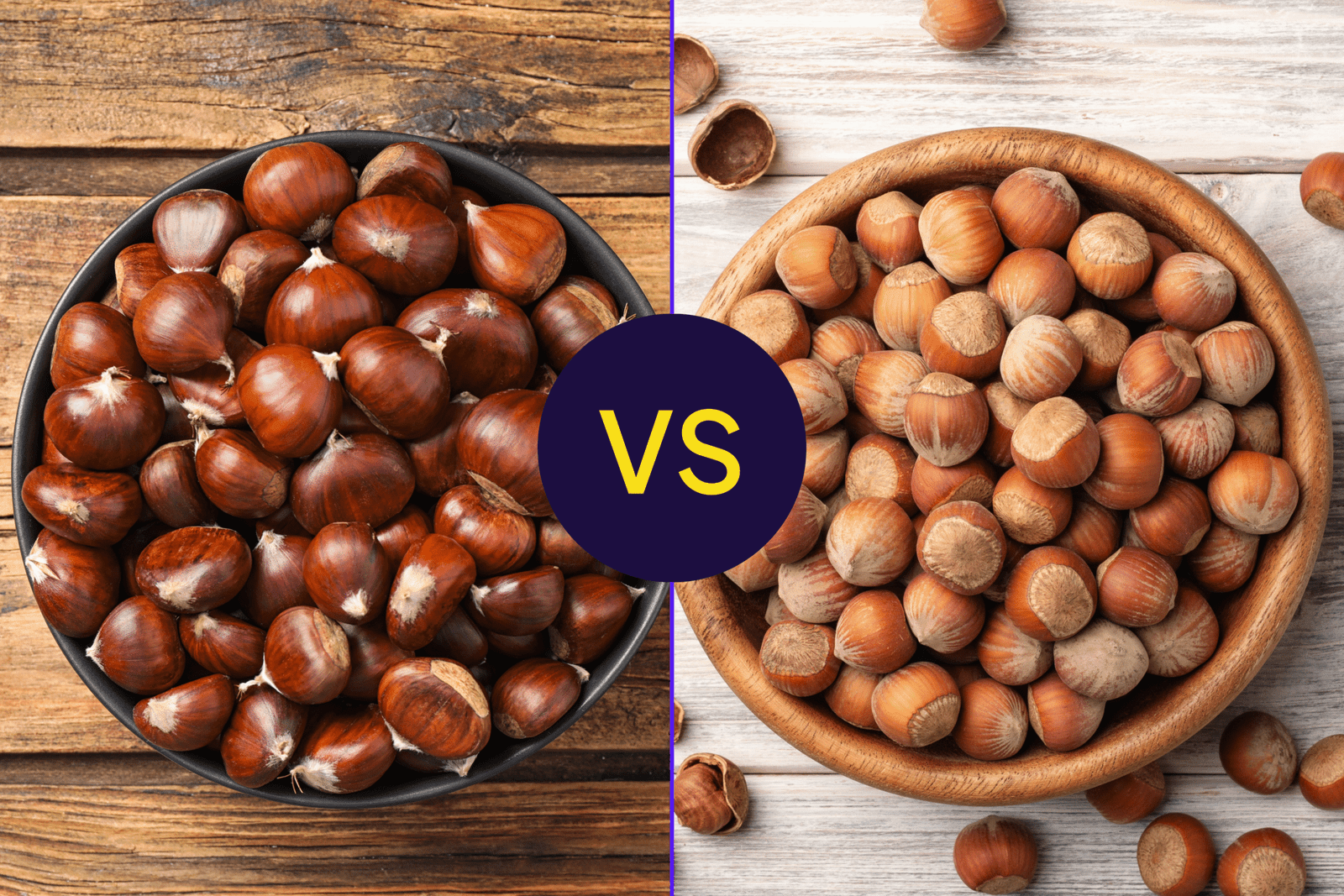
Chestnuts and hazelnuts are both great additions to seasonal recipes or your everyday snack rotation. When it comes to fiber, protein, and healthy fats, hazelnuts are the standout, but chestnuts provide more vitamin C.
All nuts are considered good sources of fiber, but hazelnuts contain more fiber than chestnuts:
- Hazelnuts: 2.72 grams of fiber in a one-ounce serving (28 grams)
- Chestnuts: 1.45 grams of fiber in a one-ounce serving (28 grams)
Fiber is a type of carbohydrate your body doesn’t fully digest. Most adults need 22-34 grams of fiber every day depending on age and gender, but most only get halfway to those daily goals.
Getting enough fiber every day is linked to a number of health benefits, including better digestion, greater feelings of fullness, and improved cholesterol and blood sugar levels. This can lead to a lower risk of conditions including:
- Cardiovascular disease (or heart disease)
- Colon cancer
- Constipation
- Irritable bowel syndrome
- Diabetes
- Obesity
Hazelnuts have nearly five times more protein than chestnuts:
- Hazelnuts: 4.19 grams of protein in a one-ounce serving (28 grams)
- Chestnuts: 0.9 grams of protein in a one-ounce serving (28 grams)
Protein is an essential nutrient, helping your body repair and grow cells. Adults should eat at least 0.8 grams of protein for every kilogram of body weight—that amounts to about 56 grams of protein daily for someone who weighs 155 pounds. However, you may need more protein depending on your age or activity level.
Protein breaks down into amino acids that help your body work and grow. Getting enough protein helps your body:
- Build and repair your muscles, skin, and organs
- Produce enzymes, hormones, and brain chemicals
- Recover after workouts or injuries
- Stay full longer with fewer food cravings
Chestnuts win in the vitamin C category, offering four times more per serving:
- Hazelnuts: 1.76 milligrams of vitamin C in a one-ounce serving (28 grams)
- Chestnuts: 7.28 milligrams of vitamin C in a one-ounce serving (28 grams)
Your body doesn’t store vitamin C, so it should be a regular part of your diet. Men over age 19 need 90 milligrams of vitamin C every day, and women over age 19 need 75 milligrams. That means one serving of chestnuts provides around 8-9% of your daily vitamin C goal.
Vitamin C is a powerful antioxidant, and it has a number of benefits for your health:
Beyond just fiber, protein, and vitamin C, there are a number of other nutritional differences between these two nuts. Here’s a nutritional comparison between one ounce (28 grams) of chestnuts and one ounce of hazelnuts:
Chestnuts
Hazelnuts
Calories
69 kcal
176 kcal
Protein
0.9 g
4.19 g
Fat
0.62 g
17 g
Cholesterol
0 mg
0 mg
Fiber
1.43 g
2.72 g
Carbohydrates
14.8 g
4.68 g
Vitamin C
7.28 mg
1.76 mg
Vitamin E
0.14 mg
4.21 mg
Zinc
0.16 mg
0.69 mg
Sugar
2.97 g
1.22 g
Potassium
166 mg
190 mg
Calcium
8.12 mg
31.9 mg
Magnesium
9.24 mg
45.6 mg
Folate
19.6 mcg
31.6 mcg
Hazelnuts have 2.5 times more calories and 27 times more fat than chestnuts do. However, most of that fat is considered monounsaturated, or “healthy,” fat, which is good for your heart. Hazelnuts also have greater concentrations of minerals including magnesium, calcium, folate (vitamin B9), and vitamin E.
Both of these nuts have naturally occurring sugar, which contributes to their sweet taste. Chestnuts have a bit more, however—these nuts are almost always roasted, and this higher sugar content plays a role in that process.
Despite the fact that nuts tend to be more energy-dense, particularly hazelnuts, research has shown that eating nuts isn’t associated with weight gain.
Chestnuts may be a better choice if you’re looking for:
- Immune system support: The vitamin C content in chestnuts may help strengthen your natural immune defenses during cold and flu season.
- A low-fat diet: If you want to eat more nuts but you’re also following a low-fat diet, chestnuts are a good option. They’re one of just a few nuts that are naturally low in fat.
- Quick energy carbs: Chestnuts have more natural sugars and carbohydrates, so they can boost your energy. They may raise your blood sugar more than hazelnuts, but in general, nuts are known to stabilize blood sugar levels.
Chestnuts are usually cooked or roasted. When their shell is removed, they have a sweet, caramel, or woody flavor. You can snack on them, or add them to dishes such as soups, stuffing, or desserts.
Try hazelnuts if you want to prioritize:
- Heart health: Hazelnuts are a good source of healthy fats and vitamin E. Both of these can help lower low-density lipoprotein (LDL), or “bad,” cholesterol and support your heart.
- A low-carb eating plan: Since hazelnuts are low in digestible carbs and higher in fats, you can work them into low-carb or ketogenic diets.
- Post-workout recovery: Some research suggests that higher intake of antioxidants can help with muscle recovery after a workout. Exercise can sometimes cause oxidative stress, an imbalance of cell-damaging compounds, in the body. Hazelnuts may be able to help ease oxidative stress.
- Sustained energy: The greater protein and fiber content in hazelnuts means they can help you stay full longer between meals.
Shelled hazelnuts have a nutty, earthy flavor when eaten raw, and a buttery, caramel taste and satisfying crunch when roasted. There are many uses for hazelnuts (in addition to eating them as a snack). Try cooking with hazelnut oil, making a hazelnut syrup for pancakes, or roughly chopping them and adding them to salads, soups, or other dishes.
Health.com uses only high-quality sources, including peer-reviewed studies, to support the facts within our articles. Read our editorial process to learn more about how we fact-check and keep our content accurate, reliable, and trustworthy.
Gonçalves B, Pinto T, Aires A, et al. Composition of Nuts and Their Potential Health Benefits-An Overview. Foods. 2023;12(5):942. doi:10.3390/foods12050942
U.S. Department of Agriculture: FoodData Central. Hazelnuts.
U.S. Department of Agriculture: FoodData Central. Chestnuts.
U.S. Department of Agriculture and U.S. Department of Health and Human Services. Dietary Guidelines for Americans, 2020-2025.
Akbar A, Shreenath AP. High Fiber Diet. [Updated 2023 May 1]. In: StatPearls [Internet]. Treasure Island (FL): StatPearls Publishing; 2025 Jan-.
- Centers for Disease Control and Prevention. Fiber: The carb that helps you manage diabetes.
MedlinePlus. Fiber.
Medline Plus. Protein in diet.
American Heart Association. Protein: What’s enough?
Moon J, Koh G. Clinical Evidence and Mechanisms of High-Protein Diet-Induced Weight Loss. J Obes Metab Syndr. 2020;29(3):166-173. doi:10.7570/jomes20028
Turnagöl HH, Koşar ŞN, Güzel Y, Aktitiz S, Atakan MM. Nutritional Considerations for Injury Prevention and Recovery in Combat Sports. Nutrients. 2021;14(1):53. doi:10.3390/nu14010053
Cintineo HP, Arent MA, Antonio J, Arent SM. Effects of Protein Supplementation on Performance and Recovery in Resistance and Endurance Training. Front Nutr. 2018;5:83. doi:10.3389/fnut.2018.00083
Espinosa-Salas S, Gonzalez-Arias M. Nutrition: Macronutrient intake, imbalances, and interventions. In: StatPearls. StatPearls Publishing; 2023
National Institutes of Health: Office of Dietary Supplements. Vitamin C.
MedlinePlus. Facts about monounsaturated fats.
Squara S, Stilo F, Cialiè Rosso M, et al. Corylus avellana L. Aroma Blueprint: Potent Odorants Signatures in the Volatilome of High Quality Hazelnuts. Front Plant Sci. 2022;13:840028. doi:10.3389/fpls.2022.840028
Santos MJ, Pinto T, Vilela A. Sweet chestnut (Castanea sativa Mill.) nutritional and phenolic composition interactions with chestnut flavor physiology. Foods. 2022;11(24):4052. doi:10.3390/foods11244052
Guarneiri LL, Cooper JA. Intake of Nuts or Nut Products Does Not Lead to Weight Gain, Independent of Dietary Substitution Instructions: A Systematic Review and Meta-Analysis of Randomized Trials. Adv Nutr. 2021;12(2):384-401. doi:10.1093/advances/nmaa113
Di Renzo L, Cioccoloni G, Bernardini S, et al. A Hazelnut-Enriched Diet Modulates Oxidative Stress and Inflammation Gene Expression without Weight Gain. Oxid Med Cell Longev. 2019;2019:4683723. doi:10.1155/2019/4683723
Holesh JE, Aslam S, Martin A. Physiology, Carbohydrates. [Updated 2023 May 12]. In: StatPearls [Internet]. Treasure Island (FL): StatPearls Publishing; 2025 Jan-.
Chen B, Li Y, Li Z, et al. Vitamin E ameliorates blood cholesterol level and alters gut microbiota composition: A randomized controlled trial. Nutr Metab Cardiovasc Dis. 2025;35(8):103964. doi:10.1016/j.numecd.2025.103964
Chen J, Ding J, Han C, et al. Effects of different antioxidants on exercise-induced oxidative stress and muscle damage in athletes: a systematic review and meta-analysis. BMC Sports Sci Med Rehabil. 2025;17(1):328. doi:10.1186/s13102-025-01381-2
University of Wyoming Extension. Appetite for knowledge: Healthy hazelnuts.
