

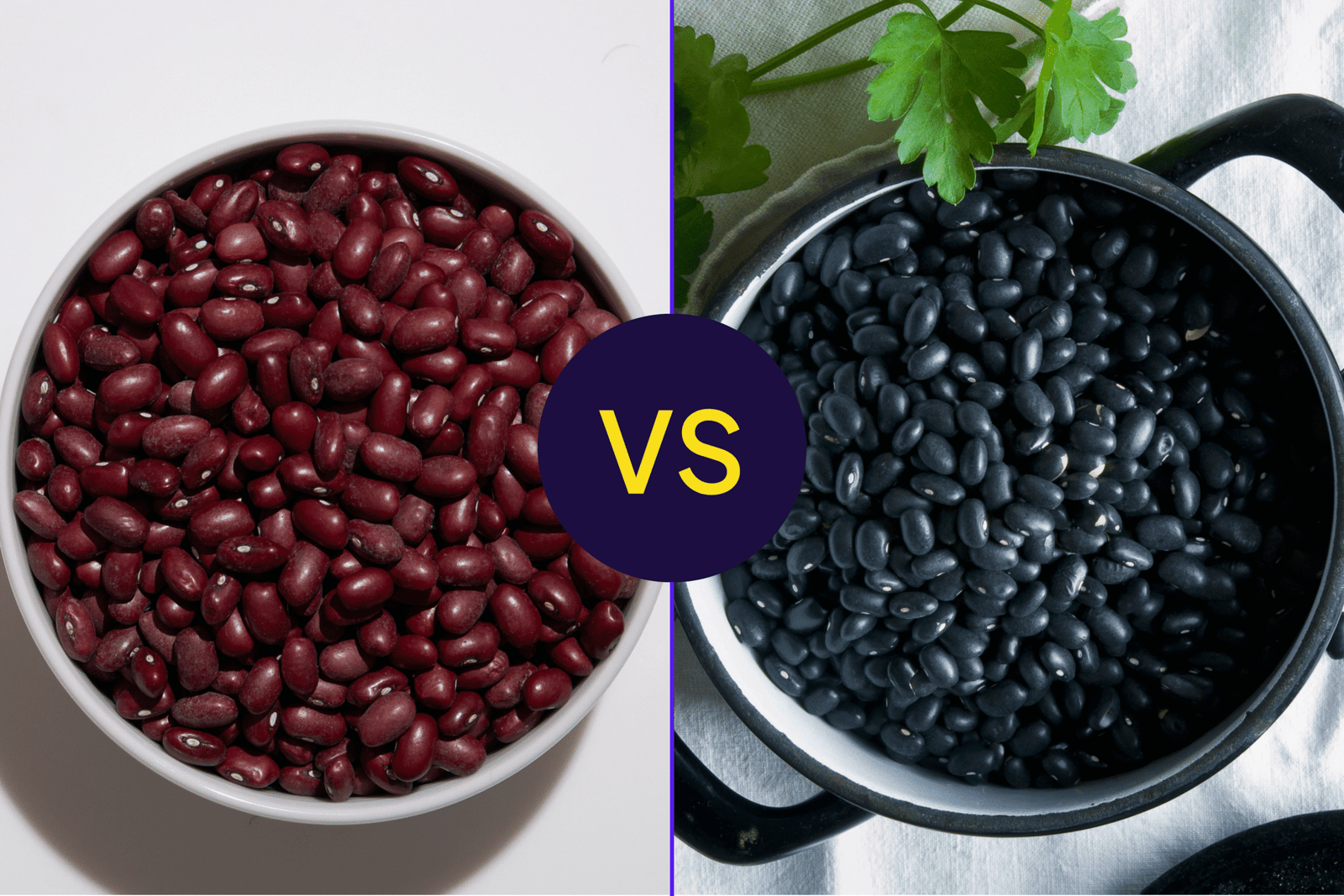
Black beans and kidney beans are pantry staples known for their fiber, plant protein, and mineral content. While there are small nutritional differences between the two, the best choice likely comes down to your personal preference. Here’s how they compare.
Kidney beans contain slightly more fiber per serving. A half-cup of cooked black beans provides about 9 grams of fiber, while the same portion of kidney beans offers roughly 10 grams. Fiber supports digestion, can help lower cholesterol, and slows carbohydrate absorption, which can keep blood sugar levels steady.
In practical terms, the difference is small. Both beans are high in fiber and can help you meet daily fiber needs (about 25 grams for women and 38 grams for men).
Kidney beans are also slightly higher in protein. A half-cup serving of black beans contains around 9 grams of protein, compared with about 10 grams in kidney beans. Protein plays an important role in maintaining muscle, supporting metabolism, and promoting satiety.
Like fiber, the difference is small. Both varieties are excellent sources of plant-based protein.
Black beans and kidney beans provide similar amounts of iron, roughly 2 milligrams per half-cup. Most adult women need 18 milligrams per day (8 milligrams after menopause), and men need 8 milligrams daily.
Iron is part of hemoglobin, a protein that carries oxygen in red blood cells, and myoglobin, which helps bring oxygen to muscles. Dietary sources of iron help prevent iron-deficiency anemia, which can cause symptoms like fatigue and weakness.
Both types of beans contain non-heme iron, the type found in plants. Non-heme iron is absorbed less efficiently than heme iron from animal foods. However, you can improve absorption by pairing beans with foods like bell peppers, citrus, or tomatoes, as vitamin C improves absorption.
Overall, both beans offer a similar balance of calories, carbohydrates, and fat. Kidney beans provide slightly more calcium, while black beans contain more magnesium.
Black Beans (1/2 cup)
Kidney Beans (1/2 cup)
Calories
150
165
Carbohyrates
26 grams (g)
28 g
Protein
9 g
10 g
Fat
2 g
2 g
Fiber
9 g
10 g
Iron
2 milligrams (mg)
2 mg
Calcium
56 mg
78 mg
Magnesium
42 mg
33 mg
Overall, there is no clear “winner.”
Kidney beans edge out black beans slightly in fiber and protein, but the differences are negligible and unlikely to affect nutrition. Choosing between them often comes down to your preferences and what recipes you follow.
Regardless of which type you choose, beans offer benefits that support long-term health.
- Blood sugar support: Beans digest slowly due to their fiber and resistant starch, leading to a more gradual rise in blood sugar.
- Heart health: The soluble fiber in beans may help lower LDL (“bad”) cholesterol.
- Gut health: Beans are high-fiber foods that feed your healthy gut bacteria.
- Weight management: Fiber and protein from beans can promote satiety, helping you feel fuller for longer.
Health.com uses only high-quality sources, including peer-reviewed studies, to support the facts within our articles. Read our editorial process to learn more about how we fact-check and keep our content accurate, reliable, and trustworthy.
U.S. Department of Agriculture: FoodData Central. Beans, kidney, light red, canned, sodium added, sugar added, drained and rinsed
U.S. Department of Agriculture: FoodData Central. Beans, black, canned, sodium added, drained and rinsed
Alahmari LA. Dietary fiber influence on overall health, with an emphasis on CVD, diabetes, obesity, colon cancer, and inflammation. Front Nutr. 2024;11:1510564. doi:10.3389/fnut.2024.1510564
Daley SF, Shreenath AP. The role of dietary fiber in health promotion and disease prevention: a practical guide for clinicians. StatPearls.
Ignot-Gutiérrez A, Serena-Romero G, Guajardo-Flores D, Alvarado-Olivarez M, Martínez AJ, Cruz-Huerta E. Proteins and peptides from food sources with effect on satiety and their role as anti-obesity agents: a narrative review. Nutrients. 2024;16(20):3560. doi:10.3390/nu16203560
Ishaq I, Noreen S, Maduabuchi Aja P, Atoki AV. Role of protein intake in maintaining muscle mass composition among elderly females suffering from sarcopenia. Front Nutr. 2025;12:1547325. doi:10.3389/fnut.2025.1547325
National Institutes of Health Office of Dietary Supplements. Iron.
Piskin E, Cianciosi D, Gulec S, Tomas M, Capanoglu E. Iron absorption: factors, limitations, and improvement methods. ACS Omega. 2022;7(24):20441-20456. doi:10.1021/acsomega.2c01833
Kadyan S, Sharma A, Arjmandi BH, Singh P, Nagpal R. Prebiotic potential of dietary beans and pulses and their resistant starch for aging-associated gut and metabolic health. Nutrients. 2022;14(9):1726. doi:10.3390/nu14091726
Doma K, Olinar KF, Ramdath DD, Wolever TM, Duncan AM. Canned beans decrease serum total and ldl cholesterol in adults with elevated ldl cholesterol in a 4-wk multicenter, randomized, crossover study. The Journal of Nutrition. 2021;151(12):3701-3709. doi:10.1093/jn/nxab323
Fluit MJ, Adams BF, Ribau ZJ, Duncan AM. Beans improve satiety to an extent that is not significantly different from beef in older adults: a randomized, crossover trial. The Journal of Nutrition. 2025;155(4):1193-1201. doi:10.1016/j.tjnut.2025.02.008
