

Welcome to the second installment of our monthlong summer challenge! Last week, we asked you to take a daily walk in nature without your phone.
Now we have an exercise that may help you get a better night’s rest: Put your phone away 30 minutes before bed.
It’s simple, but it’s not easy; many of us use our screens as a nighttime escape.
Get this challenge by email. You will also receive the weekly Well newsletter, with guidance to help you live your healthiest life. Get it in your inbox.
When I’ve had a long day, for instance, I get into bed and scroll on Instagram before turning off the light. I tell myself that my feed is calming — cake decorating, ducks on a farm race-waddling to be fed — so it will soothe me to sleep.
It never does.
No matter what your social media feed looks like, “it’s still stimulating your brain,” said Dr. Shalini Paruthi, a sleep medicine attending physician at John J. Cochran Veterans Hospital in St. Louis. “There is still so much cognitive and emotional engagement and arousal.”
Yet smartphones are the last thing many of us see before drifting off to sleep: A 2025 YouGov survey found that 43 percent of Americans said they “always or often” browsed the internet on their phone before falling asleep. And, even if we’re not doom-scrolling, there’s evidence linking nighttime cellphone use to interrupted sleep.
Starting tonight, you’re going to carve out some tech-free time before bed. If the thought makes you uneasy, we have some tips.
Week 2: Put some space between you and your phone.
This exercise was inspired by a 2025 study in the journal Technology, Mind and Behavior in which subjects who did a 30-minute digital detox before bed reported that the next day, they used their phones less and felt better, compared to days when they didn’t detox.
So turn your phone off 30 minutes before bed to help prepare for sleep, and leave it off for the rest of the night.
Ideally, you’re able to put your phone in another room, experts said. If not, place it out of arm’s reach, so you’d have to leave your bed to get it, said Kostadin Kushlev, an associate professor of psychology at Georgetown University who runs the Happy Tech Lab and was a coauthor on the above study.
If there are people you can’t be out of contact with, like your parents or your kids, Dr. Paruthi said, put your phone on “do not disturb” mode, and set it to allow calls only from them.
Make bedtime inviting.
Plan ahead so you have some analog activities that you can do instead of scrolling, Dr. Paruthi recommended.
You can view this half-hour as creative bonus time: Write a letter to someone, start a journal, do some knitting. One of my family members is working on a Lego version of the Concorde jet before bed, which may take her all summer.
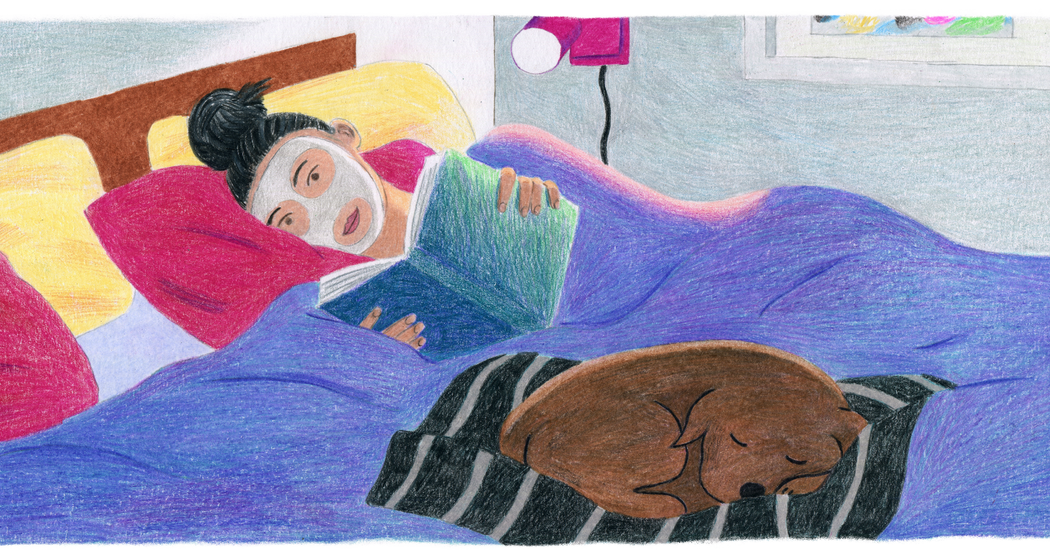
Or you can spend that time doing something calming, like meditating, Dr. Paruthi added. I have been doing my bedtime ritual very slowly so that it fills a half hour. It includes an elaborate skin care routine, stretching, tidying up and laying out my clothes for the next day.
Manoush Zomorodi, the author of “Body Electric: The Hidden Health Costs of the Digital Age and New Science to Reclaim Your Well-Being,” told me she rolls a massage ball under her feet, which soothes her and releases tension. “And I’ll pet my adorable dog, who’s basically like my relaxation talisman,” she added.
Bring a book to bed.
Dr. Kushlev also suggested reading a book (preferably analog). So I sought advice from Ann Patchett, author of the new novel “Whistler” and a devoted bedtime reader. She recommended reading books that are engaging and enjoyable, and nothing that you know will upset you. (In her case, that would be horror.)
Patchett said she loves to suggest middle-grade novels to adults, such as “The Miraculous Journey of Edward Tulane” by Kate DiCamillo. The book has short chapters, so it’s good for bedtime, but is “an entire novel that is as good as anything you will ever read in your life.”
She also recommended “Tiny Beautiful Things,” a collection of essays from “Dear Sugar,” the advice column by Cheryl Strayed — a “rush of compassion” in book form.
Try this 30-minute detox every night before bed for a week, and see if you are able to fall asleep faster or stay asleep longer, even by a little bit.
“Even a small change is a win,” Dr. Paruthi said.
It’s almost summer. Put your phone down. Go outside.
To kick off Well’s summer challenge, we’re asking you to make a simple commitment that can improve your health.
For the next month, you’ll carve out 20 minutes daily to step away from your screen and head outdoors.
I’m in!
You’ve joined readers to pledge a total of
0
minutes of screen-free time. Congratulations!
