

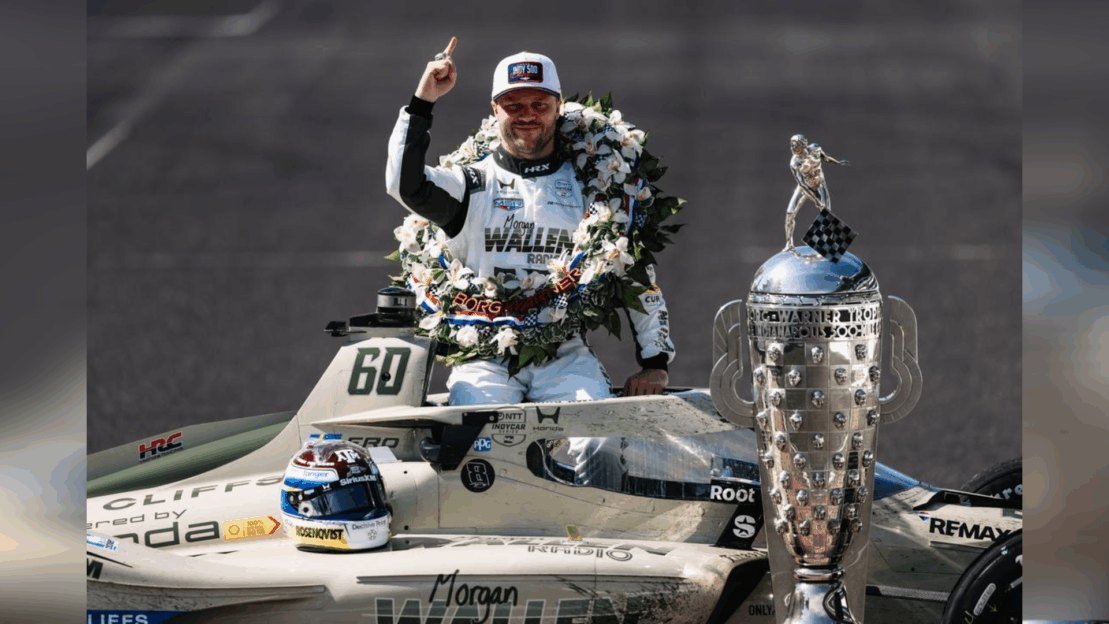
Felix Rosenqvist finally got to enjoy the view from Indy’s most exclusive spot: Victory Lane.
By winning this year’s Indianapolis 500 in the most dramatic fashion—building what looked like an insurmountable late lead, losing it after a red flag, then getting a second chance from another caution before aggressively snatching it back to win by the slimmest margin ever—the Swedish speedster accomplished what hundreds of drivers have failed to do over the race’s 110 runnings. At the same time, one bold move instantly wiped away seven previous years of his own Indy race-day heartbreak.
Obviously, it takes speed to win the world’s most prestigious race—and Rosenqvist’s winning average of 174.199 mph ranks as the sixth-fastest Indy 500 in history. But to cross the finish line first in 2026, the 34-year-old first had to slow down and absorb the lessons learned from past missed opportunities. That experience—both good and catastrophic—proved to be an invaluable asset when improbable moments appeared.
So when Rosenqvist’s wall-side slingshot pass on two-time Indy 500 runner-up David Malukas on the final lap gave him the lead in the last 50 feet, the move was a blend of blink-of-an-eye execution shaped by years of near-misses and tough defeats. “I saw the team deserved a shot at winning,” he says. “If you give us a shot, we’ll make the most out of it, and if it doesn’t, or if we end up in the wall, that’s what happens.”
His bold decision led to a life-changing victory that came exactly three weeks after another personal milestone—the birth of his first daughter. Rosenqvist’s debut appearance in the winner’s circle was the ultimate reward for a career riddled with unfortunate crashes, lost leads, and mechanical failures. This time, Rosenqvist turned personal frustration into a raceday foundation that helped prepare him to capitalize on his most iconic split-second situation.
“The experience of just having been in that situation before for seven years, being thrown around at the Speedway for good and bad, just kind of sets you up for knowing what to do when the moment comes,” Rosenqvist says.
Film study, work with a performance coach, and the hard lessons from past losses all fed into the decision to time his move on Malukas with uncanny precision and become the 77th driver to drink the ceremonial milk.
While the sequence of events leading up to his second career IndyCar win was unique, Rosenqvist’s maneuvering on that final lap will be something gearheads break down for years. That one perfect lap was the product of building on his previous failed attempts at Indy finally converging at the right time. Still, even with full Meyer Shank support behind him, there was no way to anticipate a finish like the No. 60 Honda delivered.
“There’s just no way you even dare to dream of having whatever happened to me happen in real life,” he admits. “I’m not sure the way it played out has really happened before. We were basically creating something new with that finish.”
INDYCAR/Joe Skibinski
An Indy 500 Victory 7 Losses in the Making
Rosenqvist’s margin of victory—0.0233 seconds—set a new Indy 500 record for closest finish, breaking Al Unser Jr.’s 1992 mark of 0.0430 seconds over Scott Goodyear.
On the track, his historic win was a victory for veteran drivers and silenced critics who questioned his ability to hoist the Borg-Warner Trophy in Meyer Shank’s blue, white, and red after his previous outings resulted in a wide range of racing disappointments. A rookie crash in 2019 and an off-the-pace, penalty-induced 27th-place finish in 2021 highlighted his early low moments. Even when there were glimpses of speed on the track—with fourth-place finishes in both 2022 and 2025—he lacked the late-race track position to reach the podium. An engine failure on Lap 56 in 2024 only added to his heartbreak on the 2.5-mile rectangular oval.
None of those, he says, can match the agony of 2023. After qualifying fifth and leading 33 laps, a late-race slip sent him into the Turn 1 wall on Lap 185, resulting in a collision with Kyle Kirkwood that infamously launched a tire over the grandstand fence. “That was gut-wrenching,” he says, “because I was pretty much having an even better race than I had this year, until that point.”
Determined not to relive that kind of collapse, Rosenqvist doubled down on physically and mentally preparing himself to maximize the chaotic moments that inevitably pop up in such high-speed, high-pressure scenarios. The preparation, he says, has been an ongoing team effort dating back to last season’s fifth-place finish, won by Alex Palou.
During the offseason, Rosenqvist worked with Indy-based reaction-speed specialists Ares Elite Sports Vision, which put him through mental and cognitive drills geared specifically toward making split-second decisions on track. The team had Rosenqvist perform a variety of exercises, including answering math questions while his heart rate was elevated. “We do drills like counting a math problem at the same time as you’re on a treadmill, where you stress the brain in different ways,” he says. “I’m not going to say it directly led to the win, but things like this mattered.”
He also spent more time in the film room, going over race replays with Meyer Shank teammate Marcus Armstrong and studying race onboards to get a better feel for opposing drivers from a driver’s point of view. “Indy is just like it is, consistent, where you’re building your sort of good tricks every year, and I just feel so much stronger every year, and that trajectory has just continued, which allowed me to finally get the big one.”
The Tricks—and Teamwork—that Allowed Felix Rosenqvist’s Dream to Finally Work
Rosenqvist heads into this weekend’s Bommarito Automotive Group 500 coming off a month that he admits may never be replicated. May was so packed with emotional moments that winning the Indianapolis 500 ranked second in importance behind becoming a father for the first time. Rosenqvist and his wife Emille welcomed their daughter, Stella, on May 4. He then capped the month with a solid sixth-place finish at the Chevrolet Detroit Grand Prix, completing a mind-blowing run of career and personal highs.
“I think it’s going to be hard to beat becoming a dad three weeks ago [and] winning this race,” he says. “I think I have to accept to myself that I’m probably not going to have a better three weeks of my life. This last month has taken out emotions I didn’t know I had out of myself, so it’s super cool.”
While Rosenqvist is the face of the Meyer Shank team, taking on the media responsibilities and the perks that come with winning the Indy 500, he’s quick to point out that it was the group around him that put him in position to win on his eighth attempt. “It takes an army to do that,” he says. “You need to prepare the car for months ahead of the race. You need spotters, and so many things that need to be right when that happens. Everyone executed—it was a 10 out of 10 performance when it mattered.”
Even this year’s victory run started with frustration days before the race. After dominating the Indy 500 qualifying rounds the previous weekend, an ill-timed slow final run dropped him to fourth and handed Palou the top spot. While frustrating knowing he had the fastest car, the setback became a part of the process of handling adversity as an older, wiser race vet. “Every time you go through that sequence, you learn something new, and that’s what truly I think the experienced guys, they have a better understanding what to do when that starts to happen.”
In a race that also set the record for most lead changes (70), Rosenqvist took over the top spot from Pato O’Ward on Lap 185. His advantage grew into what should have been an insurmountable 20-second gap before a crash by Caio Collet on Lap 193 brought out the red flag, erased his lead, and revived memories of 2023. Watching the replay, he could see the disappointment in the pit area. In the car, though, he only heard support and positivity, easing any chance of another mental spiral. “They were just like cheering me on, like, ‘Hey, bro, we got this, we’re looking good here, we got the best car,’” he recalls.
At the restart, his lead was over, as a chaotic four-wide surge saw teammate Marcus Armstrong and David Malukas blow past him. But hold on: Another crash, this time by Mick Schumacher on Lap 197 brought out another caution and set up a wild one-lap shootout. Rosenqvist this time threw caution to the wind on the final lap—he aggressively picked off O’Ward before passing his teammate Armstrong with a bold high line move. The final showdown was with leader Malukas, executing a side draft down the front stretch, surging ahead in the final yards to squeeze out the closest finish in Indy 500 history.
“I was just so locked in, man,” he says. “I didn’t really think much about anything else than like my line and trying to go forward and the fuel game that we were playing up till the final moments of the race. We actually kind of had to win the race twice in my book.”
