

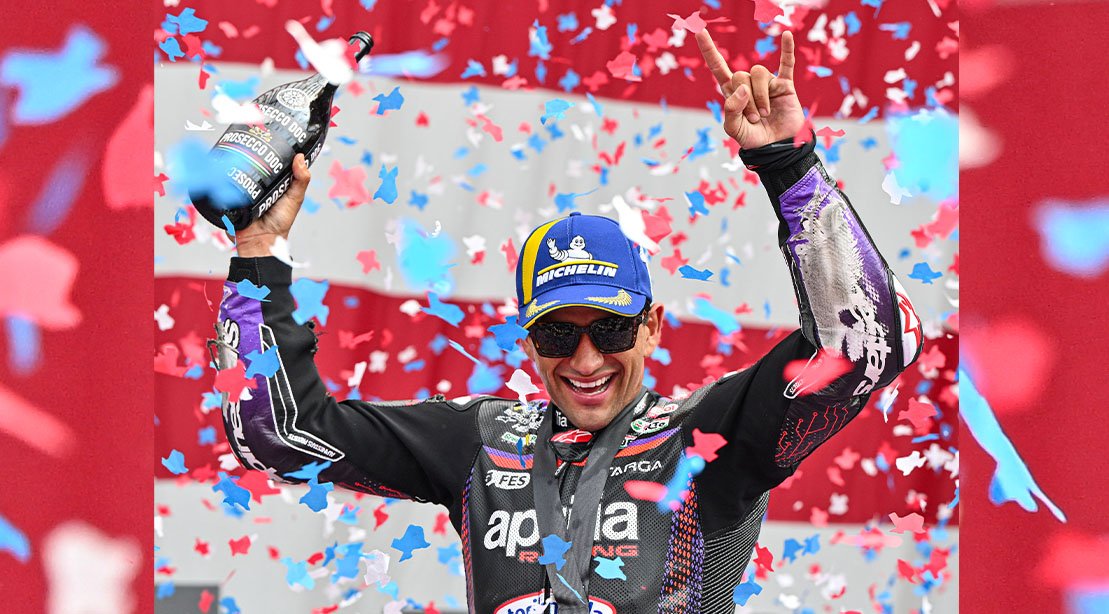
From the outside, MotoGP looks like pure speed. Bikes ripping past 200 mph, riders leaning into angles that don’t feel survivable, everything happening faster than the eye can process. It’s easy to assume that’s the job–just hold on, go faster than everyone else, and figure it out as you go.
But when you talk to Jorge Martín, the illusion falls apart pretty quickly.
“Controlling a bike is not that difficult,” Martín says. “Maybe handling the pressure is one of the toughest.”
Ahead of this weekend’s Spanish Grand Prix in Jerez, Spain, the pressure Martin faces won’t be visible on race day. Not in the highlights, not in the slow-motion replays. The real work isn’t just managing speed—it’s managing everything that comes with it. The pressure of other rides, the unpredictability of conditions, the constant stream of decisions that have to be made in real time while your heart rate is pushing its limit.
“The mental side is even more difficult,” he explains. “To manage the pressure, the other riders are really competitive and this is the toughest part to be on a really high level.”
Speed is just the entry point. Control is the real skill set.
Jorge Martin
The Mental Training Behind Elite MotoGP Racing
For Martín, the race doesn’t start when the lights go out. It starts earlier, when the questions begin to build and the variables start stacking on top of each other.
“There are so many things that can happen during a race or even before the race,” he says. “You can have a lot of doubts—like which tire the other riders are gonna use, how they will start, if the bike will be at 100 percent, if I will be ready.”
Those thoughts can easily take over if you let them. Martín’s approach is to reduce everything down to what actually matters in the moment, even if that requires actively pushing distractions aside.
“Let’s control what I can control,” he says. “That is riding a motorbike, focusing on being my best self.”
It’s a mindset that sounds straightforward but takes discipline to maintain, especially for someone who naturally tends to overthink. That ability to quiet the noise doesn’t eliminate uncertainty. It just keeps it from becoming overwhelming.
Jorge Martin
What Does MotoGP Training Look Like? Inside Jorge Martín’s Routine
MotoGP doesn’t give athletes a consistent environment to prepare for. Conditions change, bikes evolve, and no two races play out the same way. Because of that, Martín doesn’t train for one scenario—he trains to be ready for all of them.
“There’s no specific training for being a rider,” he says. “You have to train all areas… you have to be ready for everything that can happen.”
That philosophy shapes how he approaches every session. Instead of focusing on one area, he builds his performance across multiple systems so nothing becomes a weakness.
“I do cycling, gym, motorbike, mental training,” he says. “I need to train every day.”
The physical demand alone is extreme. During a race, Martín’s heart rate sits at a level that most athletes only experience in short bursts. Martín’s heart rate can exceed 180 beats per minute, making it easy to see why he says cardio us about 70 percent of the sport.
At the same time, the body is under constant strain from multiple directions. Acceleration relies on the lower body, braking loads the upper body, and the core has to stabilize everything in between.
“You use the legs on acceleration, the arms and shoulders on braking, and the core is really important,” he explains. “You have to train a bit of everything.”
That balance carries over into how he structures his workouts. High-intensity intervals, VO2 training, and strength sessions all play a role in making sure he’s prepared for whatever the race demands.
Even outside of structured sessions, movement is constant. Cycling isn’t just training for Martín—it’s part of how he experiences each place he travels to and how he keeps his body moving daily.
“I cannot understand a life without a bicycle or a gym,” he says.
Jorge Martín’s Recovery Secrets: Cold Plunges, Sleep, and Nutrition
As Martín’s career has progressed, recovery has become just as important—if not more important—than training itself. What used to be something he could rely on naturally now requires intention and structure.
“My house is like a clinic now,” he says. “It’s crazy.”
That shift reflects how demanding the sport really is. Training might build performance, but recovery is what allows him to maintain it over time.
“The recovery is much more important than the training for me,” he explains.
His approach is comprehensive. It includes everything from hyperbaric chambers and cold plunges to nutrition, sleep, and a full team focused on keeping his body functioning at a high level.
Immediately after a race, the priorities are simple but deliberate. There isn’t time for anything elaborate, so the focus shifts to what will have the most immediate impact.
“Cold plunge and a good meal,” he says. “That’s the most important.”
Routine plays a major role in keeping everything together. With constant travel and unpredictable schedules, Martín relies on a fixed window before competition to create stability.
“For me, 40 minutes before I practice, I have my own routine and I need to do that routine,” he says. “The things I do before, I don’t really care. The things I do after, I don’t really care.”
Within that window, there’s one moment he doesn’t skip. Right before getting on the bike, he takes time to reset mentally and physically. He needs just two minutes of mindfulness time.
That moment helps him transition from preparation into performance. It’s small, but it anchors everything that comes after. There’s also a release built into his system. After the structure and discipline of race week, Martín allows himself a complete reset when it comes to food.
“I will destroy everything,” he says, laughing. “I just eat everything I can.”
That flexibility is part of the plan. Without it, maintaining the level of control required during training and racing wouldn’t be sustainable.
Jorge Martin
What Separates Great Riders From Champions in MotoGP
From the outside, MotoGP can look deceptively simple. A rider sits on a bike and goes fast. That perception is something Martín has heard throughout his career, and it’s one he knows doesn’t come close to capturing the reality.
“A lot of people told me, ‘You are seated on a bike, it’s not that difficult,’” he says.
What they don’t see is the intensity behind every second on the track. The physical output is constant, but so is the mental processing required to stay competitive and safe. Imagine being in a dead sprint in a crowd of other sprinters, while trying to mentally process your grocery list.
At that level, there’s no separation between thinking and reacting. Every adjustment has to happen instantly, whether it’s strategy, positioning, or how the bike is responding in real time.
“You have to be really intelligent,” he says. “We have to work on the electronics, on the overtaking, on the strategy.”
At the highest level, talent alone isn’t enough to sustain success. Martín has seen too many riders with similar ability fall short when the sport pushes back. Everyone can win under the right conditions. The difference is what happens after things go wrong.
“When you fall and you are really in pain, to get back up and be back winning, that’s the big difference,” he says.
