

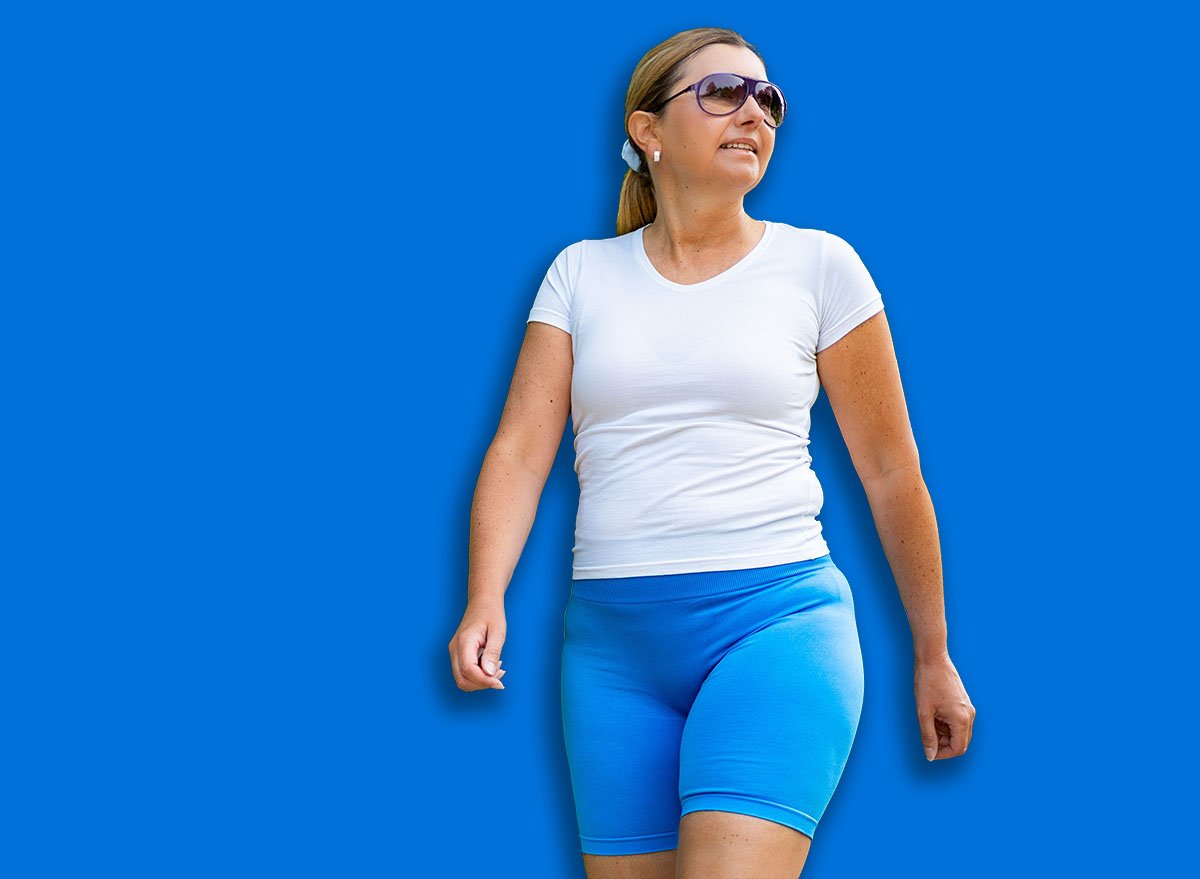
Count your steps for 60 seconds. This many after 60 means you’re in great shape.
Walking might be the most underrated thing you can do for your health. It keeps you moving, gets your heart rate up, and builds a base that supports everything else. I’ve worked with a lot of people over the years, and the ones who stay consistent with walking tend to feel better, move better, and recover faster. It doesn’t need a perfect setup. Step outside, head to a park, walk your neighborhood, or hop on a walking pad—it all counts.
There’s a reason walking shows up in almost every program I put together. It checks a lot of boxes without beating you up. It supports cardiovascular fitness, helps manage body weight through increased daily activity, and keeps your joints moving without putting a ton of stress on them. You can build it into your day without overthinking it, and it fits just about any schedule.
That’s what makes it so effective. You can do it often, anywhere, and adjust the pace based on how you feel. When you add a simple time-based test like this, it gives you a quick way to see where you stand. One minute, count your steps, and you’ve got a clear snapshot of your conditioning (and health).
What a 60-Second Walking Test Reveals
Shutterstock
This test gives you a quick look at how well your body moves when you pick up the pace and stay consistent. It’s not about sprinting. It’s about how efficiently you can turn your legs over, keep a rhythm, and stay in control for a full minute. Your step count reflects more than just speed. It shows how well your stride, coordination, and posture work together. When those pieces line up, your movement feels smooth and repeatable, and your pace stays steady without extra effort.
It also ties directly into your cardiovascular fitness. Even for 60 seconds, your heart and lungs have to support the effort. A higher, steady step count usually means your body can deliver oxygen efficiently and keep you moving without a drop in pace. On top of that, walking offers real value in terms of energy output. A steady pace can burn around 80 to 120 calories per mile for most adults, depending on body size and speed. Stack that over days and weeks, and it becomes a simple, reliable way to support overall health, conditioning, and daily movement.
As you move through the minute, the goal stays simple. Keep your steps quick, stay tall, and hold a steady rhythm from start to finish. When that holds together, it shows your body moves efficiently and can support a higher level of fitness.
How to Perform the 60-Second Walking Test
Shutterstock
You don’t need much for this: just a timer and a clear space.
How to Do It:
- Stand tall with your feet under your hips.
- Start a 60-second timer.
- Walk at a brisk, steady pace in place or across a flat surface.
- Lift your feet enough to keep a natural stride.
- Count each step as your foot hits the ground.
- Finish the full minute and record your total steps.
You can do this outside, on a track, in your home, or on a walking pad. Keep it simple and focus on staying consistent.
How Your Step Count Stacks Up After 60
Shutterstock
This test works best when your pace stays steady from start to finish.
- Under 80 steps: You’re building your base. Focus on finding a comfortable rhythm and gradually increasing your pace.
- 80 to 110 steps: This is a solid range. Your body moves well and supports steady activity.
- 110 to 130 steps: You’re in great shape. Your coordination and conditioning allow you to maintain a quicker pace with control.
- 130+ steps: This is excellent. Your movement stays efficient, your pace is strong, and your body handles the effort with ease.
How to Improve Your Walking Speed and Conditioning
Shutterstock
Walking improves quickly when it becomes part of your routine. The goal is to build a pace you can maintain, then gradually push that pace forward without losing your rhythm. Small adjustments in how you walk can make a noticeable difference in both speed and efficiency. Over time, those improvements show up in how you feel during longer walks and how easily you can pick up the pace when you need to. The key is to stay consistent and give your body enough exposure to adapt.
- Walk regularly: Daily or near-daily walks help build a strong aerobic base and keep your body moving well.
- Add short bursts of speed: Mix in 20- to 30-second intervals where you walk faster, then return to your normal pace.
- Focus on quick, light steps: Shorter, faster steps often help you move more efficiently than overstriding.
- Use your arms: Let them swing naturally to help set your pace and keep your rhythm steady.
- Stay tall through your posture: Keep your chest up and your head level so your stride stays smooth.
- Build your time gradually: Longer walks improve endurance and make faster paces feel more comfortable.
- Walk on different surfaces: Mix in sidewalks, trails, or slight inclines to challenge your body in new ways.
- Stay consistent over time: The more often you walk, the more natural and efficient your pace becomes.
References
- Ungvari, Zoltan et al. “The multifaceted benefits of walking for healthy aging: from Blue Zones to molecular mechanisms.” GeroScience vol. 45,6 (2023): 3211-3239. doi:10.1007/s11357-023-00873-8
- Serwe, Katrina M et al. “Effectiveness of long and short bout walking on increasing physical activity in women.” Journal of women’s health (2002) vol. 20,2 (2011): 247-53. doi:10.1089/jwh.2010.2019
- Harvard Health Publishing. “Calories Burned in 30 Minutes for People of Three Different Weights.” Harvard Health, 8 Mar. 2021, https://www.health.harvard.edu/diet-and-weight-loss/calories-burned-in-30-minutes-for-people-of-three-different-weights. Accessed 28 Apr. 2026.
Jarrod Nobbe, MA, CSCS
Jarrod Nobbe is a USAW National Coach, Sports Performance Coach, Personal Trainer, and writer, and has been involved in health and fitness for the past 12 years. Read more about Jarrod
