

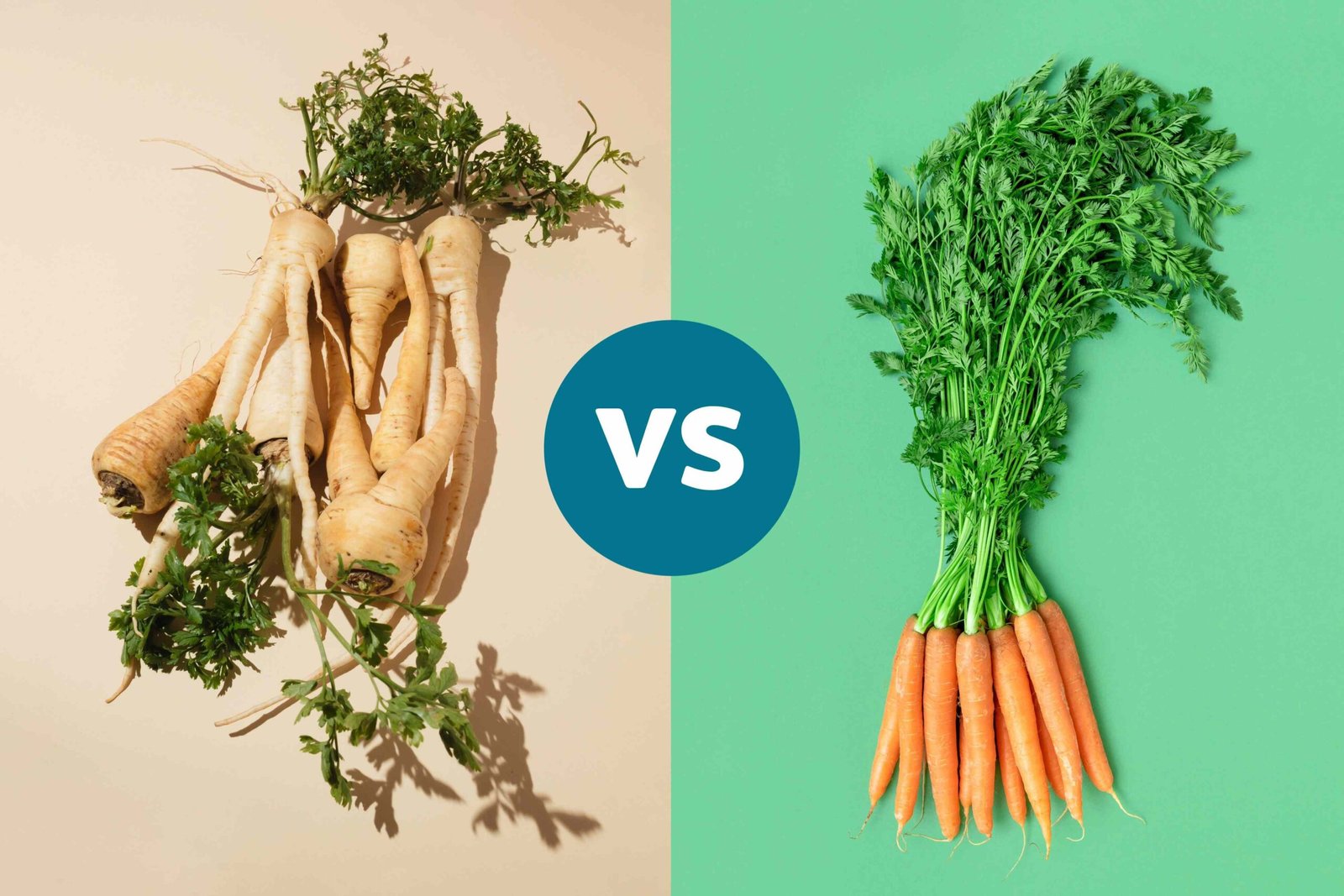
Not only are the colors and textures of parsnips and carrots different, but their nutritional makeup also varies. Parsnips are higher in carbs and folate, while carrots are packed with vitamin A. Here is what you need to know about the differences between the two.
Parsnips have more calories, carbohydrates, protein, and fiber than carrots. They also have nearly double the folate content of carrots.
Meanwhile, carrots have a considerable amount of vitamin A—so much so that they are responsible for 30% of the vitamin A in the U.S. diet. Parsnips, on the other hand, do not contain any vitamin A.
Characteristic
Parsnips (100g)
Carrots (100g)
Calories
75 calories
48 calories
Carbohydrates
18 grams
10.3 grams
Protein
1.2 grams
0.94 grams
Fiber
4.9 grams
3.1 grams
Folate
67 µg
37 µg
Vitamin A
0 µg
745.87 mcg
Potassium
375 milligrams
280 milligrams
Availability
Fall, winter
All four seasons
Even though parsnips are a starchy vegetable that is high in carbohydrates, they still play an important role in your overall nutrition. Parsnips may also offer several potential health benefits. Here is what you need to know about the benefits of eating parsnips.
- May offer medicinal properties: Historically, Persian cultures have used parsnips to treat a range of conditions, including headaches, stomatitis, ophthalmitis, dermatitis, and fever. It has also been used as a laxative, diuretic, and healing agent for frostbite.
- May improve specific skin conditions: Parsnips contain psoralen, a compound that is sensitive to light. Researchers have found that concentrated doses of psoralens may help treat certain skin conditions such as eczema, psoriasis, and vitiligo.
- May reduce inflammation: One study found that aging parsnips after they have been harvested enhances their ability to reduce inflammation and act as an antioxidant. Researchers have concluded that parsnips could become a functional food used to manage respiratory health and reduce inflammation.
- May give your immune system a boost: Parsnips contain about 17 milligrams of vitamin C per 100 grams, which is about 20% of the daily value, depending on your gender. Researchers have found that vitamin C can help shorten the duration of the common cold and other respiratory infections. Meanwhile, parsnips are also high in antioxidants—such as quercetin, kaempferol, and apigenin. These antioxidants not only improve immunity but also prevent infections.
Carrots are a rich source of vitamin A, with one carrot providing 110% of the daily value you need for vitamin A. They also offer several potential health benefits. Here is what you need to know about the benefits of eating carrots.
- May promote eye health: Because carrots are so rich in vitamin A, eating them regularly may help boost your eye health. For instance, vitamin A is known for its role in helping prevent age-related macular degeneration. Meanwhile, if you are deficient in vitamin A, you could develop xerophthalmia, which causes night blindness.
- May lower your cancer risk: Researchers have found that beta-carotene, which is found in carrots, can reduce the risk of certain cancers, such as colon cancer. Additionally, the lycopene in carrots may protect against other types of cancer, including stomach, prostate, lung, and breast cancer.
- May help regulate blood pressure: One meta-analysis found that carrots, along with other fruits and vegetables, can have a significant impact on heart health. For instance, the lycopene in carrots helps support cardiovascular health and may help prevent heart disease. Meanwhile, the potassium in carrots may help improve blood pressure by helping your body rid itself of excess salt and fluids, especially when part of a well-balanced diet.
- May improve brain health: The beta-carotene, vitamin E, vitamin C, and zinc in carrots may help enhance cognitive function and support overall brain health. Meanwhile, if you are eating purple carrots, the anthocyanins in them may help protect you from neurodegenerative diseases like Alzheimer’s and Parkinson’s by reducing oxidative stress and inflammation.
Both parsnips and carrots are rich in potassium. Consequently, some people with kidney disease may need to limit their intake of these root vegetables depending on their potassium levels. However, it is recommended that you consult with a healthcare provider before eliminating them from your diet.
It’s also possible that you may need to limit your carrot intake if you have a birch allergy. Carrots contain similar proteins to those found in birch pollen, which can cause oral allergy syndrome or pollen-food allergy syndrome. The same is true for mugwort allergies.
Both carrots and parsnips can be part of a nutritious, well-balanced diet. In fact, because they are both root vegetables, they pair well together and can be included in a roasted vegetable dish as well as incorporated into soups or stews.
They can also be eaten raw, but most people prefer parsnips cooked, especially because they become sweeter when cooked.
You can also treat parsnips like potatoes and slice them thinly to turn them into chips. Meanwhile, carrots make a nice puree when cooked. Ultimately, the choice comes down to your preferences for taste, texture, and sweetness.
Health.com uses only high-quality sources, including peer-reviewed studies, to support the facts within our articles. Read our editorial process to learn more about how we fact-check and keep our content accurate, reliable, and trustworthy.
USDA, Agricultural Research Service. Carrot facts.
USDA, FoodData Central. Parsnips, raw.
USDA, FoodData Central. Carrots, mature, raw.
USDA, SNAP-Ed Connection. Parsnips.
U.S. Department of Agriculture. Carrots, raw.
National Institutes of Health, Office of Dietary Supplements. Vitamin A and Carotenoids.
USDA, SNAP-Ed Connect. Carrots.
Kenari HM, Kordafshari G, Moghimi M, Eghbalian F, TaherKhani D. Review of pharmacological properties and chemical constituents of Pastinaca sativa. J Pharmacopuncture. 2021;24(1):14-23. doi:10.3831/KPI.2021.24.1.14
De Rie MA, Van Eendenburg JP, Versnick AC, Stolk LM, Bos JD, Westerhof W. A new psoralen-containing gel for topical PUVA therapy: development, and treatment results in patients with palmoplantar and plaque-type psoriasis, and hyperkeratotic eczema. Br J Dermatol. 1995 Jun;132(6):964-9. doi:10.1111/j.1365-2133.1995.tb16956.x
Lee K, Pan JH, Choi Y, et al. Post-harvest processed parsnip showed improved anti-oxidative capacity and protective potential against acrolein-induced inflammation in vitro and in vivo. Front Nutr. 2024;11:1507886. doi:10.3389/fnut.2024.1507886
National Institutes of Health, Office of Dietary Supplements. Vitamin C.
Carr AC, Maggini S. Vitamin C and immune function. Nutrients. 2017;9(11):1211. doi:10.3390/nu9111211
Nikolić NC, Lazić MM, Karabegović IT, Stojanović GS, Todorović ZB. A characterization of content, composition and scavenging capacity of phenolic compounds in parsnip roots of various weight. Nat Prod Commun. 2014 Jun;9(6):811-4. PMID:25115085
Puertollano MA, Puertollano E, de Cienfuegos GÁ, de Pablo MA. Dietary antioxidants: Immunity and host defense. Curr Top Med Chem. 2011;11(14):1752-66. doi:10.2174/156802611796235107
Food and Drug Administration. Nutrition information for raw vegetables.
National Institutes of Health, Office of Dietary Supplements. Vitamin A.
Deding U, Baatrup G, Christensen LP, Kobaek-Larsen M. Carrot intake and risk of colorectal cancer: A prospective cohort study of 57,053 danes. Nutrients. 2020;12(2):332. doi:10.3390/nu12020332
Przybylska S, Tokarczyk G. Lycopene in the prevention of cardiovascular diseases. Int J Mol Sci. 2022;23(4):1957. doi:10.3390/ijms23041957
Zurbau A, Au-Yeung F, Blanco Mejia S, et al. Relation of different fruit and vegetable sources with incident cardiovascular outcomes: A systematic review and meta-analysis of prospective cohort studies. J Am Heart Assoc. 2020;9(19):e017728. doi:10.1161/JAHA.120.017728
Centers for Disease Control and Prevention. Effects of sodium and potassium.
Abrego-Guandique DM, Bonet ML, Caroleo MC, et al. The effect of beta-carotene on cognitive function: A systematic review. Brain Sci. 2023;13(10):1468. doi:10.3390/brainsci13101468
Moskwa J, Bronikowska M, Socha K, Markiewicz-Żukowska R. Vegetable as a source of bioactive compounds with photoprotective properties: Implication in the aging process. Nutrients. 2023;15(16):3594. doi:10.3390/nu15163594
Zhong H, Xu J, Yang M, et al. Protective effect of anthocyanins against neurodegenerative diseases through the microbial-intestinal-brain axis: A critical review. Nutrients. 2023;15(3):496. doi:10.3390/nu15030496
National Kidney Foundation. Root vegetables.
Asthma and Allergy Network. What is birch pollen allergy?
Children’s Hospital of Philadelphia. Oral allergy syndrome.
