

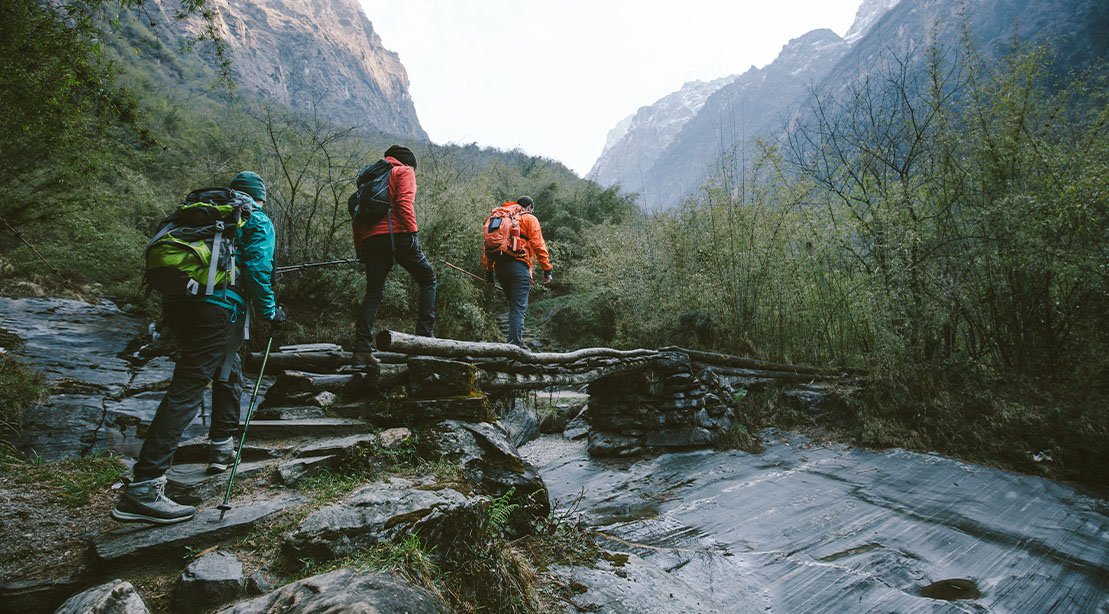
As hiking season ramps up, more people start eyeing longer trails, bigger climbs, and weekends spent outside. It sounds simple enough. Lace up, hit the trail, then take in the views as the trees open up and the air starts to feel a little thinner.
But a few miles in, once the trail pitches upward and your footing turns uneven, the effort starts to settle in. Your legs lose some pop, your breathing sharpens, and the rhythm you had early on begins to slip.
From a performance standpoint, hiking lives in its own lane. You’re moving for extended periods, navigating rocks, roots, and shifting terrain, and often climbing or descending for long stretches at a time. That combination challenges your conditioning, strength, and stability in a way most gym workouts don’t fully prepare you for.
It’s not about what you can do for a short set. It’s about how your body holds up when the effort keeps coming.
I’ve seen this play out over and over, both in my own training and with athletes. There’s always a point where people head out feeling confident, assuming their general fitness will carry them through. A few miles later, you start to see the shift. Someone’s sitting off to the side of the trail trying to catch their breath. Others start to fall well behind the pace they expected to hold. I’ve been there myself. Longer hikes, especially those with steady climbs and drawn-out descents, exposed the gaps quickly.
That’s where most people miss heading into hiking season. They rely on general fitness or treat hiking like it’s just a casual activity. If you want to move well, stay comfortable, and actually enjoy being out there, you need to be more intentional. That means preparing your body for what the trail throws at you and showing up with the right gear to handle it.
Why Hiking Is More Physically Demanding Than You Think
Hiking places a unique demand on your body as it blends steady aerobic output with continuous muscular work and constant joint stabilization. You’ll soon find yourself somewhere between producing and sustaining constant force while adapting to terrain that constantly changes. That combination taxes multiple energy systems at once, which is why fatigue builds faster than most people expect.
- High Repetition, Low-Grade Muscular Output: When hiking, each step functions like a submaximal contraction, primarily through the quads, glutes, and calves. Over time, these repeated efforts rely heavily on local muscular endurance and fatigue resistance. As those muscle groups fatigue, force production drops and movement efficiency declines.
- Aerobic System Sets the Ceiling: Hiking primarily operates in an aerobic zone, where your body depends on oxygen to produce energy through oxidative metabolism. A stronger aerobic base allows you to maintain pace at a lower energy cost, while a weaker system leads to earlier spikes in heart rate and perceived effort.
- Continuous Stability and Proprioception Demands: Uneven terrain increases reliance on proprioception, or your body’s ability to sense position and movement.
Your ankles, knees, and hips constantly adjust to maintain balance, while your core stabilizes your trunk. This creates a persistent neuromuscular demand that adds to overall fatigue.
- Elevation Changes Increase Mechanical and Metabolic Stress: Climbing requires greater concentric force production, especially from the glutes and quads, and elevates heart rate and oxygen demand. The steeper the grade, the more both the muscular and cardiovascular systems have to contribute.
- Eccentric Loading on Descents Drives Muscle Damage: Downhill hiking places a high eccentric load on the quads, which control knee flexion with each step. Eccentric contractions generate more mechanical stress and muscle damage, which is why descents often lead to greater soreness and fatigue than the climb itself.
When you look at hiking through this lens, it becomes clear why general fitness doesn’t always translate. The trail demands efficiency, durability, and the ability to sustain output across multiple systems simultaneously.
How to Train for Hiking: Build Endurance, Strength & Stability Fast
Before you start adding miles or random workouts, it helps to take a step back and look at what hiking actually requires. A simple needs analysis gives you a clear picture of the physical qualities that show up on the trail. Once you understand those, you can train with purpose instead of guessing.
At its core, most hikes demand a mix of aerobic capacity, muscular endurance, strength, and stability. The terrain and elevation may change, but these foundational needs stay consistent.
- Aerobic Capacity for Sustained Effort: Hiking lives in a steady, aerobic zone. The ability to keep moving without your heart rate spiking too early is a necessity, otherwise you’ll feel cooked before you ever begin. Incline walking, longer steady-state efforts, and low-intensity cardio build that base.
- Muscular Endurance to Handle Repetition: Your legs repeat the same movement pattern for thousands of steps. Step-ups, lunges, and longer lower-body sets help build the capacity needed to maintain pace.
- Strength to Handle Elevation and Load: Steeper climbs and added pack weight require force production (and mental durability). Movements like split squats and hinges build trail-specific strength that carries over to the trail.
- Eccentric Control for Descents: Downhill hiking places a high demand on your ability to absorb force. Controlled step-downs and tempo-based lower-body work prepare your legs for that stress.
- Stability for Uneven Terrain: Rocks, roots, and shifting ground challenge your balance. Single-leg work, carries, and core stability exercises help you stay controlled and efficient.
Shi/Adobe Stock
How to Train for Different Types of Hikes (Flat, Steep, Rocky, Loaded)
You wouldn’t train for a sprint by logging marathon miles, and you wouldn’t prepare for a marathon by only doing short, all-out efforts. Hiking works the same way. The demands change with terrain, elevation, and duration, so your preparation needs to match the hike
ahead of you. I’ve seen people put in solid work, show up confident, and still struggle simply because their training didn’t reflect what the trail required.
Flat, Long-Distance Trails
Flat trails challenge pacing and durability. The effort stays steady, but the total volume adds up fast. Without a strong aerobic base and enough time on your feet, fatigue builds, and minor discomforts become bigger issues.
Steep Climbs and Elevation Gains
Steep climbs demand both strength and conditioning. Your legs have to produce force with every step while your aerobic system supports the effort. Without both, climbs turn into frequent stops and broken rhythm. Step-ups, incline walking, and loaded carries prepare you well here.
Rocky and Uneven Terrain
Rocky trails challenge control and foot placement. Every step requires adjustment, which increases the demand on your ankles, knees, and hips. Poor stability slows your pace and increases the chance of missteps. Single-leg work and balance training help you stay efficient.
Loaded or Multi-Day Hikes
Hiking with a pack shifts your posture and increases joint stress from the start. Fatigue builds faster, especially through your shoulders, hips, and lower back. I’ve seen plenty of hikers underestimate this and feel it within the first mile. Training with a load ahead of time makes a noticeable difference in how you hold up.
Photo by Davide Sacchet on Unsplash
Best Exercises for Hiking Strength, Endurance, and Injury Prevention
Effective hiking prep comes down to choosing movements that transfer directly to the trail. Each step requires force production, control, and the ability to repeat that effort for miles. Strong legs support that effort, while upper body strength and core stability help you stay efficient, especially when carrying a pack or navigating uneven terrain.
For Climbing Strength and Power
- Step-Ups (bench or box)
- Bulgarian Split Squats
- Goblet Squats
Climbing relies on consistent force through the hips and legs. These movements build concentric strength, which supports a steady push uphill without a rapid spike in effort.
For Muscular Endurance
- Walking Lunges
- High-Rep Step-Ups
- Bodyweight Squat Variations
Long stretches of hiking turn into a high-repetition effort for the lower body. Training muscular endurance improves fatigue resistance, allowing each step to stay strong as the miles add up.
For Downhill Control (Eccentric Strength)
- Step-Downs
- Tempo Squats (slow lowering)
- Reverse Lunges
Descending places a high eccentric load on the quads as they control each step. These exercises train your muscles to absorb force efficiently, which helps limit breakdown in movement and excessive soreness.
For Stability and Balance
- Single-Leg RDLs
- Lateral Lunges
- Controlled Step-Throughs or Balance Holds
Uneven terrain requires constant adjustment. These movements improve joint control and balance, helping maintain stable foot placement across rocks, roots, and shifting ground.
For Load and Core Stability
- Farmer’s Carries
- Suitcase Carries
- Front Rack Carries
Carrying a pack shifts posture and increases total system demand. Loaded carries build core stiffness and positional strength, helping you stay upright and efficient under load.
For Upper-Body Endurance and Posture
- Pull-Ups or Assisted Pull-Ups
- Push-Ups
- Bent-Over Rows or Band Rows
Upper-body strength supports posture and pack control, especially on longer hikes. These movements help you stay tall through the torso and reduce unnecessary strain on the shoulders and lower back.
Sergii Mostovyi/Adobe Stock
3-Day Hiking Workout Plan to Build Trail-Ready Fitness
A focused plan built around these qualities prepares your body to handle the trail while building strength, endurance, and control. Supersets keep the pace up and improve your ability to move under sustained effort.
Day 1: Strength + Climbing Focus
Superset 1
- Step-Ups: 3 sets, 8-10 reps (each leg)
- Pull-Ups or Assisted Pull-Ups: 3 sets, 6-8 reps
Superset 2
- Bulgarian Split Squats: 3 sets, 8 reps
- Push-Ups: 3 sets, 10-15 reps
Superset 3
- Goblet Squats: 3 sets, 10 reps
- Farmer’s Carries: 3 sets, 30-45 seconds
Day 2: Conditioning + Endurance
Superset 1
- Incline Walking or Hiking: 30–45 minutes (steady pace)
- Every 10 minutes: Walking Lunges: 10 steps (each leg)
Superset 2
- Bodyweight Squats: 2 to 3 sets, 20 reps
- Band Rows: 2 to 3 sets, 12-15 reps
Superset 3
- Step-Ups (bodyweight): 2 sets, 15 reps (each leg)
- Push-Ups: 2 sets, 12-15 reps
Day 3: Control + Stability
Superset 1
- Step-Downs: 3 sets, 8 reps (each leg)
- Single-Leg RDLs: 3 sets, 8 reps (each leg)
Superset 2
- Reverse Lunges: 3 sets, 10 reps (each leg)
- Bent-Over Rows: 3 sets, 10 reps
Superset 3
- Suitcase Carries: 3 sets, 30 seconds (each side
- Lateral Lunges: 3 sets, 8 reps (each side)
gilitukha/Adobe Stock
Best Hiking Gear for Performance, Comfort, and Endurance
The right gear doesn’t make a hike easy, but it changes how you move and how long you stay comfortable. Poor choices show up quickly. Footing feels unstable, small hotspots turn into blisters, and fatigue builds faster than it should. The goal stays simple. Support movement, reduce friction, and stay efficient from start to finish.
Footwear That Matches the Terrain
Your footwear sets the tone for the entire hike. Traction, fit, and underfoot feel matter most once fatigue sets in.
What to look for:
- Reliable grip for dirt, rock, and loose terrain
- Secure fit through the midfoot and heel
- Cushioning that stays comfortable over distance
Performance takeaway: Stable footing keeps your stride consistent and reduces wasted energy late in a hike.
Coach’s Gear Pick: Notace Yama Trail Runners
A Pack That Moves With You
A pack should feel like an extension of your body, not something you fight against as the miles add up.
What to look for:
- Snug fit that stays close to your center of mass
- Even weight distribution across the shoulders and hips
- Minimal bounce while walking
Performance takeaway: A well-fitted pack reduces strain on your back and shoulders, helping you maintain posture and pace.
Coach’s Gear Pick: Osprey Exos 58 Pack
Hydration That Keeps Pace With Your Effort
Hydration plays a direct role in endurance and output, especially on longer or hotter hikes.
What to look for:
- Easy access to water without breaking stride
- Capacity that matches the length of your hike
- Electrolyte support for longer efforts
Performance takeaway: Consistent hydration supports energy levels and helps prevent early fatigue.
Coach’s Gear Pick: Ultimate Direction Ultra Vest 12L
Clothing That Adapts to Conditions
Clothing should help regulate temperature and manage sweat as conditions change.
What to look for:
- Breathable, moisture-wicking fabrics
- Lightweight layers for changing weather
- Freedom of movement without restriction
Performance takeaway: Comfortable body temperature and dry skin help maintain output and reduce energy drain.
Coach’s Gear Pick: Kuhl Renegade Outsider Short and Shadow Hoody
The Essentials That Keep You Moving
A few small additions help you stay prepared without weighing you down.
What to bring:
- Simple fuel source for longer efforts
- Navigation tool to plan your route and keep you on the trail
- Lightweight outer layer
- Headlamp or basic navigation tool
Performance takeaway: Preparedness keeps small issues from turning into bigger problems that slow you down.
Coach’s Gear Pick: onX Backcountry Navigation App
