

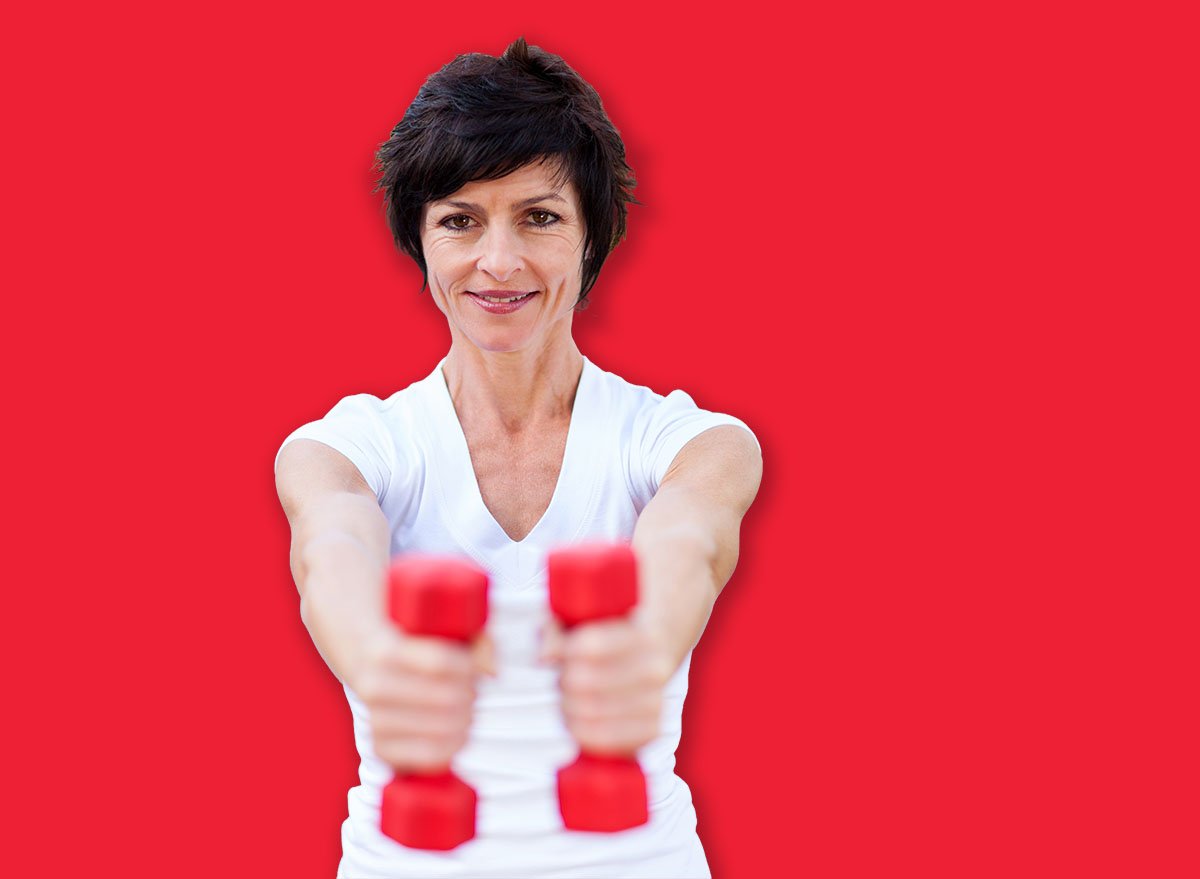
These dumbbell moves will help you build an impressive upper body.
We’re here with a newsflash: Strong, muscular pecs aren’t just for building an impressive physique or crushing upper-body sessions at the gym. An impressive chest build supports both of those things—but so much more. Strong pectoral muscles promote upper-body strength, lower injury risk, and support everyday functional movements. This includes carrying heavy groceries, pushing your cart at Home Depot, and even opening a stubborn door. They can also prevent slouching and help your golf swing.
If you’re ready to show your pecs some extra TLC, we have just the routine to get you started. We spoke with Jacob Siwicki, an online fitness coach and founder of Siwicki Fitness, with clients ranging from those in their 20s to their 70s, who shares five dumbbell exercises that will build strength faster than gym machines after 55. Before launching Siwicki Fitness in 2020, Siwicki was a top 1% globally ranked instructor at Equinox.
“Chest strength tends to decline with age, even in people who stay active, because they tend to use less weight. They believe what society says, that they can’t use heavy weights when they get older. But if they continue to use heavy weights and even increase their weights, their chest strength gets stronger and stronger and stronger,” Siwicki explains. “Gym machines might fall short on all of this because they restrict your movement and your range of motion, and they keep you static. With dumbbells, you’re using free weights, so you’re also working your stability and your stabilizers at the same time, which is very important when you get older, for balance.”
Siwicki chose these specific exercises because they’re safe and effective for those 55+ and he has clients doing these workouts who are 75 years old. They began using five-pound dumbbells and progressed to 30-pound dumbbells in most of these exercises.
Floor Chest Press
“The floor catches your elbows on every rep, so the shoulder can’t drop into a dangerous range,” Siwicki says.
- Lie flat on your back on a mat, holding a dumbbell in each hand just outside your chest.
- Keep your feet flat on the ground and maintain an engaged core.
- Press the dumbbells over your chest until your arms are extended but not locked out.
- Use control to lower the weights.
Pushups
Scale this exercise to your fitness level, whether that means performing wall pushups, incline pushups from a workout bench or sturdy chair, or placing your hands on the ground for traditional pushups.
- Assume a high plank position with your hands under your shoulders, each holding onto a dumbbell, and your body straight.
- Bend your elbows and lower your chest toward the floor.
- Maintain a long, straight body as you lower.
- Press back up, straightening your arms.
Chest Fly
- Lie flat on your back with a dumbbell in each hand and feet flat on the floor.
- Extend your arms over your chest, palms facing each other.
- Engage your core as you lower the dumbbells out to your sides in a wide arc.
- Hold for a moment at the bottom.
- Lift the weights back up together over your chest.
Close-Grip Floor Chest Press
- Lie flat on your back on a mat with your knees bent and feet flat.
- Hold a dumbbell in each hand, using a neutral grip, with your arms extended over your chest.
- Keep your elbows close to your sides as you slowly lower the dumbbells toward your chest.
- Hold for a moment at the bottom.
- Press the weights back up to the start position.
Rotating Chest Press
- Lie flat on your back with a dumbbell in each hand, knees bent and feet flat.
- Begin with your palms facing each other and arms extended over your chest.
- Lower the weights toward your chest.
- When you press the dumbbells back up, rotate your palms forward so they face your feet at the top of the movement.
- When you lower once again, rotate your palms back to a neutral position.
Alexa Mellardo
Alexa is a freelance writer, editor, and content strategist based in Greenwich, CT. She has 11+ years of experience covering wellness, fitness, food, travel, lifestyle, and home. Read more about Alexa
