

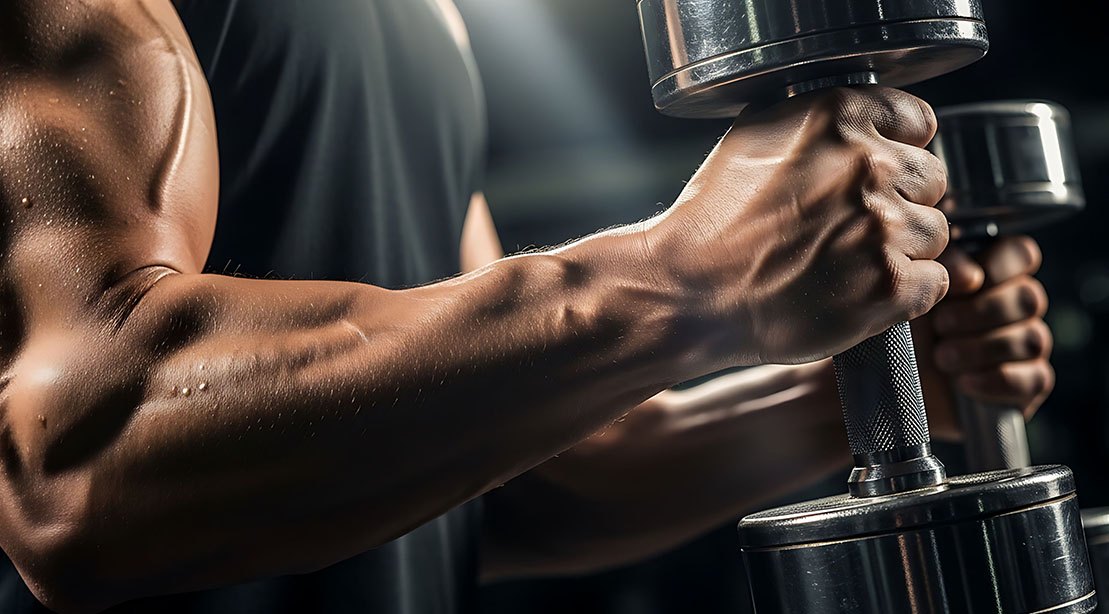
When was the last time you thought about training forearms? Probably when they were the weakest link.
That’s a shame because your forearms do far more than grip. They play a vital role in stabilizing the wrist, controlling movement at the hand and elbow, and transferring force between your upper body and whatever you’re lifting. Stronger forearms mean the difference between gains or crying into your protein shaker.
Their endurance-focused design also makes them resistant to growing, given the amount of low-level work they do. So, a few lazy wrist curls at the end of arm day may not be enough to make them grow.
Here I’m digging into the forearms: what they are, what they do, why they matter, and how to train them for more size, stronger wrists, and a grip that holds when the going gets tough.
Forearm Anatomy: The Muscles Responsible for Grip and Wrist Strength
A lot is going on between your elbow and wrist, with more than 20 muscles controlling the wrist, fingers, hand, and forearm. For our purposes, it helps to divide them into two main groups: the flexors and extensors.
The forearm flexors sit mostly on the palm side of your forearm. They help flex the wrist, curl the fingers, and generate the grip strength needed to hold anything you put in your hands.
The forearm extensors are located primarily on the back of the forearm. They extend the wrist and provide stability while gripping and ripping. Many lifters neglect the forearm extensors, even though these muscles control the wrist and promote balanced forearm development.
Don’t sleep on the brachioradialis, the thick muscle that runs along the thumb side of the forearm and helps create that meaty forearm look. It assists with elbow flexion and works hardest with a neutral or palms-down grip, which is why hammer curls and reverse curls are so effective.
Your forearms also rotate the palm down and up, and radial and ulnar deviation, which move the wrist from side to side. Put it all together: Your forearms grip, rotate, flex, extend, and stabilize every time your hands meet a weight.
Why Forearm Training Matters for Strength, Muscle Growth, and Grip Power
Your grip is front and center during deadlifts, rows, pull-ups, chin-ups, carries, shrugs, and curls. When your forearms fatigue first, your target muscle is unimpressed. Improving forearm and grip strength removes that weak link, allowing you to perform more reps and achieve greater gains.
The forearms also help stabilize the wrist during pressing and curling movements. A neutral wrist is a better foundation for transferring force, while a backward-bent wrist places unnecessary stress on the wrist.
Balanced forearm strength matters at the elbow, too. Lifters often overtrain the flexors while giving the wrist extensors little direct attention. Training both sides of the forearm promotes balanced development and improves the forearms’ strength and stability. This balance is especially important for reducing repetitive tendon stress associated with tennis elbow on the outer elbow and golfer’s elbow on the inner elbow.
Direct forearm training will not make you injury-proof, but it can improve joint control, enhance strength and endurance, and reduce the risk of a tendon becoming a painful weak link.
When your forearms get stronger, almost everything else follows.
What The Forearms Need
The forearms require a mix of strength, endurance, and isometric control because they perform multiple functions. During deadlifts, rows, pull-ups, and carries, the work is often isometric, contracting hard to keep hold. During wrist and bicep curl variations, the wrist and forearm require both strength and endurance.
The majority of forearm muscles are slow-twitch, indicating an endurance bias. This endurance bias is useful, but it can also make the forearms stubborn to grow. Genetics also influences forearm size. Lifters with longer muscle bellies and shorter tendons often have an easier time building muscle, while longer tendons and shorter muscle bellies can make growth more challenging.
Aside from your genetics, the key is to challenge your forearms in several ways. Heavy carries, holds, and compound pulling exercises build support grip strength. Plate pinches and similar drills train the thumb and finger strength. Reverse curls, wrist curls, and wrist rollers provide direct forearm stimulation, while pronation and supination exercises strengthen rotational control.
Forearm Training Methods
Start with heavy compound lifts, as forcing the forearms to work isometrically keeps the hands closed. These exercises are effective for building support grip, which is your ability to hold onto something.
Then add direct forearm work. Behind-the-back wrist curls let you load the forearm flexors through a controlled range of motion, while reverse wrist curls target the extensors. A wrist roller trains both sides under continuous tension and delivers the kind of forearm burn that makes a light plate feel much heavier than it has any right to.
Reverse curls, hammer curls, and Zottman curls deserve a place, too. These movements train the brachioradialis and elbow flexors that help give the upper forearm a thicker appearance.
It also helps to train different types of grip. Crushing grip is your ability to squeeze hard, support grip is your ability to hold a load, and pinch grip challenges the fingers and thumb. Grippers train crushing strength; carries build support strength; and plate pinches target pinch strength.
Fat-grip curls, towel pull-ups, and bottom-up kettlebell carries can improve grip and wrist stability, but program sparingly. Make every pulling exercise thick-handled, and your grip may fail long before your back gets enough work.
Also include pronation and supination exercises to train rotation. Dumbbell rotations strengthen the muscles that turn the palm up and down and help the forearm handle twisting forces.
Best Sets, Reps, and Training Frequency for Bigger Forearms
The trick is to give the forearms enough direct work to grow without turning every workout into a grip test or affecting your workout performance.
For grip strength, use three to four sets of heavy carries and bottom-up carries for 20-40 yards. These are best performed at the beginning of your workout.
Perform plate pinches (fat-grip holds) as accessory exercises near the end of your workout, each lasting 15 to 30 seconds. For forearm size, perform three to four sets of 8 to 15 reps of reverse curls, Zottam curls, hammer curls, and wrist curl variations, also as accessory work.
For muscular endurance, use two to four sets of 15 to 30 reps, longer carries, wrist rollers, or band work. Timed sets of 30 to 60 seconds also work well because they match the forearms’ need to maintain tension for extended periods.
For pronation and supination exercises, perform two to three sets of 10 to 20 slow reps per side. Keep these lighter and more precise. It’s best to train all these qualities, but it depends on your goals and time.
- Frequency: Most lifters can train their forearms directly two to four times per week. They get plenty of indirect work, so total volume matters. Start with six to ten direct sets per week, then add more only if your wrists, elbows, and performance are handling it well.
- Exercise Placement: Place most direct forearm work at the end of your session. Fatiguing your grip before deadlifts, pull-ups, or rows is a good way to make your hands the limiting factor. Occasional forearm work earlier in the session is fine when grip is the main priority, but let performance be your guide.
Sample Forearm Workout for Strength, Size, and Endurance
Unless forearm strength and size are a major priority, I’d avoid direct forearm training on pulling-predominant days. They’re already getting enough work, and adding more might exceed your ability to recover. However, if you have any elbow issues, a few forearm-rotation exercises will help prepare the area for action.
On days when squats and pressing are on the menu, programming heavy carries and direct forearm training works well. Based on the recommendations above, here are a few suggestions.
1A. Bench press variation
1B. Trap bar carry (using at least bodyweight) 40 yards
1A. Squat variation
1B. Bottoms up Kettlebell carry 20-40 yards per side
1A. Behind the back barbell wrist curls 8-15 reps
1B. Zottam curls 10-15 reps
1C. Iso plate pinch (till failure) Do both sides
Common Forearm Training Mistakes That Limit Growth
Your forearms already get plenty of indirect work; it is easy to misjudge how much direct work they need. Too few leaves are a weak link. Too much will affect workout performance. When you follow the sets and rep suggestions above, and you’re aware of the mistakes below, let the gains begin.
You’re Using Only Pulling Exercises
Pulling exercises do little to train wrist flexion, extension, pronation, supination, or pinch strength through a full range of motion. Treat compound pulling as the foundation, then use direct work to strengthen the actions it misses.
You’re Ignoring the Wrist Extensors
Most lifters naturally favor wrist and bicep curls, which emphasize the flexors. Meanwhile, the extensors on the opposite side receive little direct attention. Imbalances between the flexors and extensors are one reason for the increased strain on the tendons surrounding the elbow.
You’re Losing Wrist Position During Big Lifts
During presses, rows, and carries, the wrist should remain neutral. Allowing it to fold backward or sideways leaks force and places extra stress on the joint. Grip firmly and keep the knuckles, wrist, and forearm aligned.
Pushing Through Joint or Tendon Pain
A muscular burn, pump, or temporary fatigue is all part of direct forearm training. Sharp wrist pain or lingering tenderness on the inside or outside of the elbow is not. Instead, reduce the load, adjust your grip, shorten the range of motion, or replace the exercise.
Three Common Forearm Training Myths
These three myths can limit progress or create more problems than they solve.
Straps Make Your Grip Weak
Straps do not weaken your grip. They reduce grip demand during certain pulling exercises, which is useful when your hands give out before your back, traps, or hamstrings.
The problem is not using straps. The problem starts when lifters use them for every set and skip direct grip training. Use straps when grip is limiting the target muscle, then train your forearms separately with carries, holds, pinches, and direct wrist work.
Thinking Grippers Train The Entire Forearm
Grippers are excellent for crushing strength, but they do not train every forearm function. They do little for wrist extension, pronation, or supination, and provide little support for grip, pinch strength, or the brachioradialis through a full range of motion.
Treat grippers as one tool, not the whole toolbox.
Forearms Should Be Trained Every Day
The forearms can tolerate frequent work, but that does not mean they need hard daily training. Daily training can work if you limit volume and manage effort, but two to four focused weekly sessions suit most lifters better.
The Final Grip
The winning formula is simple: use compound lifts to build support strength, add direct flexion and extension work, train the brachioradialis, train multiple grip functions, and give pronation and supination some attention. Then manage volume so your wrists and elbows don’t hate you.
Stronger forearms will not only improve performance but also round out a balanced physique. Train them with purpose, and you will build a grip that can hold onto anything.
