

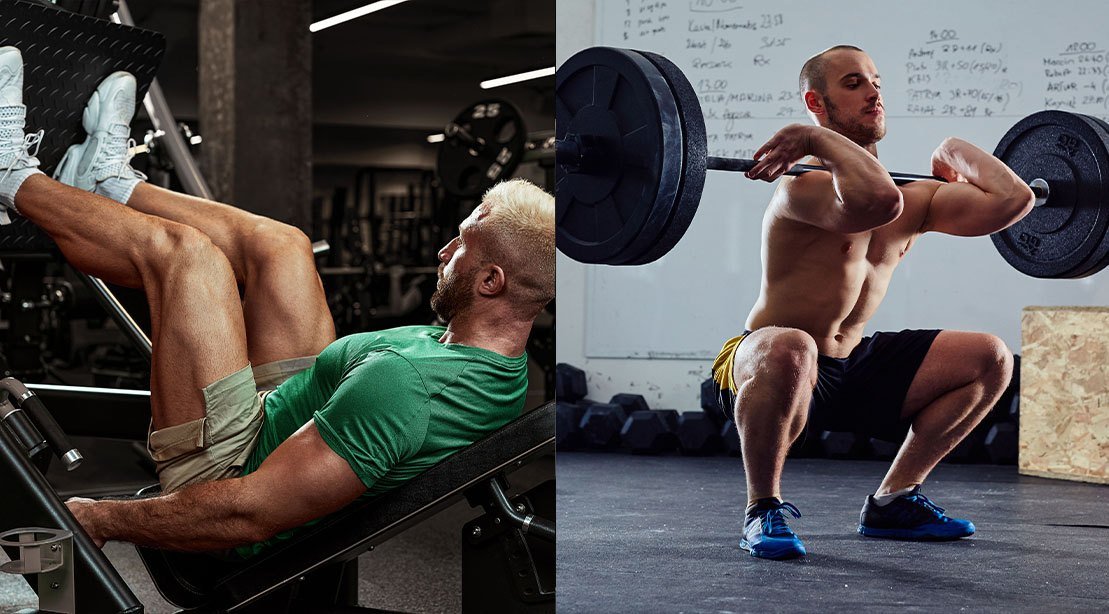
For decades, the barbell squat has worn the crown as the undisputed king of leg exercises. Walk into any hardcore gym and sooner or later you’ll hear it:
“If you want big legs, you have to squat.”
Do you, though? I’m not so sure. In fact, I’d argue that for many beginners, the squat is one of the worst possible choices to build their legs safely and efficiently. Not because squats are inherently bad, but because the exercise itself demands a very specific set of anatomical advantages, technical skill, and structural resilience that many people simply don’t possess.
Why Some Lifters Are Not Built for Barbell Squats
The fitness industry loves absolutes. Squats are king. Deadlifts are mandatory. The bench press determines your worth as a human being. The reality is much less romantic.
Not everybody is built to squat.
This isn’t opinion. Studies examining hip joint structure, femur length, pelvic geometry, muscle origin and insertion points, and ankle mobility have repeatedly shown that biomechanics vary dramatically from person to person. Some people are simply engineered for efficient squatting mechanics. Others fight their own anatomy every inch of the way.
Take two lifters of identical height and weight. One has short femurs, excellent ankle mobility, and favorable hip structure. He drops into a beautiful, upright squat with perfect balance.
The other has long femurs, tight ankles, and hip mechanics that force him into excessive forward lean. His lower back immediately becomes part of the lift whether he wants it to or not.
One person is training legs. The other is negotiating with a future orthopedic surgeon. This is where beginners get into trouble.
Valerii Apetroaiei/Adobe Stock
Leg Press vs. Squat: Which Builds More Muscle Safely For Beginners?
Squatting requires coordination, mobility, balance, spinal stabilization, and enough experience to recognize when technique begins breaking down. Worse yet, it’s an exercise that can be difficult to spot safely. One bad rep, one loss of balance, one slight shift in spinal position under heavy load, and now the lower back becomes the weakest link. Then you hear a little “pop” and you’re looking at months of recovery—which is a huge setback. Unlike a sore quad, the lower back has a long memory.
Compare that to the leg press.You’re seated. Your back is supported. Balance is removed from the equation. The movement pattern is fixed. The chance of sudden instability is dramatically reduced. You lower the weight down. You push it back up through the balls of your feet. Done.
No complicated motor learning required. For beginners, that’s one of those things that influences whether or not you come back to the gym tomorrow. The leg press allows someone to overload the quadriceps, glutes, and hamstrings without simultaneously learning how to stabilize an entire kinetic chain under compression. You can focus entirely on training your legs instead of worrying about whether your lumbar spine is about to explode.
The real truth is that you can build phenomenal legs without ever performing a single barbell squat. I did. My own structure has never favored squatting. I learned that early and painfully. I could spend years forcing my body into a movement pattern it clearly disliked, or I could focus on movements that delivered results without unnecessary orthopedic drama.
Why Beginners May Benefit More From Leg Presses
I chose the second option. Leg presses built my legs just fine. Now before the squat police start hyperventilating, let’s be fair. Squats absolutely have value. They teach coordination. They develop athleticism. They train multiple muscle groups simultaneously. They improve movement competency. But beginners should earn their way there rather than being thrown under a loaded barbell on Day 1 because somebody read an article from 1978 (that I probably wrote).
If someone spends a couple of years developing leg strength with leg presses, hack squats, pendulum squats, belt squats, and other modern machine variations, they can gradually experiment with squatting later.
Even then, I’d strongly recommend the Smith machine first. The fixed bar path removes instability while allowing the lifter to develop confidence and learn proper depth control.
Dusan Petkovic/Adobe Stock
What Beginners Should Know First Before Squatting
And if free bar squats eventually become part of the program, injury prevention becomes critical. That would likely mean: Use a proper lifting belt for heavier sets. Don’t bounce recklessly in the bottom position. Avoid ego lifting. Control the eccentric (down movement). Maintain neutral spinal alignment.
Understand that knee wraps are support tools, not permission slips to use weight you have no business lifting. Most importantly, know your range of motion. Parallel is not a religion. Forcing unnatural depth simply because social media says “ass to grass” is how perfectly healthy joints become future problems.
The irony is that modern equipment has largely solved this debate anyway. Today we have pendulum squats, hack squats, belt squats, leverage machines, and countless plate-loaded designs that replicate the mechanics of squatting while dramatically reducing spinal loading.
So the question beginners should ask isn’t “Should I squat?” The better question is: “What is the safest and most effective way for me to train my legs based on my structure?”
Squats can be excellent.
Squats can also be disastrous.
For my money, if I can build world-class legs with a leg press while sparing unnecessary wear and tear on my lower back, I’ll take the machine every time.
Call me old school.
Or maybe I’m just old enough to know better—or the only one compared to my contemporaries who doesn’t need a hip replacement.
