

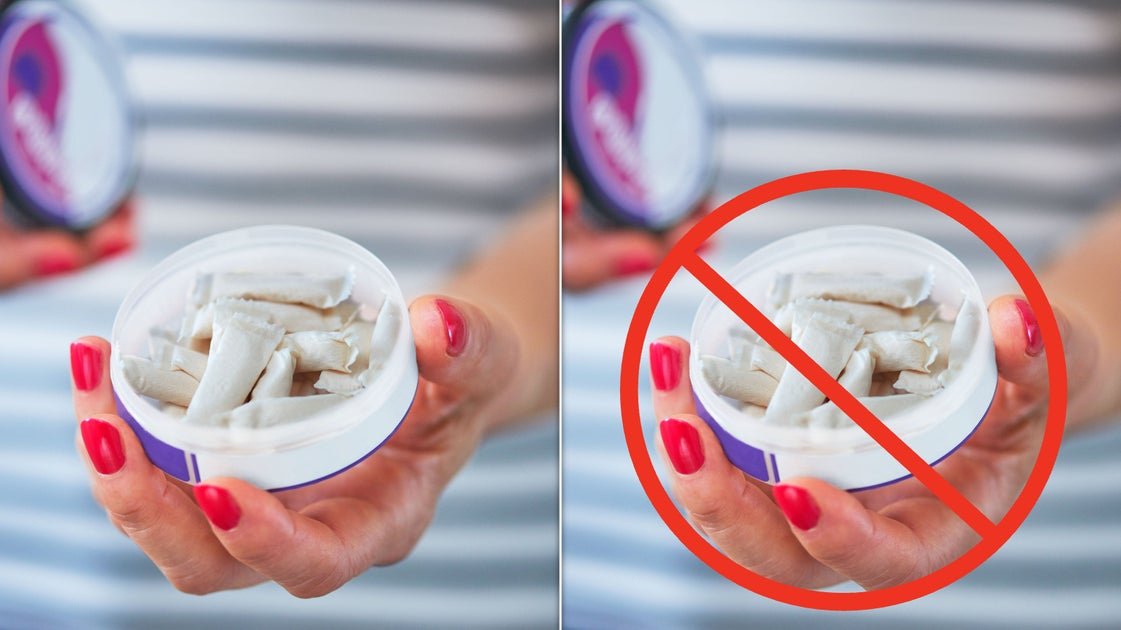
When you hear the word “nicotine,” a few things likely come to mind: perhaps cigarettes, addiction and even cancer.
Wellness influencers on social media ― and even some government officials ― are trying to change that perception.
Nicotine is most widely known as an ingredient in cigarettes, along with tobacco, but is now being pulled out as its own product and used in the form of patches, gum, pouches, vapes and more.
Health and Human Services Secretary Robert F. Kennedy, Jr. claimed that nicotine pouches, which are a smokeless nicotine product that people put on their gums, are “probably the safest way to consume nicotine” and was also allegedly seen using a nicotine pouch in his mouth during his Senate confirmation hearings.
It’s also becoming more common to hear from influencers on Instagram or TikTok that nicotine has health benefits, cognitive benefits, can boost energy and promote relaxation. The problem with cigarettes, the influencers say, isn’t the nicotine ― it’s the tobacco.
But experts told HuffPost there is much more to the story. Here’s what to know.
Nicotine now comes in many forms, and not all carry the same benefits and risks.
It is true that nicotine can be helpful for some people, particularly those trying to quit smoking, but nicotine comes in many forms ― pouches, gum, patches, vapes ― and not all forms are good.
“As a society, we’ve been promoting the use of nicotine patches and nicotine gum to help people stop smoking for decades, and we generally consider those to be safe,” said Dr. Frank Leone, the director of the Comprehensive Smoking Treatment Program at the University of Pennsylvania.
What’s the difference between a treatment like nicotine gum and a non-treatment like nicotine pouches? The formulation, for example, is vastly different.
“[Nicotine patches] actually use a nicotine that is sourced from the plant and purified,” Leone explained. “The newer nicotine delivery devices like pouches, like the newer vapes, use a synthetic form of nicotine, which the chemists recognize actually have different pharmacologic characteristics inside the brain.”
“The synthetic forms of nicotine are optimized to be absorbed and delivered to the brain very rapidly, creating the problems of addiction,” Leone added.
Another major difference? Things like nicotine patches or gum are intended to be used for a short period of time, such as months or a year, and then discontinued, Leone said. People are using pouches and vapes often with no end date in mind.
More, nicotine gum, when used to treat people who are trying to quit smoking or vaping, has between 2 and 4 milligrams of nicotine, said Dr. Pamela Ling, the director of the University of California, San Francisco Center for Tobacco Control Research and Education.
“Zyn pouches [a popular brand of nicotine pouches] start at 3 milligrams and go to 6 milligrams,” she added. “And now it’s very easy to get 9 milligrams, 12 milligrams, 15-milligram pouches.” This leads people to consuming much higher doses of nicotine.
Peter Dazeley via Getty Images
Nicotine pouches are ballooning in popularity, but they are addictive, dangerous and have unknown risks.
Claiming that nicotine is not linked to cancer is not a fair statement.
The dose of nicotine matters. “Nicotine at high levels … is able to distort the cellular mechanisms that we know have the potential to lead to cancer,” Leone said. “The newer products actually get very high levels of nicotine into the body.”
More, some people subscribe to the idea of “double decking,” which is when they put two nicotine pouches in their mouth to boost the effect, Leone added.
“We have no idea if they’re unknowingly creating the kinds of high levels of nicotine in the body that that have been associated with this biological factor in the laboratory,” Leone explained. “So, I worry.”
According to Ling, “there is evidence that nicotine isn’t by itself a carcinogen … nicotine isn’t known to cause cancer.” But that also isn’t the full story, Ling added, since cancer takes a long time to develop and many of these high-dose nicotine products (vapes, pouches) are just a few years old.
There have been studies in young people who vape but have never smoked cigarettes that show these individuals have the same DNA changes to the cells in their mouth and throats that are seen in people who smoke cigarettes, Ling explained.
“Think of how long it takes for cancer to develop — it’s going to take years to actually have cancer outcomes, but the more we learn about people vaping or people using nicotine products, the more concerns there are about its long-term safety,” Ling added.
The suggestion that nicotine promotes relaxation and better brain function is also not totally accurate.
“Like every other hack on Instagram, it sounds great upfront in a 30-second sound bite, but when you start to actually try and implement the ideas, things start to break down,” Leone said.
It is true that nicotine is not responsible for all of the “ill health effects” that come with cigarette smoking, “but it’s not completely benign,” Leone added.
When it comes to cognitive benefit, some studies do suggest that nicotine can benefit your attention and focus, according to Ling, “but these are really limited neurological types of trials where people are … completing really simple tasks.”
The studies also had conflicts of interest; “there was a lot of studies that were funded by people connected to tobacco companies doing this science,” Ling added. The literature was also mixed — some studies said nicotine may have a cognitive benefit, while others did not find benefit, she added.
When it comes to promised relaxation or stress relief, experts also have their doubts.
“It turns out that exposure to nicotine impacts, influences, distorts the connection between the parts of the brain that manage stress and the physical effects in the body of the adrenal gland producing cortisol, which is the stress management hormone,” Leone explained.
Stress management requires coordination between the body and the brain, he added. “Nicotine interrupts that pathway [and] makes it harder for it to work.”
People then end up needing nicotine to help them manage their stress, Leone noted. “So, is it that nicotine is helping them to manage stress, or is it that nicotine has made it impossible for them to manage stress without nicotine around?”
Nicotine changes the brain, which is especially dangerous (and addictive) for young people.
According to Ling, nicotine changes your brain in a rapid manner.
“Even if it feels like you might have more energy or focus when you start, you really rapidly end up needing to use nicotine to feel normal,” Ling said.
Nicotine activates what’s known as acetylcholine receptors in your brain, she said. Acetylcholine is a neurotransmitter that sends messages throughout your body and is involved in many processes, including voluntary muscle movement, memory and thinking.
“As soon as you start using nicotine, your brain starts making more of the receptors, which is why people become addicted,” Ling explained, “but also, changing the number of receptors in your brain leads to that craving, and this is especially true for young people.”
Young people are more susceptible because their brains are growing and “still pretty plastic,” Ling said, which is why young people have an easier time learning a new language, for example.
“So, adding nicotine to a developing or growing brain changes the structure of your neurons, and so it’s actually much more easy to get addicted to nicotine when you’re young,” Ling said.
It’s also harder to feel “normal” without nicotine because your brain has developed in a way that relies on a nicotine addiction.
“In order for you to accurately appreciate the value of using nicotine, you have to understand what form of nicotine you’re being exposed to,” Leone said.
If you haven’t started using nicotine, don’t start.
Any black-and-white claims that nicotine is “good” for you from an influencer online aren’t accurate.
Unless you are working with a medical professional to use nicotine patches or gum to quit smoking, you shouldn’t start using nicotine for any so-called health boon.
Nicotine is useful in the case of smoking cessation, and has the potential to be beneficial in the treatment of specific illnesses, but that is still being researched.
“I have nothing against nicotine as a chemical,” Leone said.
“It is not the chemical that is at fault. It is the way it is produced, it is the way that it is packaged, it is the modifications that the chemical engineers make to it. It is the way people use it. It is the expectations that they have of it that become the problem,” he said.
Any perceived in-the-moment benefits of nicotine (relaxation, focus) will likely be met with issues such as addiction, brain changes and DNA changes — and all of the harms of these new nicotine products aren’t fully known yet.
“Our kids are smack in the middle of a large-scale experiment without their consent,” Leone said. “You get one brain, why would you take a chance and expose yourself to something that is designed to promote brain change?”
“We’re in a situation where people are paying to be guinea pigs,” Ling added, “and then we’re going to wait and see who gets sick.”
Need help with substance use disorder or mental health issues? In the U.S., call 800-662-HELP (4357) for the SAMHSA National Helpline.
