

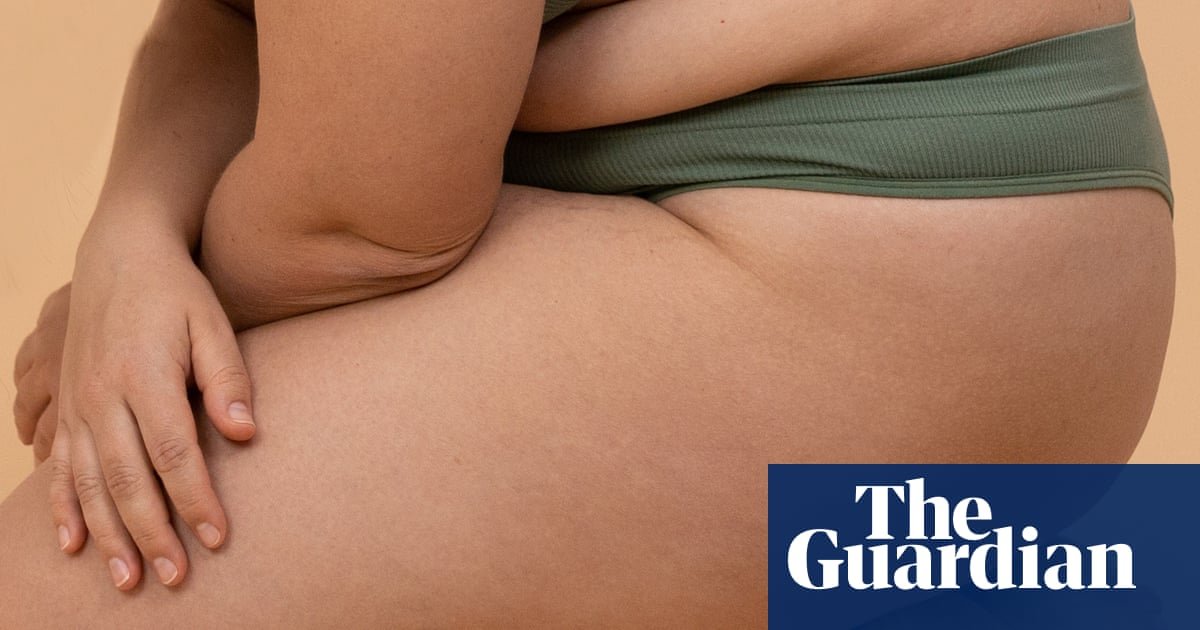
In 1981 the CD was born and so was I. Both arrivals were surprising and have drifted in and out of fashion ever since. As a baby, my majestic “chonk lord” status was cause for celebration and an indication of prosperity. But from a young age I noticed that my presence seemed to offend other people. When I was seven, I remember asking to have a go at skipping, after having turned the rope for everyone else. One child enlightened me on why I couldn’t: I was too fat to skip.
Children learn hierarchy from adults and then their peers. Who belongs, who doesn’t and why. My classmates learned from adults to see me as something to mock and despise. Even my own well-meaning father once sat me down and told me that nobody would love, trust or employ me due to my body shape. This didn’t shock me; I’d already picked up what everyone was putting down.
Overriding genetics and environment is a tall order, but I learned quickly that if I leaned into my brainy side, and could make people laugh, this might compensate for the space I took up. This was the era of Weight Watchers, Aerobics Oz Style and heroin chic, and the ideal body was unattainable and contradictory. You could only be muscular if you were male. Women needed to be thin, but not so thin they looked unfeminine (whatever that meant). There was nothing worse than “thunder thighs”. Breakfast cereals were seemingly the answer to everyone’s problems. BMI had not yet been exposed as a flawed and racist scam, and failing to look Just Right (cereal reference!) was a moral failure. I kept my head down as much as I could until my mid-20s.
Although the fat acceptance movement kicked off before I was a twinkle in my father’s eye, it took until the 2010s for body positivity to reach the mainstream. More than a kind appraisal of all presentations, body positivity was a philosophy that stared down overt and implied criticism of shape, size, ability and skin tone and served up the alternative. All historically marginalised bodies were now to be embraced and treated with reverence. By then, I’d had enough of people deciding I was a piece of crap solely because of my size. For me, body positivity felt like stark relief from a lifetime of being sent to the shame corner.
Sadly, like most things, the body positivity movement was eventually scooped up and repurposed by advertisers to sell clothes and lifestyles. The people once served by the movement were discarded; it was fine to be fat now, as long as you were also conventionally beautiful and very airbrushed.
But then along came body neutrality. Where body positivity was geared toward loving your body and insisting that everything about everyone’s appearance was gorgeous, body neutrality was devoid of hierarchy. “My body is fat” is a true statement; it doesn’t need to be couched in compliments. It is as accurate as saying “a disco ball is shiny” or “that grass is green”.
I see body neutrality as being similar to being cold and getting a jumper: you’d neither celebrate nor criticise someone for feeling cold, or for wanting to be warm. My body isn’t wrong because it’s cold. It isn’t wrong because it’s fat. I’m not an amazing person just because I’d be more comfortable if I was warm, or because I choose to eat an apple or hot chips.
Body neutrality also pairs nicely with autism and my love of the literal, as it turns out. I couldn’t settle on what I believed about my own body when I was so focused on what everyone else thought. I had understood every hateful statement hurled at me to be accurate. I can now file those thoughts away with other outdated notions like prescribing heroin for toothaches or low-rise skinny jeans.
My Body is My Home by Jasper Peach and illustrated by Beci Orpin. Photograph: Allen & Unwin
When I decided to write a book for young children about body neutrality, I spoke with several people who know more than I do, including the total brainiac scientist and author Dr Emma Beckett. Growing up in the same household, Emma’s umpteen siblings all had differently shaped bodies even though their food intake and body movement was almost identical. The same is true of the broader community: genetics, environment and economics all come into play. Size is not solely determined by self-control.
My wife and I have tried to raise our children using neutral language where possible. No forced positivity and no heavy shame. Bodies are described the same way we describe anything else. One of our dogs resembles a wiggly pile of wigs, the tree out front is tall, and the way my children describe me without prompting makes my heart sing.
A few weeks ago, our nine-year-old asked if bodies change and “get bigger in their tummies” when they grow up. “Bodies do change, but they tend to follow their own patterns,” I said. “We respond to joy and safety just as much as movement and nutrition.” After bedtime stories, milksweet and sleepy, he patted my upper arms and said “I love these floppy bits, they’re so good for cuddles.” There was no manufactured consolation in his words. I felt as if I was watching harm dissolve before it could take hold.
If I’d been taught about body neutrality as a child, I can’t begin to imagine how much easier things could have been. Not just for me, but for everyone convinced that their size was the result of being weak-willed or broken. In 1981, CDs were born and so was I. Neither of us has stayed in fashion, but there has always been a place for us – and there always will be.
