

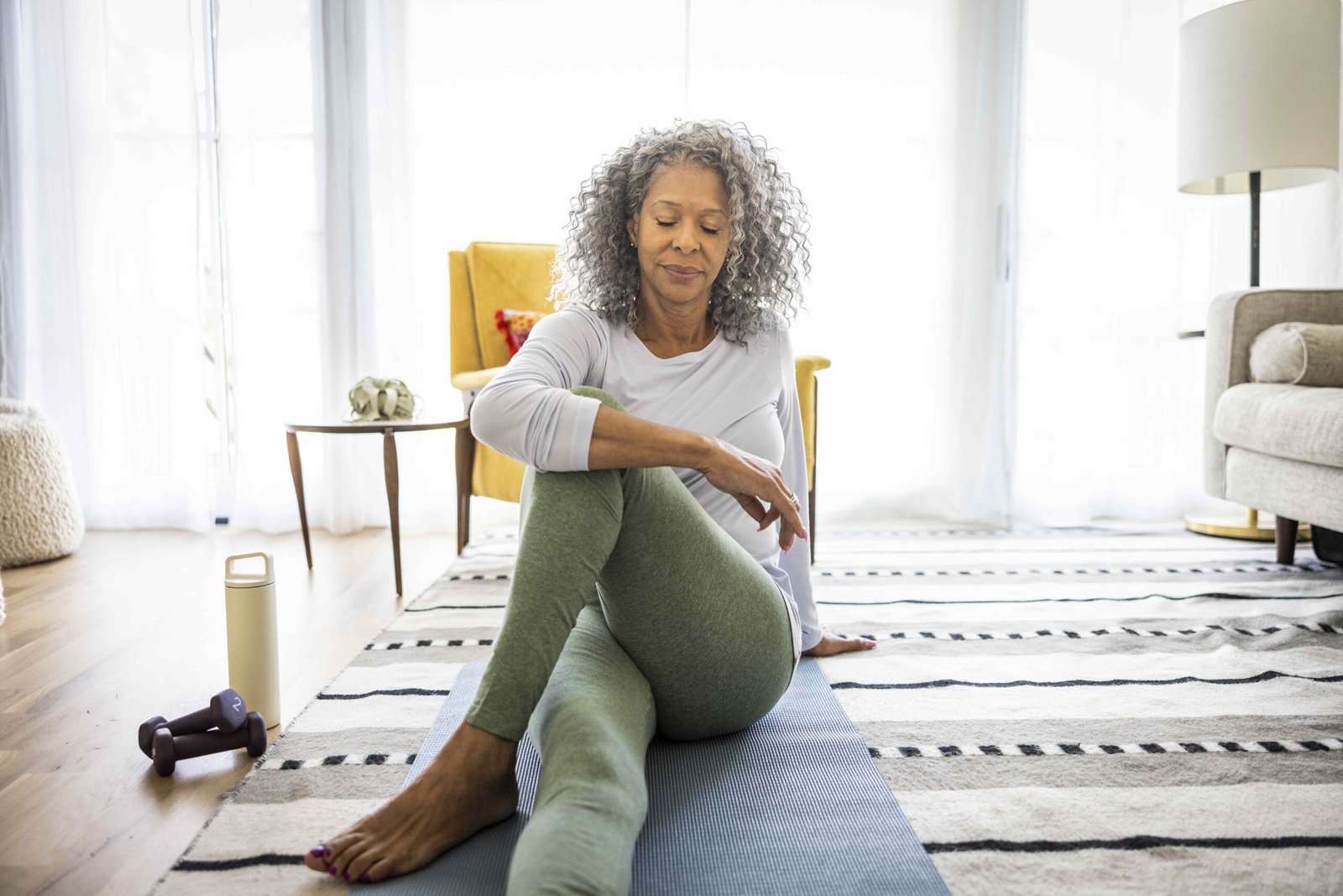
Aging isn’t kind to our mobility and range of motion: Muscle mass naturally declines, connective tissue loses elasticity and lubrication, and conditions like arthritis can cause stiffness and inflammation. But getting older doesn’t have to mean slowing down—you can support the decades of movement ahead of you by shifting from high-impact workouts to more functional exercises and targeted stretches.
Standing on one leg may sound simple, but the exercise can help build strength and improve balance, according to Robyn Culbertson, PT, DPT, a physical therapist specializing in geriatrics and spokesperson for the American Physical Therapy Association.
It may also be a useful tool in predicting a person’s risk of all-cause mortality after a certain age. Research shows that past the age of 50, people who are unable to stand on one leg for 10 seconds have an increased risk of dying within seven years.
How to do it:
- Stand tall with your feet together and your hands at your sides. Have a stable surface nearby in case you lose your balance.
- Keeping your eyes forward, lift one foot off the ground and hold the position for 10 to 60 seconds, depending on your comfort level.
- Lower your foot back down, then switch legs and repeat for another 10 to 60 seconds.
This easy exercise can encourage ankle mobility and gait coordination so you’re more stable and balanced when you walk, said Leah Verebes, PT, DPT, GCS, a physical therapist and assistant professor of physical therapy at Touro University.
How to do it:
- Stand up straight with your feet together and your arms relaxed at your sides. Position yourself near a wall or countertop for balance.
- Looking straight ahead, walk in a straight line, placing one foot directly in front of the other so the heel of your front foot touches the toes of your back foot.
- Continue forward in this heel-to-toe pattern for 10–20 steps.
- Use the wall or countertop if you feel unsteady, but try to maintain your balance on your own as much as possible.
Neck pain and stiffness are all too common. Gently rotating the neck from side to side several times throughout the day can help, Pamela Mehta, MD, an orthopedic surgeon and founder of Resilience Orthopedics, told Health.
How to do it:
- Sit tall with your feet flat on the floor and your arms relaxed at your sides.
- Keeping your eyes forward, gently turn your head to one side to look over your shoulder, moving only your neck.
- Turn until you feel a gentle stretch (not pain), and hold for 5 seconds.
- Slowly return your head to center and repeat on the other side.
Gentle swinging your arms—front, back, side-to-side, in small circles—can improve range of motion in the shoulder joint. “You can do as much or as little as you’re capable,” Mehta said, but you should do this as regularly as possible to promote joint health.
How to do it:
- Stand or sit beside a table or sturdy surface. Place one hand on it for support.
- Lean forward slightly, allowing your opposite arm to hang straight down toward the floor.
- Keeping that arm relaxed, gently swing it in small circles, reversing direction after several circles.
- Then, swing the arm forward and backward, and side to side.
- Repeat the movements with the other arm.
Regularly bending and straightening your knees can help keep them mobile, said Mehta, but this exercise can also strengthen your hip and knee flexors.
How to do it:
- Lie on your back on a yoga mat with your legs extended straight out in front of you.
- Slowly slide one heel toward your buttocks, keeping your foot in contact with the floor.
- Bend your knee as far as is comfortable, then hold the position for 5 seconds.
- Slowly slide your heel back out, straightening your leg.
- Repeat 10 times on that leg, then switch sides.
Your gluteus medius is a large, fan-shaped muscle on the side of each hip that helps stabilize your body as you walk. Working those large muscles is “one of the best ways to prevent falls,” said Mehta.
How to do it:
- Lie on your side on a yoga mat with your legs extended straight.
- Rest your head on your lower arm, and place your top hand on your hip for stability. If needed, slightly bend the bottom knee for balance.
- Keeping your top leg straight, slowly lift it toward the ceiling. Aim for about 45 degrees, or as high as feels comfortable, then slowly lower the leg back down with control.
- Start with five lifts, then switch sides. Work your way up to 10 lifts on each side.
This is a great exercise to open up and improve mobility and rotation in the mid-back, Murphy said. If you have significant spinal issues, consult with a physician before trying this one, she added.
How to do it:
- Lie on your back on a yoga mat with your arms extended out to the sides at shoulder height, forming a “T.”
- Cross your right leg over your left leg, keeping both shoulders on the floor if possible.
- Bring your right arm across your body to meet your left hand.
- Then slowly “open the book” by sweeping your right arm back out to its starting position, allowing your upper body to rotate. Repeat for five to eight reps.
- Switch leg positions and repeat on the other side.
The forward fold is a perfect low-back stretch you can do several times a day at your desk at work or in a chair at home, Culbertson said.
How to do it:
- Sit tall in a chair with your feet flat on the floor and knees open wide.
- Slowly bend forward from your hips and reach your hands toward the floor between your feet.
- Lower as far as is comfortable and hold for a few seconds.
- Slowly lift your torso back up to a seated position and repeat as needed.
If you’ve taken a yoga or mat Pilates class, you’ve probably done a cat-cow stretch. “It improves spine flexibility, core strength and posture, and helps relieve tension in the back,” Shannon Murphy, M.Ed, ATC, a certified athletic trainer at The Stone Clinic.
How to do it:
- Start on all fours on a yoga mat, with your hands under your shoulders and your knees under your hips.
- Slowly round your back toward the ceiling, tucking your chin slightly and drawing your belly button in (like a frightened cat).
- Then reverse the movement by dropping your belly toward the floor, lifting your chest, and tipping your tailbone up toward the ceiling.
- Move slowly and smoothly between these two positions for several breaths. (This exercise can also be performed seated if getting on the floor isn’t comfortable.)
This move can “wring out” and release tension in your lower back, said Culbertson
How to do it:
- Sit tall in a chair with both feet flat on the floor.
- Keeping your hips facing forward, gently rotate your torso to one side so you’re looking over your shoulder.
- Twist only as far as feels comfortable, and hold for a few seconds.
- Slowly return to center and repeat on the other side.
This simple yet effective exercise—also known as a chair squat—can strengthen your lower body and core and help you maintain your independence as you age, said Verebes. Standing up and lowering down on a chair mimics other movements, like getting into and out of bed or a vehicle, and using the toilet.
Like the single-leg stand, the sit-to-stand can also help test leg strength and endurance. The goal is to go from sitting to standing and back down as many times as possible in 30 seconds. Men and women ages 60 to 94 should be able to perform the move anywhere from 14 to 4 times in the time period, depending on age.
How to do it:
- Sit on a sturdy chair with your feet hip-width apart and flat on the floor.
- Lean forward slightly from your hips and press through your heels to stand up.
- Once standing, slowly lower yourself back down to a seated position with control.
- Use your hands for support if needed, but try to maintain balance on your own. (To make the exercise easier, use a higher chair. To make it more challenging, use a lower chair or ottoman.)
