

Check out more stories from Busted, our series that offers an unfiltered exploration and celebration of our boobs and ourselves during breast cancer awareness month.
In April 2022, Clea Shearer ― co-founder of the popular organization company The Home Edit ― announced that she had breast cancer. The diagnosis came after she discovered a lump in her breast and called multiple doctors to go in for a mammogram as soon as possible.
Estimates suggest that one in eight women in the United States will develop breast cancer at some point in their life. Shearer had just turned 40 when she discovered the mass in her breast. Stories like Shearer’s highlight the value of familiarizing yourself with what is normal and abnormal for your breasts.
Although many cancer organizations no longer recommend all women conduct monthly breast self-exams due to concerns about their effectiveness and the sense of self-blame they can promote, experts do agree that awareness of how your breasts typically look and feel is useful for detecting signs and symptoms of breast cancer, like lumps.
Still, I imagine I’m not alone when I take the time to feel around that area and wonder, “What exactly am I checking for? What would a lump actually feel like? Am I even doing this right?” So, I asked a few experts to answer those very questions.
What exactly does a breast lump feel like?
“A lump often feels like a round, hard area,” said Dr. Arif Kamal, a chief patient officer at the American Cancer Society. “It can either be deep or toward the skin itself. Typically it is not painful. It’s typically not easily movable but oftentimes fixed in a particular space, meaning it doesn’t shift in its location all that easily. In terms of shape, it is oftentimes round but sometimes it can be a little bit more irregular than that.”
Some experts have suggested the size of a breast lump ranges from as small as a pea to larger than a golf ball. Indeed, Kamal noted that many of his patients have compared it to a pea.
“In my clinical experience, a lot of times patients describe it like a pea in a pod or a frozen pea ― sort of on the smaller side, of that texture, and of that hardness,” he said. “It’s generally on the smoother side for texture, generally more firm, generally not painful. And it generally does not feel like a cyst, which feels like a fluid collection ― although even if a person feels a fluid collection, they should report that to their clinical team as well.”
Dr. Alyssa Cubbison, an assistant professor of radiology at the Ohio State University Wexner Medical Center, similarly noted that cancerous lumps often feel firm and dense and can be difficult to move from side to side. However, she emphasized that all new lumps should be evaluated by a professional.
“You mainly want to feel around for something discrete in your breast that’s separate from the rest of your breast tissue,” she explained. “Because the textures and densities of masses can be so varied, you’re just feeling for anything different, as vague as that sounds. You can use your other breast as a baseline as well.”
Of course, feeling a new lump isn’t the only indication of a potential issue. Susan Brown, senior director of health information at Susan G. Komen, shared a list of eight warning signs, including visual indicators, that people should look out for.
“See a doctor if you notice any of these breast changes,” Brown advised. “Lump, hard knot or thickening inside the breast or underarm area; swelling, warmth, redness or darkening of the breast; change in the size or shape of the breast, dimpling or puckering of the skin; itchy, scaly sore or rash on the nipple; pulling in of your nipple or other parts of the breast; nipple discharge that starts suddenly or new pain in one spot that doesn’t go away.”
Although there are some common characteristics of lumps and other warning signs, there’s ultimately no one specific thing to look or feel for when it comes to your awareness of your breasts. The key is just to understand what is normal for you so that you recognize something new or different ― and seek medical attention when you do.
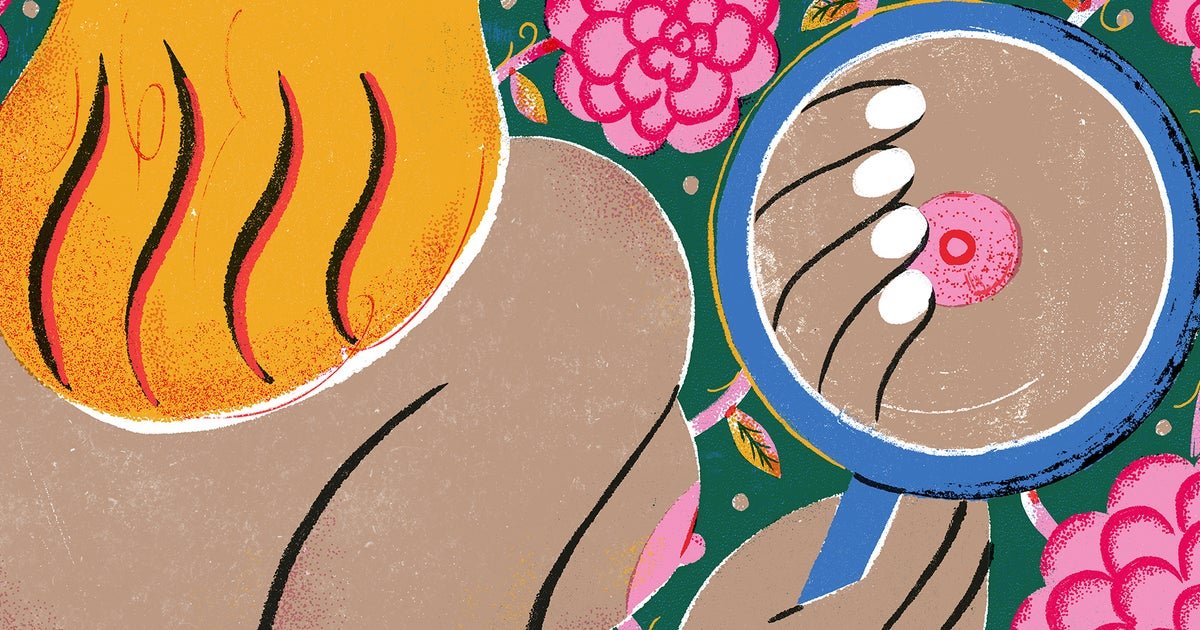
Illustration:Irene Rinaldi
Many people say that a lump in their breast has felt similar to a frozen pea.
What’s the best way to notice or spot a breast lump?
Part of the reason many experts no longer recommend monthly breast self-exams is that there are more organic situations during everyday life that provide the opportunity to familiarize yourself with your “normal” and keep you on alert for signs and symptoms.
“Many women who discover changes in their breast or underarm area that turn out to be breast cancer don’t actually discover them on the day and time they have set aside for monthly [self-exam, but rather noticed a change incidentally at some other time, such as when showering or dressing, and recognized the change because they knew what was normal for them ― or a partner noticed it,” Brown explained.
Again, the idea is not to necessarily look for something specific, just to take note if there’s anything new or different.
“If you aren’t already checking your own body, I think a good place to start is after you go in for a regular checkup with your primary care provider or gynecologist,” said Dr. Janet Yeh, assistant professor at New York University (NYC) Grossman School of Medicine and site chief of breast surgical oncology at NYU Langone Hospital―Brooklyn. “If you recently had imaging or they did an exam and it was normal, then you can get a good idea of your baseline because you know there’s nothing there. You know the lumps and bumps you might feel are your regular breast tissue.”
She recommended checking your breasts when you’re doing something comfortable and routine, like lying in bed, watching TV, standing in front of the mirror, or taking a shower (“it’s two birds with one stone since you have to wash your body anyway”).
“Everyone’s going to do it a little differently, and that’s OK,” Yeh explained. “Some use the tips of their fingers and go in little circles. Others might say to make the shape of a star. I like to feel with my palm and fingers and do a wiping motion. I think of the breasts as a clock and wipe all around a center point ― then press in to make sure I’m not missing anything behind.”
Lift your left arm as you check your left breast and your right arm for the right. Make sure to also check your underarms, as cancer and other issues can manifest in the form of swollen lymph nodes in that area.
“Some women have very lumpy breasts, so it’s important for those women to get used to their own lumps and bumps,” Yeh noted. “That way they can say, ‘OK in the upper outer area, I usually feel a lot of firmness and lumps.’ And if there’s something different they’re unsure about, it doesn’t hurt to get it checked out, even if it turns out to just be regular breast tissue.”
20 Years OfFreeJournalism
Your SupportFuelsOur Mission
Your SupportFuelsOur Mission
For two decades, HuffPost has been fearless, unflinching, and relentless in pursuit of the truth. Support our mission to keep us around for the next 20 — we can’t do this without you.
We remain committed to providing you with the unflinching, fact-based journalism everyone deserves.
Thank you again for your support along the way. We’re truly grateful for readers like you! Your initial support helped get us here and bolstered our newsroom, which kept us strong during uncertain times. Now as we continue, we need your help more than ever. We hope you will join us once again.
We remain committed to providing you with the unflinching, fact-based journalism everyone deserves.
Thank you again for your support along the way. We’re truly grateful for readers like you! Your initial support helped get us here and bolstered our newsroom, which kept us strong during uncertain times. Now as we continue, we need your help more than ever. We hope you will join us once again.
Support HuffPost
Already contributed? Log in to hide these messages.
In addition to seeing a doctor when you detect any change or abnormality, make sure to schedule regular medical appointments and screenings. If you have a family history of breast cancer or personal health factors that increase your risk, talk to a doctor about that. Discuss which tests are right for you and the proper age and cadence for screenings like mammograms.
“Our technology with breast imaging is so good these days that we really do pick things up early,” Yeh said. “If you’re compliant with the guidelines and getting your mammogram, it’ll likely pick up things before you can even feel them. Fortunately, most of the breast cancer we see is so early, we can’t even feel it ourselves. Still, it remains important to let a professional know if you feel a new lump in your breast.”
