

Squats aren’t enough after 60. These 4 moves train real balance.
Balance tends to get more attention after 60, usually because it no longer feels automatic. You notice it when you step off a curb, shift your weight, or have to catch yourself mid-step. A lot of that comes back to how well your legs and hips can control your body, especially when you’re on one leg.
Squats build strength, but they don’t always challenge balance in the way daily movement demands. Most of what you do happens one leg at a time. Walking, climbing stairs, and stepping around objects all rely on control, not just strength. That’s where these movements start to separate themselves.
Another advantage here is how flexible these exercises are. You can run through them with just your bodyweight and still get a solid training effect. As you get stronger, it’s easy to add a pair of dumbbells, a kettlebell, or even a band to increase the challenge without changing the movement itself. That makes it easier to keep progressing without overhauling your routine.
From a coaching standpoint, balance improves when you train control and awareness, not just output. These exercises force your body to stabilize, adjust, and stay connected while you move. Stay consistent with them, and you’ll feel the difference in how steady you are throughout the day.
Box Step-Downs
Box step-downs train your quads and glutes while your core works to control your descent and keep your hips level. As you lower one foot toward the ground, your stance leg has to stay steady without your knee drifting inward or your hips tipping. That lines up with balance because you’re managing your body on one leg through the full range. It carries over into things like stairs and uneven ground, where control matters more than strength alone.
Muscles Trained: Quadriceps, glutes, core
How to Do It:
- Stand on a box or step with one foot planted firmly.
- Shift your weight into your standing leg.
- Lower your opposite foot toward the ground with control.
- Lightly tap your heel to the floor.
- Press through your standing leg to return to the starting position.
Recommended Sets and Reps: Perform 3 sets of 8 to 10 reps per leg. Rest for 45 seconds between each set.
Best Variations: Lower box height, slower tempo, assisted balance
Form Tip: Keep your knee tracking over your toes and your hips level.
Split Squats
Split squats train your legs while your core works to keep your torso upright and your position steady. With your feet staggered, your body has to stay controlled as you move up and down, which adds a balance component you don’t get from a regular squat. That narrower base forces you to stay organized through your hips and midsection. It also carries over into walking and standing positions, where your weight shifts from side to side.
Muscles Trained: Quadriceps, glutes, hamstrings, core
How to Do It:
- Stand in a split stance with one foot forward and one foot back.
- Keep your torso upright and your core engaged.
- Lower your back knee toward the ground.
- Press through your front foot to rise back up.
- Complete all reps, then switch sides.
Recommended Sets and Reps: Perform 3 sets of 8 to 10 reps per leg. Rest for 45 seconds between each set.
Best Variations: Shorter stance, assisted split squats, slower tempo
Form Tip: Keep your weight through your front foot and stay tall.
Reverse Lunge
Reverse lunges train your legs while your core works to control your balance as you step back and return to standing. Stepping backward gives you more control over your position, helping you stay steady throughout the movement. Your midsection has to stay engaged as you transition between positions, especially when you come back to standing. That kind of control carries over into everyday movement when you change direction or catch yourself mid-step.
Muscles Trained: Glutes, quadriceps, hamstrings, core
How to Do It:
- Stand tall with your feet together.
- Step one foot back into a lunge.
- Lower your back knee toward the ground.
- Push through your front foot to return to standing.
- Alternate legs with each rep.
Recommended Sets and Reps: Perform 3 sets of 8 to 10 reps per leg. Rest for 45 seconds between each set.
Best Variations: Assisted lunges, shorter step, slower tempo
Form Tip: Keep your torso upright and move with control.
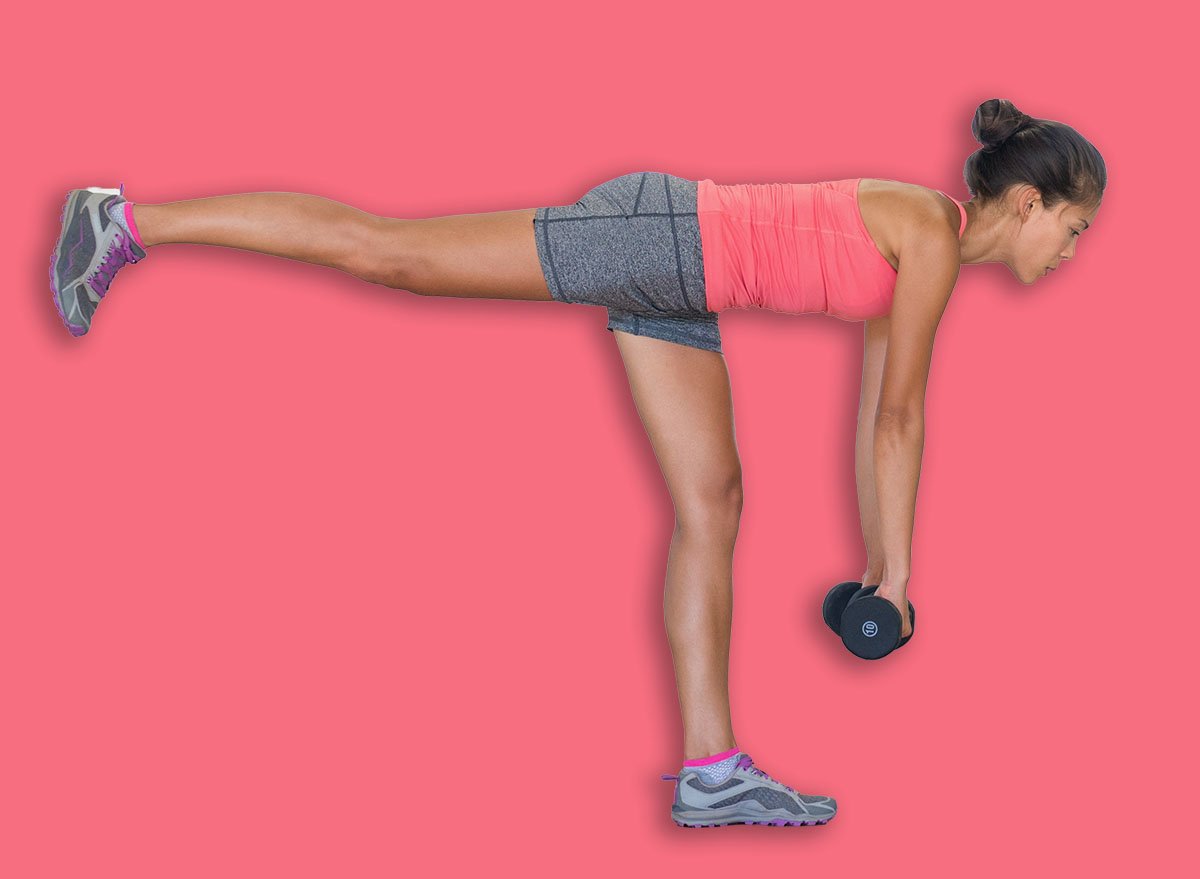
Single-Leg RDL
Single-leg RDLs train your glutes and hamstrings while your core works to keep your hips square and your body balanced. As you hinge forward on one leg, your midsection has to stay engaged to prevent rotation and keep everything aligned. This position challenges your balance in a way that closely matches real movement. It shows up when you bend, reach, or shift your weight and need to stay steady.
Muscles Trained: Glutes, hamstrings, core
How to Do It:
- Stand tall with your weight on one leg.
- Hinge at your hips and extend your opposite leg behind you.
- Lower your torso while keeping your back flat.
- Keep your hips square to the ground.
- Return to standing by driving your hips forward.
Recommended Sets and Reps: Perform 3 sets of 8 to 10 reps per leg. Rest for 45 seconds between each set.
Best Variations: Assisted balance, reduced range of motion, slower tempo
Form Tip: Keep your hips level and move through your hips.
What Builds Better Balance Day to Day
Shutterstock
Balance improves when your body gets regular chances to stabilize. These movements work because they challenge you on one leg and keep your hips and core engaged throughout the rep. Stay patient with them and keep your focus on how you move, not just getting through the set.
- Slow your reps down: Give yourself time to feel each position and stay in control, rather than rushing through.
- Own your stance leg: Keep your weight centered and steady, rather than shifting around to find balance.
- Use support when needed: A wall or rail can help you stay in control as you build strength and confidence.
- Mix in different surfaces or heights: Small changes, like a lower box or softer ground, can introduce a new challenge without altering the movement entirely.
- Stay active outside of workouts: Walking, changing direction, and moving throughout the day reinforce what you’re building here.
References
- Wang, Jixian et al. “Age-Related Dysfunction in Balance: A Comprehensive Review of Causes, Consequences, and Interventions.” Aging and disease vol. 16,2 714-737. 24 Jan. 2024, doi:10.14336/AD.2024.0124-1
- Johnson, Charlotte et al. “Aging and the Relationship between Balance Performance, Vestibular Function and Somatosensory Thresholds.” The journal of international advanced otology vol. 16,3 (2020): 328-337. doi:10.5152/iao.2020.8287
