

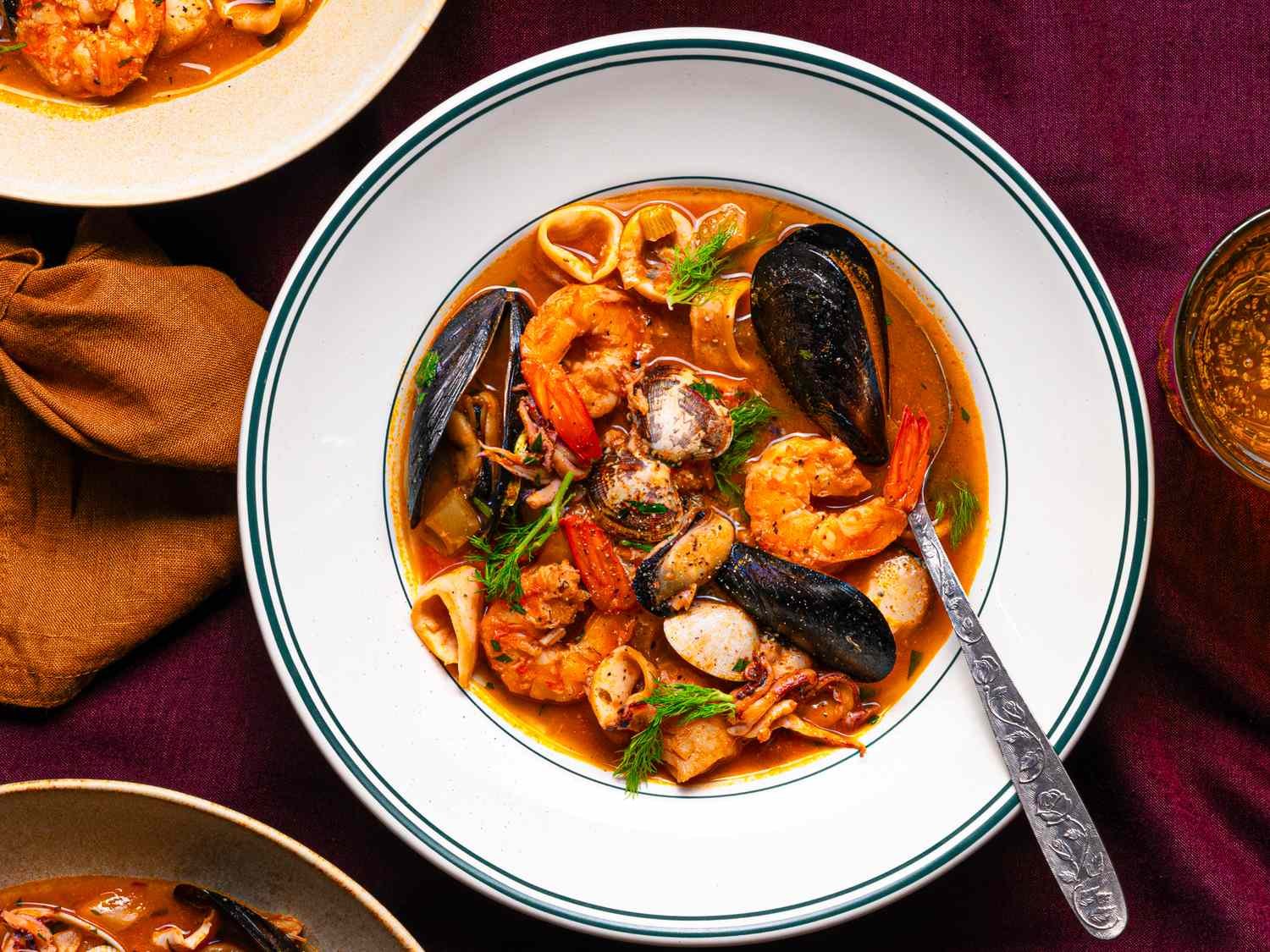
Why It Works
- A reduced tomato base—built from sautéed shrimp shells, fennel, aromatics, and passata—creates a concentrated, deeply flavored broth that pairs well with the seafood.
- Adding each type of seafood in stages ensures tender, perfectly cooked results.
Growing up Italian-American in Philly, I developed an almost Pavlovian response to certain Christmas Eve smells: garlic softening in olive oil, the faint licorice waft of fennel, the mineral sweetness of shellfish hitting a hot pot. These smells were the promise of the Feast of the Seven Fishes, the meat-free dinner that brought together too many relatives in too small a kitchen, and the day when zuppa di pesce (seafood stew) was sure to be served.
Serious Eats / Mateja Zvirotić Andrijanić
Zuppa di pesce belongs to a broad family of Italian coastal fish stews, but the version many of us in the US know—tomato-heavy, shellfish-forward, and served at holiday gatherings—developed primarily in Italian-American kitchens (on the West Coast, a related dish is cioppino). In Italy, zuppa di pesce never had one official recipe or even one name. Along the Tuscan coast, there’s cacciucco, a peppery brick-red stew built on small, hard-to-sell fish. Head south to Naples, and zuppa di pesce turns lighter, more focused on the garlic, white wine, and whatever the boats brought in. On the Adriatic, brodetto rules, a fisherman’s stew that varies from town to town. These weren’t fancy celebrations; they were practical ways to use the less desirable catch, transformed by long simmering and plenty of bread.
But when Italian immigrants—mostly from the south—arrived in the United States, the recipe changed. They kept the general framework of the dish—wine, aromatics, a mix of fish and shellfish—but adapted it to American seafood. Access to abundant cold-water shrimp, clams, mussels, and meaty North Atlantic cod allowed the dish to grow more varied. Zuppa di pesce grew tomatoier, richer, and more likely to be served over linguine than bread, a shift that matched the broader red-sauce cooking style many immigrant families developed in the US. By mid-century, it was a seafood extravaganza that practically wrote its own holiday invitations.
Serious Eats / Mateja Zvirotić Andrijanić
The version here is the one I grew up with—Philly-style Italian-American, tomato-forward, and absolutely stacked with seafood, a mix shaped by what’s available on the East Coast. What I’ve learned from making zuppa di pesce over the years is that it is not defined by any fixed mix of seafood. It’s about choosing what looks freshest and cooking each component so it stays plump and tender.
That principle is very much in line with how Italian dishes have evolved across geography. If your market has gorgeous haddock, or your fishmonger is pushing razor clams, or you luck into a deal on monkfish, you should feel completely free to adapt. The only rule is cooking each component at the right moment so nothing overcooks.
Serious Eats / Mateja Zvirotić Andrijanić
Building the Strong Flavor Base
The most important part of this recipe is the tomato base, which you can make ahead for easier day-of serving. Starting by sautéing the shrimp shells in oil is a small step that pays off: It infuses the oil with a subtle seafood flavor before you even add aromatics. The shells are strained out, leaving behind a foundation with more depth than olive oil alone can provide.
From there, onions and fennel add sweetness. Fennel is common in coastal Italian cooking, and here it brings an aromatic backbone that helps the broth taste fuller without adding heaviness. Garlic, oregano, and red pepper flakes add familiar Italian-American character, while white wine brings acidity. I also use a pinch of saffron—not essential in every Italian version, but useful here for adding complexity that complements the seafood rather than overwhelming it.
Tomato passata and clam juice form the body of the stew. Passata reduces smoothly and cleanly, and letting it cook down by about half concentrates the flavor, making the broth rich enough to stand up to the seafood.
Serious Eats / Mateja Zvirotić Andrijanić
Timing the Seafood
Once the broth is reduced, the seafood goes in based on how long each type needs. Squid benefits from a longer, gentle simmer to turn tender. Cod cooks more quickly but holds its shape well if nestled into the broth. Shrimp cook fast and go in last. The goal is for everything to be fully cooked, but not overcooked. Because the broth is already cooked, the seafood only needs enough time to firm up. Clams and mussels are steamed separately, which gives you the advantage of removing each as soon as it opens and transferring to the finished stew, so all are properly and evenly cooked.
Serious Eats / Mateja Zvirotić Andrijanić
Finishing and Serving
Once the shellfish are added, the stew just needs a brief simmer to come together. Fresh parsley brightens the broth, and a drizzle of olive oil rounds it out. You can serve this with crusty bread or over linguine—both are common in Italian-American households, and either works.
Serious Eats / Mateja Zvirotić Andrijanić
It’s a dish shaped equally by tradition and adaptation, which is exactly what makes it durable. Whether for Christmas Eve or a weeknight in midwinter, it delivers deep flavor, straightforward technique, and enough flexibility to make it your own.
