

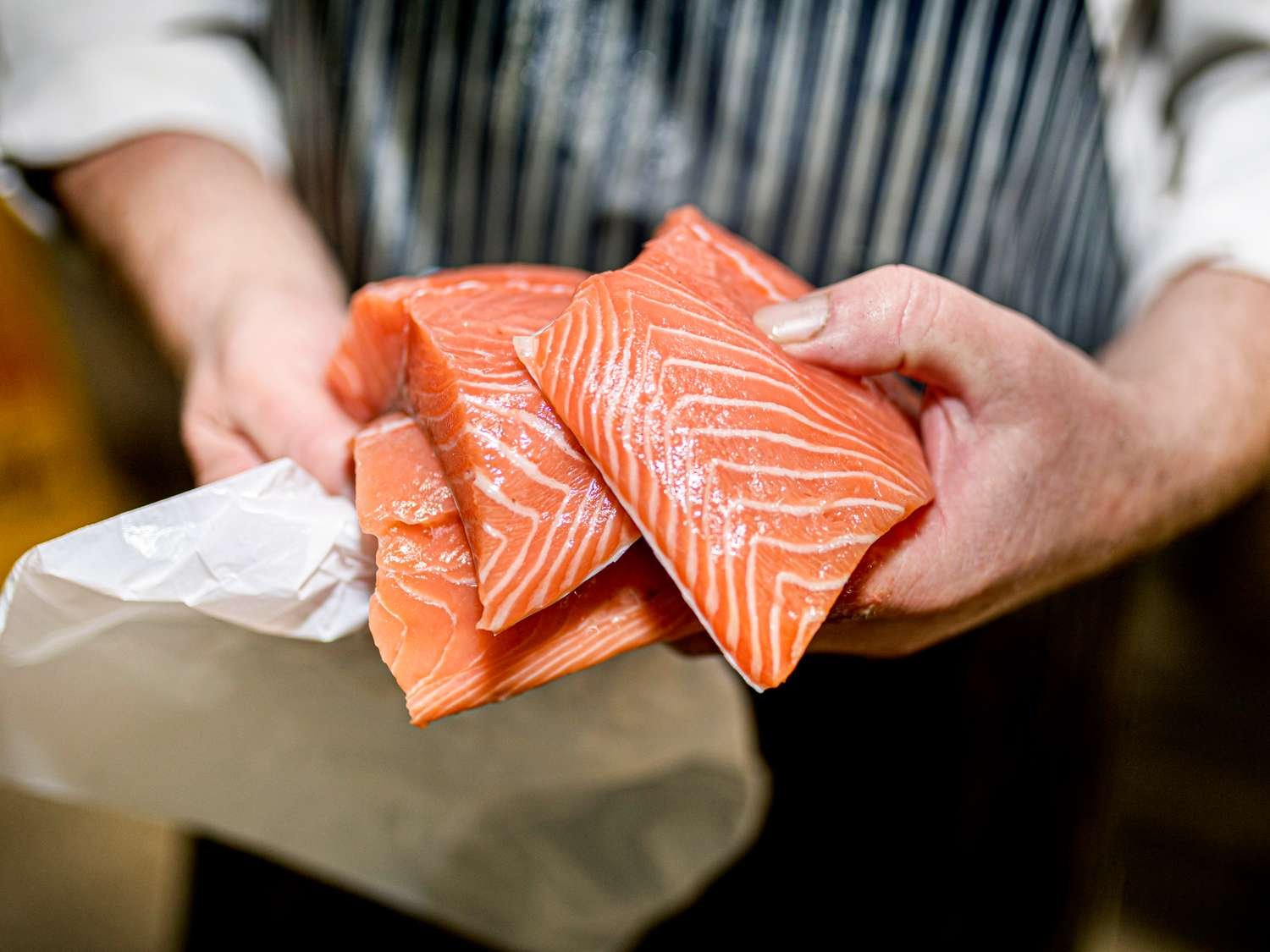
The salmon counter doesn’t have to be intimidating. Understanding the basics of sourcing, freshness, and sustainability makes it easy to pick the perfect fillet for tonight—or stock your freezer for next week.
Making salmon for dinner seems so simple, so straightforward. But a few hours later, you’re standing at the fish counter, your eyes glazing over, because you can’t decide between the pricey but gorgeous wild king salmon and the local farmed Atlantic salmon, which you’re pretty sure has the right sustainability certification. And what about the sockeye in the freezer case? All of a sudden, the roasted salmon you planned to make seems far from simple and not at all straightforward.
Serious Eats / Vy Tran
I won’t pretend that shopping for salmon is uncomplicated. There are often multiple choices and several factors to consider when making a purchase. However, once you understand your options and set a few parameters around price, convenience, sustainability, and what you plan to do with your fish, the salmon landscape becomes a whole lot more navigable. Let’s dive right in.
Step 1: Be Selective About Where You Shop
Before you decide which salmon to purchase, make sure you’re in the best place to buy high-quality seafood that’s been selected and handled with intention, all of which is possible at a dedicated fish market, a farmers market, a supermarket with a good fish counter, and even at big box stores. In The Blue Food Cookbook: Delicious Seafood Recipes for a Sustainable Future, chef Andrew Zimmern and sustainable seafood expert and educator Barton Seaver say that where you shop should be clean, well-lit, and inviting. There might be a pleasant sea breeze smell, but it definitely shouldn’t smell like day-old fish. The people working there should be wearing clean aprons and gloves. The seafood—and this extends to anything you find in the freezer case—should be arranged with care in an organized fashion.
Outside of those sensory clues, Zimmern and Seaver recommend talking to the people selling you fish. They are likely to know way more than you, and if they don’t, you might be in the wrong shop, says Zimmern. Take advantage of their expertise and ask questions. They should be able to steer you toward salmon that suits your values, timeline, budget, and recipe—they may even introduce you to an option you weren’t aware existed!
Step 2: Decide How Fancy (or Not) You Want to Go
One of the key considerations when shopping is what you plan to do with the salmon. Are you hosting a dinner party and hoping to impress? If so, splurge a bit and go for what you might call “special-occasion salmon,” which includes king (Chinook) and sockeye. Both are Pacific salmon and likely to be wild-caught. They’ll also deliver intense flavor and that buttery richness we associate with salmon.
For a simple supper, consider coho (silver) or pink salmon, two Pacific salmons that are likely wild-caught. Farmed Atlantic salmon also falls into this “everyday salmon” category. All tend to be leaner, milder, and less expensive than king and sockeye, but they still make for a lovely salmon experience and might be more appropriate for certain preparation methods. For instance, Zimmern and Seaver, recommend pink salmon for salmon cakes or salmon pasta, while cookbook author Diane Morgan—who’s written two books on salmon—thinks coho is perfect for risotto, chowder, and stir-fries, all methods that add big flavor to a more subtle fish.
Step 3: Fresh or Frozen?
Fresh salmon is fantastic, but it’s not always affordable, convenient, or even available (wild salmon is seasonal, so you won’t find it fresh year-round no matter where you live). “Frozen” used to be a “dirty word in the seafood community,” says Zimmern, but those days are over. He and Seaver are excited by the technology available to the commercial seafood industry and how it allows fish to be frozen closer to when and where it was caught, guaranteeing a better-quality product. Advances in freezing have also made seafood more affordable and accessible. The fresh, wild-caught sockeye you see at the counter might strain your budget, but the frozen king salmon that’s on sale could allow you to “indulge” in salmon once or twice a week. It’s also worth noting that much of the fish you’ll find at a seafood counter has been previously frozen—so it’s just a question of whether it was thawed at the shop or in your own fridge. Plus, if you have salmon in the freezer, you can quickly defrost it whenever you want!
Whether you opt for fresh or frozen salmon, there are a few key factors to keep in mind when shopping for each. In The Blue Food Cookbook, Zimmern and Seaver explain that fresh fish should be sitting on cold blocks like marble or on a tray above ice; they shouldn’t be in direct contact with ice or water.
Getty Images / Necati Aydin
Now look at the fish. “Glisten is the best way to describe the way any fish should look,” says Morgan. It should never look dry. The flesh should also be “uniform and consistent in color,” say Zimmern and Seaver. Browning along the edges can be a sign of age or oxidation, while green spotting can indicate poor handling during the gutting process. (Don’t worry about a marbled appearance, though—this is perfectly safe and natural.) Fresh fish should also be “taut and firm,” as flabby texture is a sign of age.
When shopping for frozen salmon, Morgan recommends ones that come vacuum-sealed, as Styrofoam trays and plastic wrapping won’t protect the fish in the same way. Zimmern and Seaver note that you won’t always be able to see the actual fish when it’s frozen, but when you can, make sure there’s no ice crystallization or uneven color, which can indicate freezer burn. When you aren’t able to see the fish, make sure the packaging isn’t dented or broken and make sure there’s no ice buildup on the freezer case—that could be a sign of temperature variation, which is not good for the fish.
There is also a third option—canned salmon. Most canned salmon is pink salmon, which Zimmern and Seaver describe as light in color, mild in flavor, and leaner than the rest. They’re partial to cans that include the skin and bones, as you get more nutrition and flavor.
Step 4: Wild or Farmed?
Farmed salmon has developed a reputation for being inferior to wild. But Zimmern and Seaver encourage you to consider the idea that both options have the potential to give you the salmon experience you’re looking for, while also satisfying your goals around price, flavor, and sustainability.
“We’re big fans of aquaculture when it’s done properly,” says Zimmern. “We’re big fans of wild when it comes from a sustainable, regenerative resource.” There are, unfortunately, bad actors in both spaces, but Zimmern and Seaver see that turning around. Because consumers are more educated and more vocal, it simply makes more financial sense to do things the right way.
Many consumers favor wild salmon because they find it more flavorful than farmed, and that is sometimes true. However, Seaver is quick to point out that “farmed salmon is a vastly diverse category,” adding that farmed salmon from Norway, Scotland, and the Faroe Islands tends to be heavy, rich, and oozing with fat. Of course, plenty of people prefer farmed salmon that is leaner and milder like those farmed in Maine or British Columbia.
Price and availability also come into play. Because farmed salmon comes from a controlled environment, it tends to be more economical and more widely available compared to wild salmon, which has to be caught. Wild salmon is also quite seasonal, with different types available at various times.
Step 5: Spotting Sustainable Salmon
NOAA, the National Oceanic and Atmospheric Administration, defines sustainable seafood as “wild-caught or farmed seafood that is harvested or produced in ways that protect the long-term health of species populations and ecosystems.” There are resources and certifications to help you determine the sustainability of the salmon you’re considering, but according to NOAA’s Rachel Hager, “If the seafood you purchase is caught or farmed in the United States, you can feel confident you’re making a sustainable seafood choice.”
NOAA’s website is a great resource for gaining an overall understanding of sustainable seafood, but it also features seafood profiles, so you can read up on specific types of salmon—both wild and farmed—to help you make the best choice. The Monterey Bay Aquarium’s Seafood Watch Program is another valuable resource for sustainability information on wild and farmed salmon; uses an easy color-coded system to make choosing fish easier. If you’re shopping for farmed salmon, you may see certifications from the Aquaculture Stewardship Council or the Global Seafood Alliance, which has a Best Aquaculture Practices certification. When shopping for wild salmon, look for the MSC Blue Fish label from the Marine Stewardship Council.
Educating yourself and understanding certifications are part of being a savvy consumer, but it always pays to speak to the person behind the counter, as they should be privy not only to the latest information but also details about the specific fish you’re considering.
Step 6: Know Your Cuts
Fillets may be the most obvious choice—and being easy and quick to cook, they are a weeknight workhorse—but they’re not your only option.
Salmon steaks are meaty, horseshoe-shaped pieces, cut across the fish, explains Morgan. They are often poached, but Morgan prefers to broil or pan-sear them. It’s best to secure the smaller end bits with toothpicks or kitchen string to ensure even cooking.
Serious Eats / Vy Tran
Salmon sides are the two whole sides of a fish and ideal when serving a crowd. Morgan recommends baking or roasting a side in the oven. If you don’t mind investing in a fish basket, she says a side of salmon is great on the grill.
Serious Eats / Amanda Suarez
Salmon fillets are versatile and can be baked or pan-seared, but Morgan’s favorite method is to grill them on a cedar plank or plancha. She seeks out center-cut pieces or ones cut closer to the collar rather than the tail, which tend to be thinner.
Getty Images / intek1
Canned salmon is typically mild, lean pink salmon. It’s economical, and Zimmern and Seaver love to use it in pasta and salmon cakes. It’s also perfect for quick salads.
As with all salmon-related questions, if in doubt, take your eyes off what is hopefully a beautiful, glistening piece of salmon, look up, and ask the expert at the counter for advice!
