

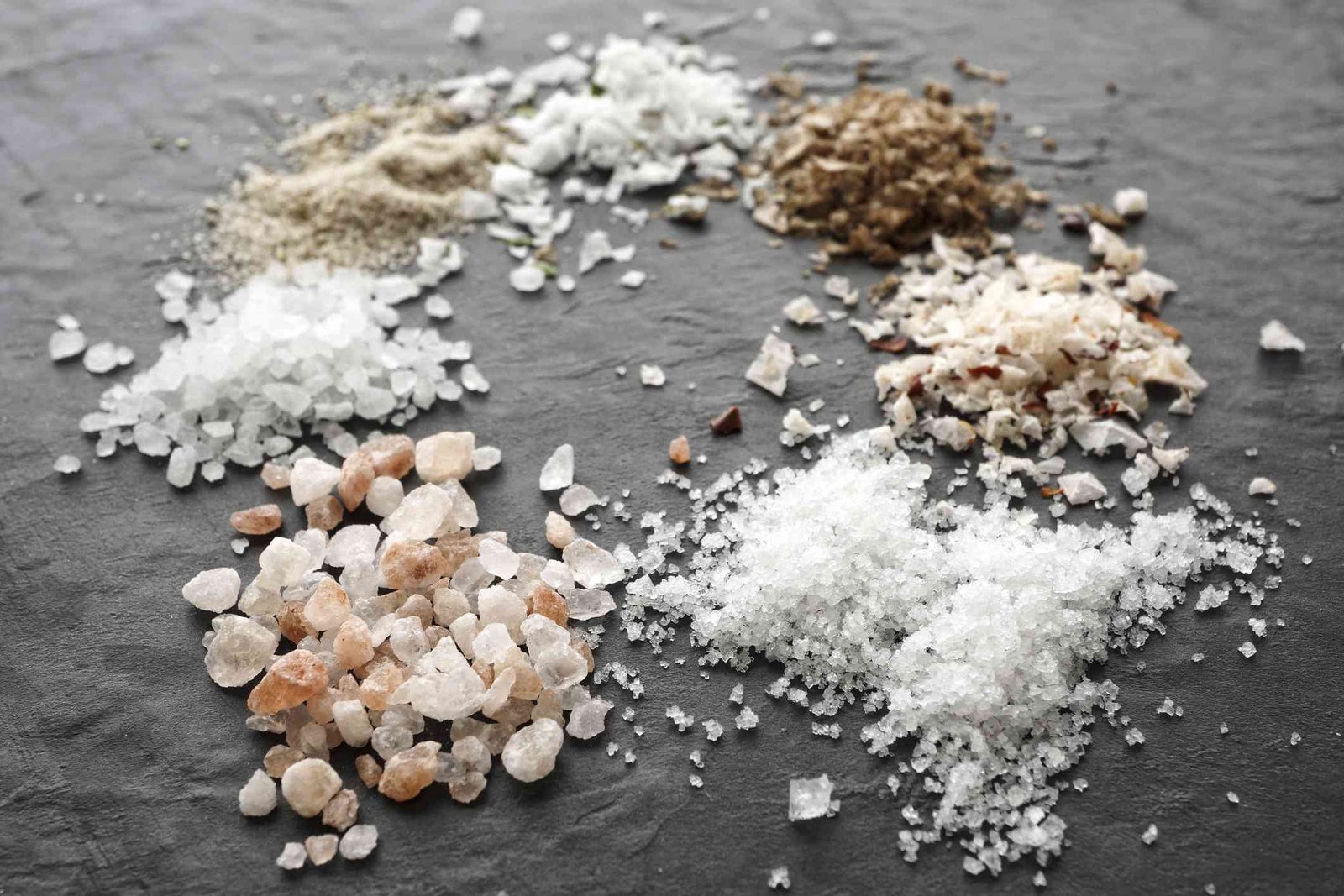
Black salt, also known as kala namak or black Himalayan salt, is a type of rock salt used in Indian cooking. It has become a popular alternative to regular table salt because it contains more trace minerals and is less processed. It’s also lower in sodium than regular salt, though it still contains sodium, which can raise blood pressure in some people.
Black salt is slightly lower in sodium than regular salt. However, this difference is mainly because black salt crystals are larger, meaning fewer granules fit into a spoon. When comparing sodium content per 100 grams, there isn’t much difference between black salt and regular table salt.
Per 100 grams, the sodium content is:
- Unrefined black salt (Himalayan): 38,200 milligrams
- Regular salt: 38,300 milligrams
Per teaspoon, the sodium content is:
- Unrefined black salt (Himalayan): 420 milligrams
- Regular salt: 2,330 milligrams
Unrefined black salt is often considered healthier than refined table salt because it is usually less processed, retaining small amounts of trace minerals like iron, magnesium, and calcium. However, there is no evidence to suggest one salt is healthier than the other. Whether you choose black salt or regular salt may ultimately come down to your taste preferences.
Benefits & Drawbacks
Here are some potential benefits and drawbacks of each type of salt:
Black salt:
- It has slightly less sodium than traditional salt.
- It contains small amounts of trace minerals like iron, magnesium, and calcium. However, the trace minerals are unlikely to provide meaningful health benefits when consumed in typical amounts.
- It contains some antioxidants, which help counteract oxidative stress, an imbalance of substances in your body that can damage cells.
- Is is typically less processed. However, some types of black salt are heavily processed, which can further reduce its natural mineral content.
- It may help with heartburn, gas, and bloating. These benefits may come from iron and other nutrients in the salt, but more research is needed.
Regular table salt:
- It is refined and highly processed, removing many trace minerals.
- It is often fortified with iodine, a trace element necessary for thyroid health. This can be especially helpful to people at risk for iodine deficiency. (Iodine isn’t commonly found in black salt.)
- It contains anticaking agents used to prevent the formation of clumps. Anticaking agents are considered safe when used in food production.
Although black salt has slightly less sodium than table salt, it’s still a concentrated source, making it important to consume in moderation. The American Heart Association (AHA) recommends no more than 2,300 milligrams of sodium per day, or about 1 teaspoon of table salt.
Black salt may also contain higher levels of fluoride, which can contribute to dental fluorosis, a change in how teeth look in children.
If you choose black salt instead of regular table salt, be sure to eat a variety of iodine-rich foods like fish, milk products, seaweed, and eggs to help prevent deficiency since black salt doesn’t contain added iodine.
Research also shows that black salt contains more microplastics than marine salt, such as sea salt. Microplastics are tiny particles of plastic that can make their way into our food. They can harm the environment and your health, though more research is needed to fully understand their effect on humans.
There are many different types of black salt, though Black Himalayan salt is the most common. Black Himalayan salt is a coarse salt that comes from the mines of the Himalayas. It’s found in many Ayurvedic medicines used to support digestive health, though there’s little research to support these benefits.
Black salt was traditionally made by combining pink Himalayan salt with herbs and spices and heating it to very high temperatures. Today, black salt is commonly made by combining sodium chloride with trace amounts of sodium sulfate, sodium bisulfate, and ferric sulfate with charcoal.
Characteristics of Black Salt vs. Regular Salt
Unrefined black salt (Himalayan)
Regular salt
Taste
Savory with a sulfurous or “eggy” smell
Salty with a hint of a sour, sweet, and bitter taste
Trace minerals/additives
Retains iron, magnesium, and calcium
Processed to remove minerals. Contains anti-caking agents, as well as iodine if fortified
Color
Pinkish gray/brown
White
Texture
Grainy, coarse
Fine, smooth
There are three main types of black salt: Black Himalayan salt, black lava salt, and black ritual salt.
- Black Himalayan salt: This is the most common type of black salt, known for its pungent and savory flavor. Black Himalayan salt adds flavor to Indian and South Asian dishes. It’s also used in vegan dishes to provide a slight sulfur flavor that mimics eggs.
- Black lava salt: Black lava salt, also known as Hawaiian black salt, is made by mixing sea salt with activated charcoal to provide a slight smoky flavor. It’s much darker in color than black Himalayan salt.
- Black ritual salt: This type of salt, known as witches salt, is a mixture of charcoal, ashes, and sea salt/kosher salt. Black ritual salt is not safe to eat and is mostly used in witchcraft and spiritual practices to protect against negative energy. This practice is likely harmless, but no research suggests any benefits of black ritual salt.
Health.com uses only high-quality sources, including peer-reviewed studies, to support the facts within our articles. Read our editorial process to learn more about how we fact-check and keep our content accurate, reliable, and trustworthy.
Chander V, Tewari D, Negi V, Singh R, Upadhyaya K, Aleya L. Structural characterization of Himalayan black rock salt by SEM, XRD and in-vitro antioxidant activity. Sci Total Environ. 2020;748:141269. doi:10.1016/j.scitotenv.2020.141269
Kuttykattil, A., Raju, S., Vanka, K.S, et al. Consuming microplastics? Investigation of commercial salts as a source of microplastics (MPs) in diet. Environ Sci Pollut Res 30, 930–942 (2023). doi:10.1007/s11356-022-22101-0
American Heart Association. Shaking the salt habit to lower high blood pressure.
U.S. Department of Agriculture: FoodData Central. Himalayan black salt.
U.S. Department of Agriculture: FoodData Central. Salt, table.
National Institutes of Health Office of Dietary Supplements. Iodine: Fact sheet for health professionals.
U.S. Food and Drug Administration. Food ingredients.
Na M, Chen Y, Han Y, Ma S, Liu J, Chen X. Determination of potassium ferrocyanide in table salt and salted food using a water-soluble fluorescent silicon quantum dots. Food Chem. 2019;288:248-255. doi:10.1016/j.foodchem.2019.02.111
American Heart Association. How much sodium should I eat per day?.
Rustagi N, Rathore AS, Meena JK, Chugh A, Pal R. Neglected health literacy undermining fluorosis control efforts: A pilot study among schoolchildren in an endemic village of rural Rajasthan, India. J Family Med Prim Care. 2017;6(3):533-537. doi:10.4103/2249-4863.222017
Singh K, Tyagi SK, Chaudhary M, Baliyan D. Traditional and rural manufacturing process of black salt. The Pharma Innovation Journal. 2023;12(6):1977-1980.
Moses SK. Cemetery hoodoo: Culture, ritual crime and forensic archaeology. Forensic Sci Int Synerg. 2019;2:17-23. doi:10.1016/j.fsisyn.2019.10.003
