

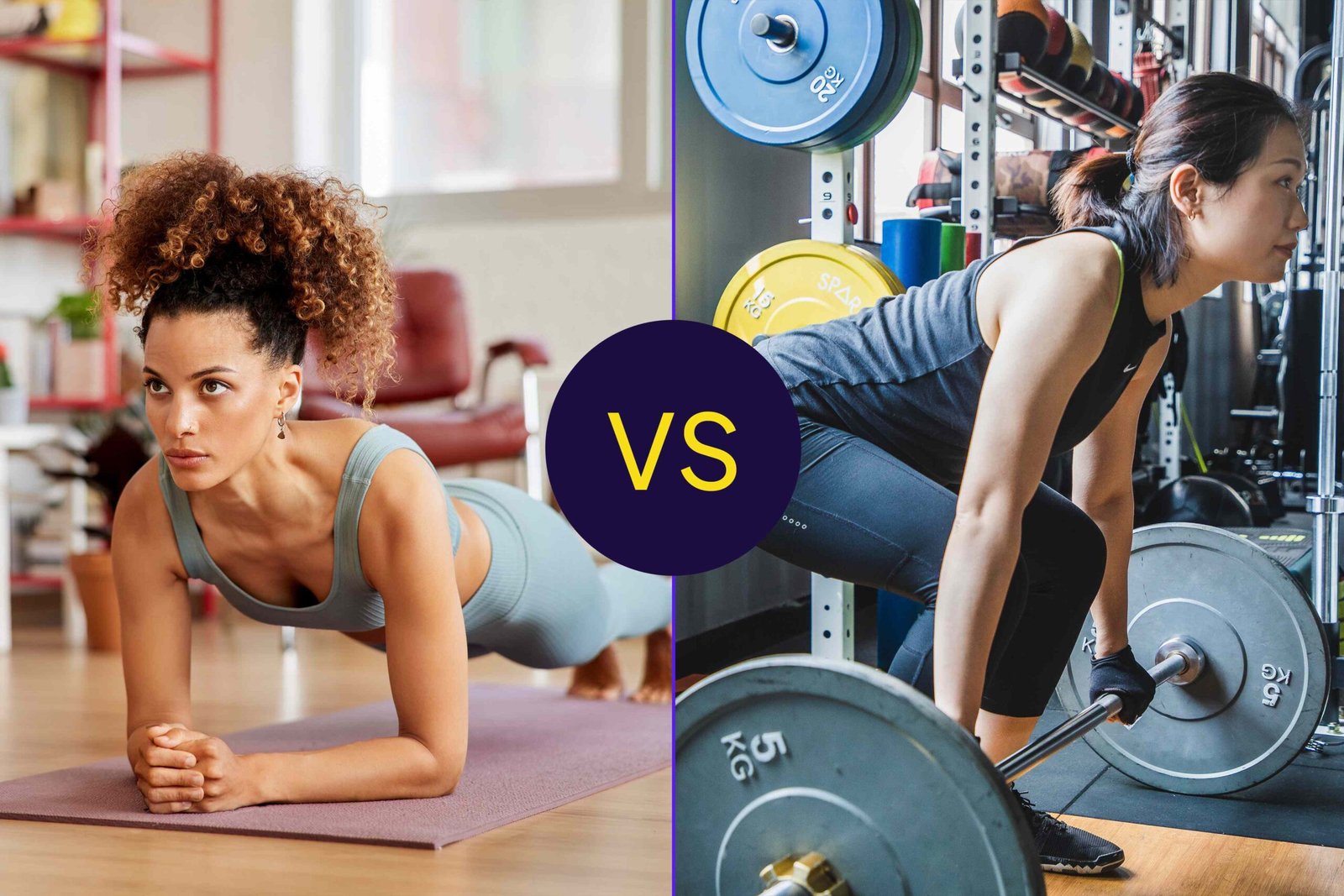
Bodyweight exercises and weightlifting can both help you get stronger, but they work in different ways. The best choice depends on your goals, experience level, and access to equipment. Generally, weightlifting is better for long-term gains.
When it comes to muscle growth, weightlifting generally has an advantage. Lifting weights makes it easier to steadily increase resistance, which is one of the main drivers of muscle and strength gains. Besides slowly increasing the amount of weight you lift as you get stronger, you can also adjust the number of sets or repetitions to continue making progress.
Bodyweight exercises can still promote muscle growth, especially for beginners or people returning to exercise. However, as strength improves, it can become harder to keep increasing the challenge without adding more repetitions, holding positions longer, or learning advanced movements. Over time, progress may slow because there is a limit to how much resistance body weight alone can provide.
Bottom line: While both methods are effective, weightlifting often allows for faster and more noticeable strength gains because it offers more ways to increase difficulty.
Even though weightlifting can increase muscle size and strength more efficiently, that doesn’t mean bodyweight exercises fall short. Bodyweight movements often work several muscle groups at the same time, helping the body learn to move as a unit rather than in isolated parts.
Many bodyweight exercises require balance, coordination, and control. Because you are supporting your own body, muscles must work together to keep you stable. This improves body awareness, posture, and control, which are important for daily movement.
These skills carry over into everyday activities like carrying groceries, getting up from a chair, climbing stairs, or walking on uneven ground. Training balance and coordination can also help reduce the risk of falls and injuries, especially as people age.
Weightlifting can also support everyday strength, particularly when using free weights like dumbbells or barbells. Free-weight exercises challenge balance and stability more than machines when they are performed with proper form.
One of the biggest advantages of bodyweight exercises is convenience. They can be done at home, outdoors, or while traveling, with little to no equipment needed.
Weightlifting usually requires access to a gym or home equipment, which can take more time and cost more money. For people with limited space or busy schedules, bodyweight workouts may be easier to stick with.
For beginners, bodyweight exercises are often easier to modify, which makes them a safe place to start. Movements can be adjusted to match different strength and fitness levels, helping people build confidence as they learn proper form. Because bodyweight exercises do not use external weights, there is generally less risk of lifting too much too soon.
That said, weightlifting can also be very safe when done correctly. Most injuries happen when people lift weights that are too heavy or use poor technique. Starting with lighter weights, focusing on proper form, and increasing resistance gradually can greatly reduce injury risk. When done with good instruction and appropriate loading, weightlifting is a safe and effective way to build strength.
If you’re deciding between bodyweight exercises and weightlifting, start by thinking about your goals and lifestyle. If building muscle and strength as efficiently as possible is your priority, incorporating weightlifting may be helpful. If convenience, balance, or low impact matter more, bodyweight exercises can be a great place to begin.
Beginners may benefit from starting with bodyweight movements to learn proper form and build confidence before adding weights. As strength improves, combining both types of exercise can provide well-rounded results. Using bodyweight exercises for balance and coordination alongside weightlifting for strength can support long-term fitness and reduce injury risk.
No matter which approach you choose, consistency matters most. Start at a level that feels manageable, focus on good form, and increase difficulty gradually to build strength safely over time.
