

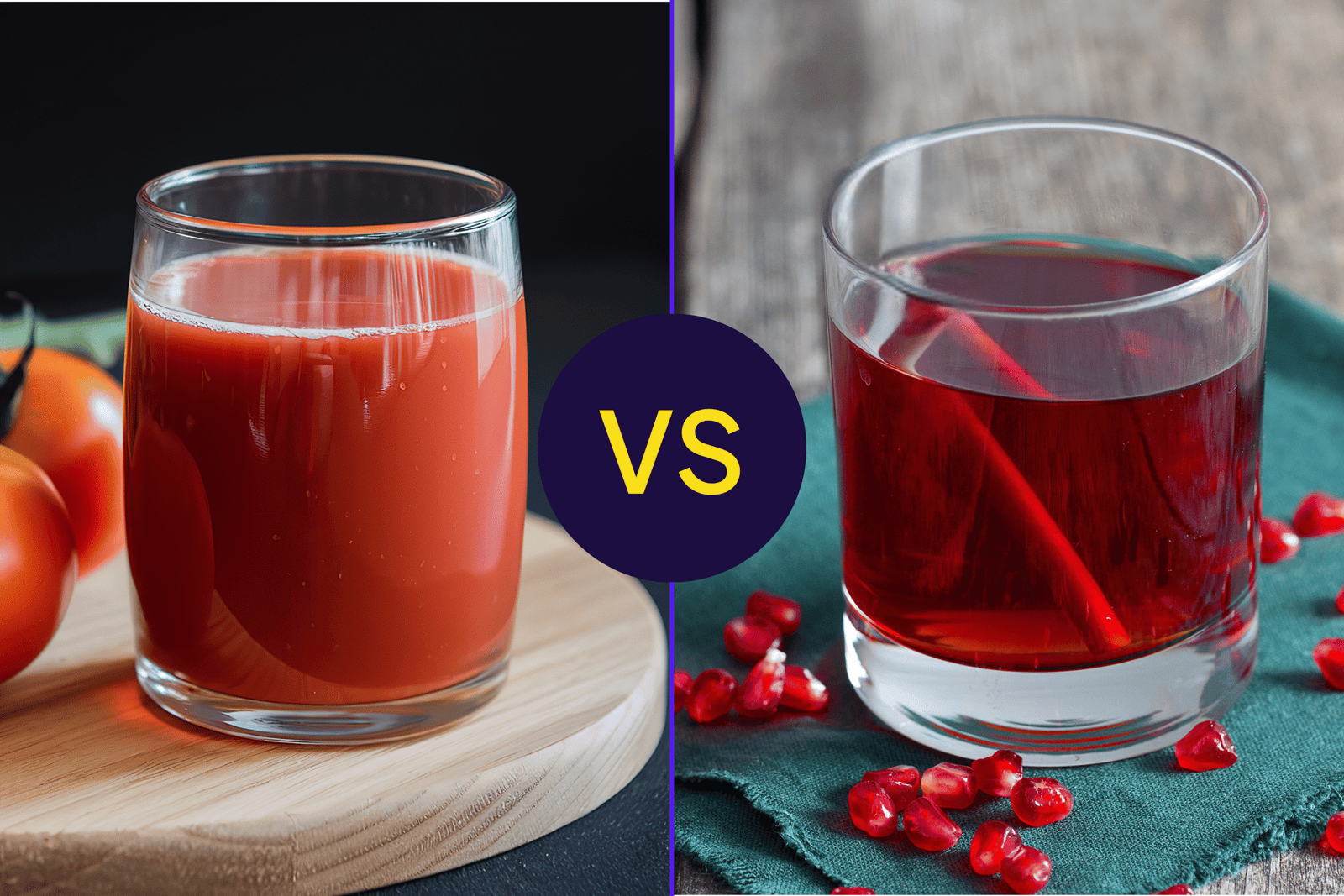
Pomegranate juice and tomato juice are both often praised for their potential to lower blood pressure, which may help reduce the risk of serious conditions like heart disease and stroke. But which one works better? While no studies directly compare the two, the evidence in favor of pomegranate juice appears somewhat stronger. However, any potential benefits may be short-lived.
When it comes to reducing blood pressure, more high-quality research points to pomegranate juice’s potential. Studies suggest that drinking 5 to 10 ounces daily may lower systolic blood pressure (the top number) by about five to seven points—though this effect was observed for only about two months.
A few factors could explain why the juice could help reduce blood pressure—even temporarily. One is that pomegranates contain natural nitrates, which convert to nitric oxide in the body and help to relax and dilate blood vessels, potentially lowering blood pressure, said Rachel Gargano, RD, CSSD, CBS, the chief registered dietitian at Live It Up. Pomegranate juice also provides antioxidants that inhibit angiotensin-converting enzymes, a key factor in blood pressure control. And pomegranate juice is a good source of potassium (533 mg per cup), which can help lower pressure—though excessive intake can be harmful for people with kidney problems.
Tomato juice, meanwhile, has far less robust research behind it, preventive cardiologist Kaustubh Dabhadkar, MD, MPH, FACC, told Health. But some evidence does suggest that tomato extract containing the compound lycopene may offer blood pressure benefits, especially at higher doses. “Lycopene, a prominent antioxidant, works by helping protect the cells that line our blood vessels,” Gargano explained.
Plus, tomato juice is also rich in blood pressure lowering potassium, providing a little less than pomegranate juice, at 527 milligrams (mg) per cup.
Both pomegranate and tomato juice offer benefits beyond possibly lowering blood pressure. Research suggests that pomegranate juice may help reduce “bad” LDL cholesterol while raising “good” HDL cholesterol. It’s possible that tomato juice, thanks to its lycopene content, may help reduce platelet clumping, an effect that can slightly lower the risk of heart attack and stroke, Dabhadkar said.
While both juices are nutritious, tomato juice has the edge. A 100-mg serving of tomato juice contains more of the following nutrients than pomegranate juice:
Tomato Juice
Pomegranate Juice
Protein
0.86 grams (g)
0.15 g
Fiber
0.4 g
0.1 g
Iron
0.3 mg
0.1 mg
Vitamin A
23 micrograms (mcg)
0 mcg
Vitamin C
49.8 mg
0.1 mg
Beta carotene
270 mcg
0 mcg
To lower blood pressure, experts recommend following a healthy dietary pattern rich in vegetables, fruits, and whole grains rather than relying on fruit juices alone. But if you’re thinking of incorporating pomegranate or tomato juice into your diet for blood pressure support, Dabhadkar noted a few precautions.
Pomegranate juice can interact with certain medicines, including blood pressure medications, Dabhadkar explained. “It’s important to discuss this with your physician,” he said.
Pomegranate juice is also higher in calories than tomato juice and contains significantly more natural sugars (34 grams versus 6 grams per cup), so people who are pre-diabetic, diabetic, or watching their weight may want to take a more cautious approach. “It’s often better to eat your calories rather than to drink them,” Dabhadkar said. “The fibers in fruits and vegetables slow sugar absorption, helping the body deal better with the sugar load.”
When choosing tomato juice, both Dabhadkar and Gargano recommend opting for low-sodium versions. Many store-bought varieties are high in salt, with some containing up to a third of the recommended sodium intake of 2,300 mg/d for most adults. Consuming these high sodium options could inadvertently raise blood pressure over time, undermining any potential benefits of drinking tomato juice.
Health.com uses only high-quality sources, including peer-reviewed studies, to support the facts within our articles. Read our editorial process to learn more about how we fact-check and keep our content accurate, reliable, and trustworthy.
American Heart Association. Understanding blood pressure readings.
Ghaemi F, Emadzadeh M, Atkin SL, Jamialahmadi T, Zengin G, Sahebkar A. Impact of pomegranate juice on blood pressure: A systematic review and meta-analysis. Phytother Res. 2023;37(10):4429-4441. doi:10.1002/ptr.7952
Bahari H, Omidian K, Goudarzi K, Rafiei H, Asbaghi O, Hosseini Kolbadi KS, Naderian M, Hosseini A. The effects of pomegranate consumption on blood pressure in adults: A systematic review and meta-analysis. Phytother Res. 2024;38(5):2234-2248. doi:10.1002/ptr.8170
Ali MY, Jannat S, Chang MS. Discovery of potent angiotensin-converting enzyme inhibitors in pomegranate as a treatment for hypertension. J Agric Food Chem. 2023;71(30):11476-11490. doi:10.1021/acs.jafc.3c02115
Office of Dietary Supplements, National Institutes of Health. Food Sources of Potassium: Appendix 10. 2015-2020 Dietary Guidelines for Americans. https://ods.od.nih.gov/pubs/app10dgapotassiumlist.pdf.
American Heart Association. How potassium can help prevent or treat high blood pressure.
Wolak T, Sharoni Y, Levy J, Linnewiel-Hermoni K, Stepensky D, Paran E. Effect of tomato nutrient complex on blood pressure: A double blind, randomized dose⁻response study. Nutrients. 2019;11(5):950. doi:10.3390/nu11050950
Roelofs EJ, Smith-Ryan AE, Trexler ET, Hirsch KR, Mock MG. Effects of pomegranate extract on blood flow and vessel diameter after high-intensity exercise in young, healthy adults. Eur J Sport Sci. 2017;17(3):317-325. doi:10.1080/17461391.2016.1230892
USDA Food Central. Pomegranate juice, 100%.
USDA Food Central. Tomato juice, 100%.
University Hospitals. Nutrition facts.
American Heart Association. Shaking the salt habit to lower high blood pressure.
