

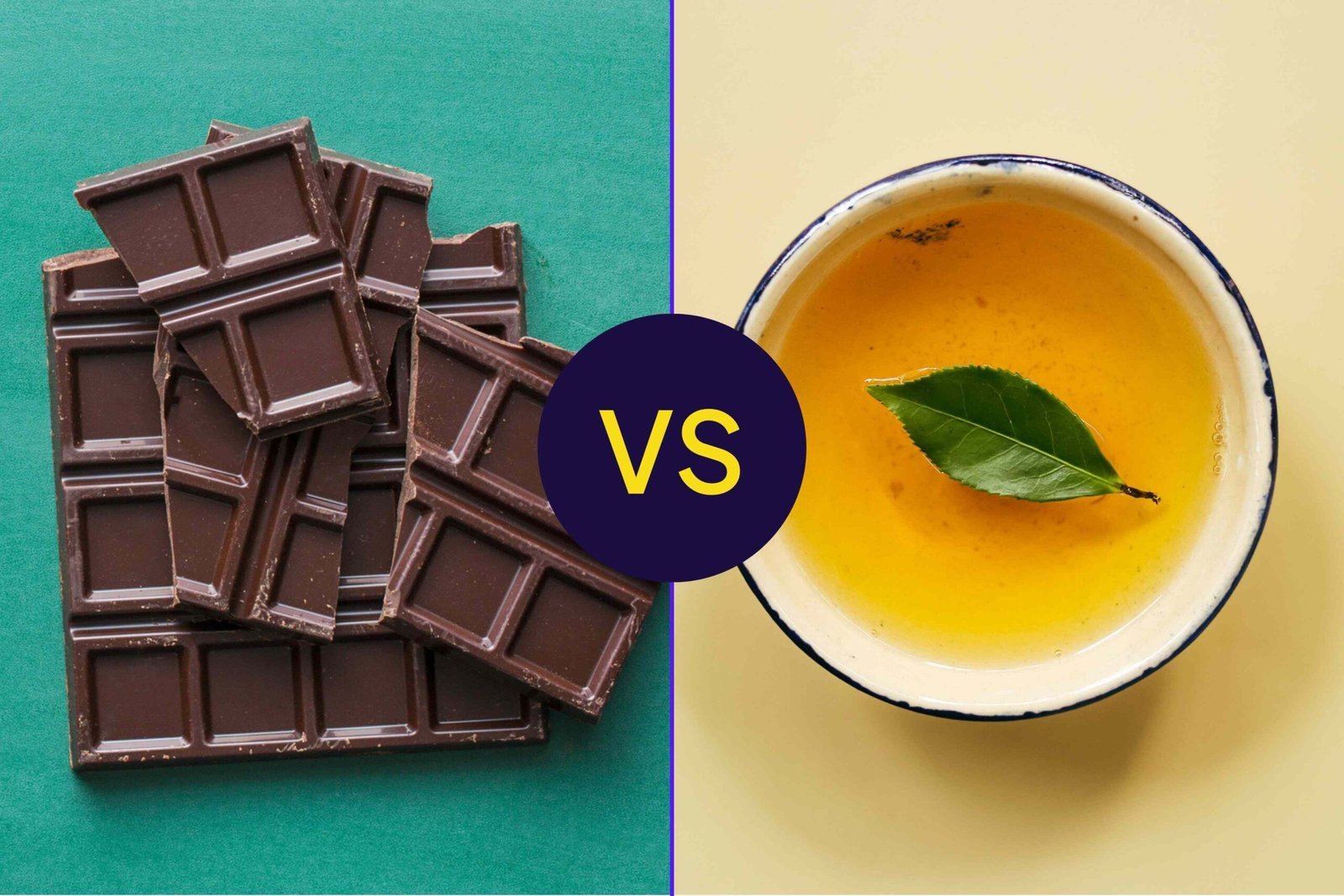
Antioxidants help protect the body from cell damage, inflammation, and disease. Both dark chocolate and green tea contain polyphenols with antioxidant benefits, but one stands out.
Dark chocolate has more polyphenols and higher antioxidant capacity than green tea. Dark chocolate with higher cocoa usually has more antioxidants.
Green tea and dark chocolate have different polyphenol levels depending on where they grow and how they are made:
- Natural (non-alkalized) cacao generally has higher polyphenol levels than alkalized cacao.
- Brewing methods, such as temperature and time, also affect green tea polyphenols. A study showed that brewing green tea for 5–10 minutes at 176–212°F (80–100°C) results in higher antioxidant capacity than brewing for a shorter time or at lower temperatures.
Green tea has caffeine and L-theanine (an amino acid), both of which improve alertness. L-theanine can also promote calmness and reduce stress. Some studies showed that regularly drinking green tea may improve cognitive tasks such as attention, memory, learning, problem-solving, and decision-making.
Some studies suggest cacao or chocolate may also improve alertness and cognitive performance. Plus, eating chocolate has been shown to improve mood in the short term.
Here is a nutritional comparison of dark chocolate and green tea:
Nutrient
Dark Chocolate (per 1 ounce/ 28 grams)
Green Tea (per 245 grams/ 1 cup)
Energy
170 kcal
2.4 kcal
Protein
2.2 grams (g)
0.5 g
Total Fat
12.1 g
0 g
Carbohydrate
13 g
0 g
Fiber
3 g
0 g
Sugars
6.8 g
0 g
Iron
3.3 milligrams (mg)
0.1 mg
Magnesium
64.6 mg
2.5 mg
Potassium
203 mg
19.6 mg
Caffeine
22.7 mg
29.4 mg
Green tea is a low-calorie drink with few nutrients. Dark chocolate can be high in calories, carbohydrates, and added sugars. It is also a good source of iron and magnesium. Both green tea and dark chocolate provide small amounts of caffeine.
Green tea catechins may block enzymes that break down carbohydrates, proteins, and fats. This can reduce the absorption of these nutrients and their calories.
A decrease in fat absorption and calories may support blood cholesterol levels. Research shows that drinking green tea may help lower blood low-density lipoprotein (LDL), triglycerides, and total cholesterol.
Polyphenols in cacao or dark chocolate may improve blood flow. Studies suggest that drinking cocoa or eating dark chocolate may help support blood pressure.
However, most chocolate also contains high amounts of added sugars and saturated fats. Eating a diet high in sugar and saturated fat can negatively affect heart health, so it’s important to eat these foods in moderation.
Eating a diet rich in antioxidants is linked to a lower risk of type 2 diabetes. Antioxidants may protect the pancreatic cells that make insulin.
However, a study looked at the effects of drinking green tea or cocoa in people with diabetes. Both had no effect on fasting blood sugar or insulin resistance.
Polyphenol-rich foods can affect gut bacteria and health.
The body can’t absorb most polyphenols well. Sometimes, their benefits come from their effect on gut bacteria. Beneficial bacteria use these molecules as food and increase in number.
Bacteria can also break polyphenols down into molecules that the body can absorb.
Enjoying both green tea and dark chocolate in moderation can be part of a nutritious and balanced diet.
Always read the nutrition facts labels when buying chocolate. Some have higher sugar and saturated fat than others. Opt for ones with lower added sugar, lower saturated fat, and higher cocoa percentages.
Using cocoa solids in sweet baked goods or homemade hot cocoa is also a great way to add more polyphenols to your diet.
Green tea is also a great companion to snacks. Keep green tea leaves in an airtight container in a cool, dark, and dry place for the best freshness. Brew at 176–212°F (80–100°C) for 5–10 minutes to maximize polyphenols.
Health.com uses only high-quality sources, including peer-reviewed studies, to support the facts within our articles. Read our editorial process to learn more about how we fact-check and keep our content accurate, reliable, and trustworthy.
Lee KW, Kim YJ, Lee HJ, Lee CY. Cocoa has more phenolic phytochemicals and a higher antioxidant capacity than teas and red wine. J Agric Food Chem. 2003;51(25):7292-7295. doi:10.1021/jf0344385
Jaćimović S, Popović-Djordjević J, Sarić B, Krstić A, Mickovski-Stefanović V, Pantelić NĐ. Antioxidant activity and multi-elemental analysis of dark chocolate. Foods. 2022;11(10):1445. doi:10.3390/foods11101445
Razola-Díaz MDC, Aznar-Ramos MJ, Verardo V, Melgar-Locatelli S, Castilla-Ortega E, Rodríguez-Pérez C. Exploring the nutritional composition and bioactive compounds in different cocoa powders. Antioxidants. 2023;12(3):716. doi:10.3390/antiox12030716
Sharpe E, Hua F, Schuckers S, Andreescu S, Bradley R. Effects of brewing conditions on the antioxidant capacity of twenty-four commercial green tea varieties. Food Chem. 2016;192:380-387. doi:10.1016/j.foodchem.2015.07.005
Yang M, Zhang X, Yang CS. Bioavailability of tea polyphenols: a key factor in understanding their mechanisms of action in vivo and health effects. J Agric Food Chem. 2025;73(7):3816-3825. doi:10.1021/acs.jafc.4c09205
Kurosaka C, Miyake S, Kobayashi M, Tagata C, Tatsumi Y. Green tea consumption rapidly enhances cognitive performance and flow state during mental tasks in healthy young adults. Sá Filho AS, ed. PLoS One. 2025;20(7):e0328394. doi:10.1371/journal.pone.0328394
Baba Y, Inagaki S, Nakagawa S, Kaneko T, Kobayashi M, Takihara T. Effect of daily intake of green tea catechins on cognitive function in middle-aged and older subjects: a randomized, placebo-controlled study. Molecules. 2020;25(18):4265. doi:10.3390/molecules25184265
Sasaki A, Mizuno K, Morito Y, et al. The effects of dark chocolate on cognitive performance during cognitively demanding tasks: A randomized, single-blinded, crossover, dose-comparison study. Heliyon. 2024;10(2):e24430. doi:10.1016/j.heliyon.2024.e24430
Abdoli E, Rezaie E, Mirghafourvand M, Payahoo L, Naseri E, Ghanbari-Homaie S. A clinical trial of the effects of cocoa rich chocolate on depression and sleep quality in menopausal women. Sci Rep. 2024;14(1):23971. doi:10.1038/s41598-024-74804-8
Shin JH, Kim CS, Cha J, et al. Consumption of 85% cocoa dark chocolate improves mood in association with gut microbial changes in healthy adults: a randomized controlled trial. J Nutr Biochem. 2022;99:108854. doi:10.1016/j.jnutbio.2021.108854
U.S. Department of Agriculture: FoodData Central. Beverages, tea, green, brewed, regular.
U.S. Department of Agriculture: FoodData Central. Chocolate, dark, 70-85% cacao solids.
Xu R, Yang K, Li S, Dai M, Chen G. Effect of green tea consumption on blood lipids: a systematic review and meta-analysis of randomized controlled trials. Nutr J. 2020;19(1):48. doi:10.1186/s12937-020-00557-5
Magrone T, Russo MA, Jirillo E. Cocoa and dark chocolate polyphenols: from biology to clinical applications. Front Immunol. 2017;8:677. doi:10.3389/fimmu.2017.00677
Amoah I, Lim JJ, Osei EO, et al. Effect of cocoa beverage and dark chocolate consumption on blood pressure in those with normal and elevated blood pressure: a systematic review and meta-analysis. Foods. 2022;11(13):1962. doi:10.3390/foods11131962
Garcia-Yu IA, Garcia-Ortiz L, Gomez-Marcos MA, et al. Effects of cocoa-rich chocolate on blood pressure, cardiovascular risk factors, and arterial stiffness in postmenopausal women: a randomized clinical trial. Nutrients. 2020;12(6):1758. doi:10.3390/nu12061758
Van Der Schaft N, Schoufour JD, Nano J, et al. Dietary antioxidant capacity and risk of type 2 diabetes mellitus, prediabetes and insulin resistance: the Rotterdam Study. Eur J Epidemiol. 2019;34(9):853-861. doi:10.1007/s10654-019-00548-9
Alkhudaydi HMS, Spencer JPE. A comparison of the effects of green tea and cocoa on glycaemic control and insulin sensitivity in patients with type 2 diabetes mellitus: a systematic review and meta-analysis. J Nutr Health Aging. 2024;9(1):17-36. doi:10.3233/NHA-230204
