

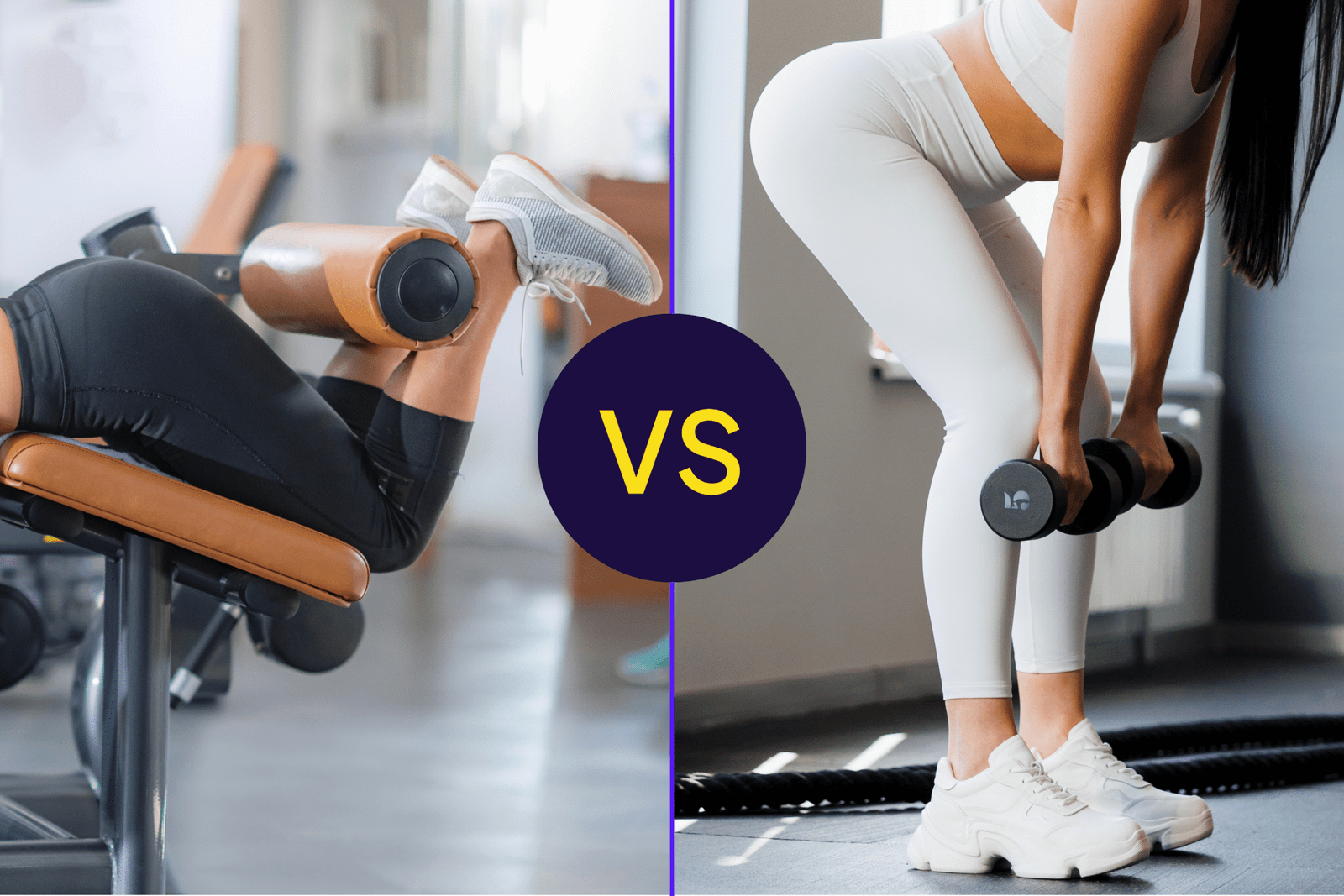
The three muscles in the back of the thigh known as the hamstrings are crucial for walking, climbing stairs, and squatting, as well as keeping the knees and hips mobile. Hamstrings are prone to stiffness, strain, and injury, but strengthening them can keep them healthy and functional.
Hamstring curls and Romanian deadlifts both target the hamstrings, but the best exercise for you depends on your experience level.
To be clear, neither exercise is inherently “better” than the other, said Cori Lefkowith, a strength coach and author of The Strong System. “The most effective approach is to include both,” she told Health.
But if you’re newer to strength training and prefer to limit the number of exercises in your routine, the hamstring curl—which involves bringing the heel toward the glutes—may be a better choice, said Nick Fey, MS, a metabolic specialist and personal trainer in Des Moines, Iowa. “As long as weight, range of motion, and rep volume are appropriate, the leg curl is a great exercise for beginners starting their strength-training journey,” he explained.
That said, more experienced lifters can also benefit from hamstring curls, Fey added. But those who are comfortable with barbells or lifting heavier weights might want to prioritize the Romanian deadlift, said Milica McDowell, MS, DPT, C-EP, a physical therapist, exercise physiologist, and vice president of operations at Gait Happens. “It’s an exercise that can be loaded much heavier than a hamstring curl for a more advanced exercise or for those trying to create more strength gains,” she told Health.
Because Romanian deadlifts require precise technique, McDowell recommended practicing the movement under the supervision of a trainer or coach until you get the form and movement just right.
Injury history is another important consideration. People with knee problems or those who’ve had knee surgery may experience pain during hamstring curls, while Romanian deadlifts can exacerbate back pain, Fey cautioned.
Ultimately, if you’re able to incorporate both moves in your routine, you’ll likely see the most benefits. “Using a variety of exercises that train both the hip hinge movement and knee flexion leads to stronger, more resilient hamstrings and better long-term strength and muscle gains,” Lefkowith said.
When doing both exercises, Fey suggested starting with four sets of eight to 10 reps. “Once a weight feels easy at that rep range, increase the weight by 5 to 10 pounds, and aim for eight repetitions,” he said.
Hamstring Curls
Hamstring curls can be done seated or lying on your stomach using a leg curl machine. Another option is to lie prone on a mat while gripping a light dumbbell between your ankles. With each variation, the movement is the same: Bend your knees and bring your heels toward your glutes.
You can also do hamstring curls using a large exercise ball known as a Swiss ball, McDowell said. Lie on your back with your heels resting on the ball and your hips raised, like you’re doing a shoulder bridge. From there, bend your knees to pull the ball toward your glutes, then slowly extend your legs to roll it back out.
A standing hamstring curl with a resistance band is another effective option, and works one leg at a time. Loop the band around one ankle and secure the other end under the opposite foot. Holding onto a sturdy chair, counter, or other surface for support, bend your knee back 90 degrees toward the calf. Complete the set, then switch sides.
Regardless of the variation you choose, it’s important to “focus on the movement coming from bending the knees, as if curling your heel into your butt,” Lefkowith said. “Start lighter, since the exercise isolates the hamstrings more directly and you don’t want to use momentum.”
Romanian Deadlifts
The goal of a Romanian deadlift is to hinge at the hips to activate the hamstrings. Keep the knees soft, not bent. “With too much knee bend, you turn the movement into more of a squat and miss the hamstring emphasis of the exercise,” Fey said.
People typically use a barbell, but kettlebells or dumbbells are good alternatives if you’re new to the exercise or don’t have access to a barbell, both Lefkowich and Fey said.
- To begin, hold the barbell or a weight in each hand at hip height, with your feet set directly under your hips and your toes pointed straight ahead.
- Take a breath to brace your core. With a slight bend in the knees and your back straight (not rounded), push your hips back into a hinge as you lower your chest, allowing the weights to descend to about knee height. “The weights should follow the path of your legs, and the arms should remain straight while stable at the shoulder joint,” Fey said.
- To come back up and complete the movement, drive through your heels while squeezing your glutes to bring your hips forward and lift your chest. Exhale as you rise.
If you’ve never tried a Romanian deadlift and aren’t sure if you’re ready for it, Fey recommended trying to hold a 30-second plank. “If you can complete that pain-free and in good form, you have adequate core strength to introduce RDLs safely,” he said.
McDowell also recommended practicing hip hinges without weights to learn the movement pattern before adding load. This can help prevent strain, particularly in the lower back, caused by incorrect form.
