

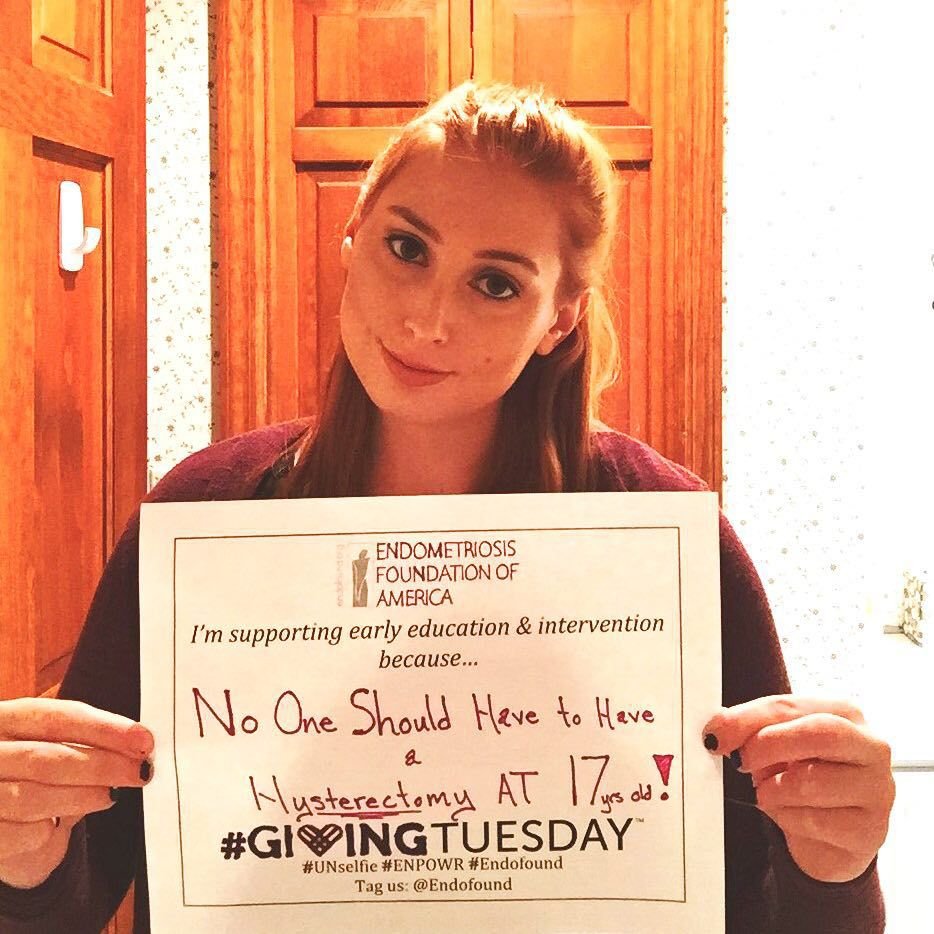
I remember before I went under, I grabbed my doctor’s hand and said, “Just please don’t take my uterus, unless you definitely need to.”
I had a hysterectomy at 17. My doctor removed my uterus but left my ovaries and part of my cervix. I felt better since the painful cramping began at age 13, before my first period. At 14, I collapsed from the pain. That’s when healthcare providers first suspected endometriosis, in which endometrial tissue grows outside the uterus and sticks to other organs.
Years of pain followed. I was often bedridden and unable to function. The pain was so intense, I couldn’t even think straight. After several laparoscopic surgeries, my doctor suggested surgery to remove my uterus.
The night before surgery, I was in a hotel with my mom, completely freaking out. She was ready to fly me home. We made a pros and cons list. Cons? I couldn’t have kids. Pros? Pain-free, living a life, going to college. The pros outweighed the cons, but that one con was big.
I remember thinking to myself, “Who’s going to want me if I can’t provide a family for them?” I don’t think this now, but that’s the first thing that went through my head; that I was a genetic dead end. It wasn’t the cookie-cutter future people think of. I know I can adopt and have other options, but I thought about how I couldn’t provide grandkids for my parents.
Specialists in Atlanta thought I had adenomyosis, in which endometrial tissue grows in the uterine wall. After surgery, my uterus showed signs of both adenomyosis and endometriosis.
In the months following, I still had pain and was a little depressed, but I was feeling better. I was able to go to college. But by my sophomore year, I started having intense endometriosis pain again. It was like a knife to my gut. I had given up so much, and now I was in pain again.
I learned that my endometriosis wasn’t properly cut out. Some of it was still there, growing again. Throughout college, I had a couple of surgeries at home with local specialists. I’d go back to school less than a week later, just trying to get by, because I didn’t want to leave school. When I called my healthcare providers in Atlanta, they told me there was nothing else they could do and made me question myself. Am I a baby? Am I going to have to live with this pain forever?
In the middle of my first year of law school, I had what I call the “flare of a lifetime.” It sounds dramatic, but I thought I was dying. I couldn’t eat, I didn’t have a life. Never before was I completely taken out the way I was from that flare-up. I knew something had to change. I studied in my bathtub and brought my heating pad to lectures. I had to set it so high to feel any relief that it would burn my stomach, which is now covered in scars.
I took a medical leave from law school and my healthcare providers in Atlanta still weren’t taking me seriously. This new pain I was feeling was nothing in comparison to the pain I had before my hysterectomy. It was 10 times worse and hit me like a tsunami. I was drowning. I lost so much weight and was throwing up from the pain.
After a two-year battle, I ultimately connected with Tamer Seckin, MD, who was also Lena Dunham’s endometriosis specialist. He changed my life with a pro-bono excision operation in March 2015. He described my endometriosis as a bundle of “crinkled-up newspaper” and apologized to me for how bad it had gotten. He told me the part of my cervix that had been left in was causing problems. It just shows that a hysterectomy isn’t a cure.
It took me about two years to recover from that surgery, with help from injections and pelvic floor physical therapy, which was expensive. Then I finally started getting back parts of the person I used to be.
In 2020, I was preparing for acupuncture school so I could help women with pelvic issues. I just wanted to enjoy my 30s. I was never able to live like a normal teenager. I had wonderful friends who would read to me while I was in the bathtub to relieve my pain or just lie in bed with me and watch TV. But I missed the moments that people look forward to, like school dances.
Dating isn’t so great, even though I’ve tried to get myself out there. I don’t want to say when I’m in pain—it’s just awkward. I’ve come to peace with not being able to have kids. Hopefully, my brothers will so I can be an aunt. Because I still have one ovary (the other was removed while I was in college), healthcare providers could harvest my eggs, but even going through that process—having those hormones injected into me—could make my endometriosis go out of control. After having 12 surgeries from ages 14 to 25, that’s not something I want to go through.
When I heard about Lena Dunham’s hysterectomy, my heart sank for her. I’ve come to terms with it, but I’m definitely upset that I could’ve had other options or a different outcome. Hysterectomies aren’t always a cure, and there is a possibility of experiencing pain throughout your lifetime if you have endometriosis. Treatment is complex and individualized to the person with the condition.
