

The International Classification of Diseases (ICD-11) is the 11th edition of a global categorization system for physical and mental illnesses published by the World Health Organization (WHO). The ICD-11 is a revised version of the ICD-10 and the first update to be developed and published in two decades.
Development and Release of the ICD-11
The 11th version of the ICD was released as a preliminary version on June 18, 2018. It was officially presented at the World Health Assembly in May 2019 and became the official reporting system for member states on January 1, 2022.
The initial advance preview allows countries time to plan, train health professionals in its use, and obtain necessary translations. It’s also important to note that anyone can submit an evidence-based proposal for ICD revisions, and these are processed openly and transparently.
This version is the result of work completed over the course of a decade involving 300 specialists divided into 30 workgroups across 55 countries who provided input. Healthcare workers joined collaborative meetings to incorporate practical applications in the ICD-11 revision in addition to theoretical concepts, particularly in the area of mental health.
Following the approval and revisions process of the ICD-11, the WHO’s Department of Mental Health and Substance Abuse will publish Clinical Descriptions and Diagnostic Guidelines (CDDG) for the mental, behavioral, and neurodevelopmental disorders listed in the ICD-11.
The ICD-11 catalogs known human diseases, medical conditions, and mental health disorders and is used for insurance coding purposes, for statistical tracking of illnesses, and as a global health categorization tool that can be used across countries and in different languages.
Improvements in the ICD-11
The ICD-11 includes improvements to address gaps in the ICD-10 and incorporate medical updates, discoveries, and changes in thinking. Key revisions focus on categorization and coding structure, international use, digital readiness, and user-friendliness.
Coding Structure
In terms of general improvements, the ICD-11 has a more sophisticated structure than the ICD-10. With around 55,000 codes that can be used to classify diseases, disorders, injuries, and causes of death, the ICD-11 offers a fine level of detail in coding these illnesses.
A key feature of the revised system is that it provides a simple coding structure that makes it easier to record various conditions with specificity.
International Applicability
The ICD-11 offers guidance for its use with different cultures as well as translations into 43 different languages. In this way, the revised system provides a common coding language that can be used by healthcare professionals and researchers worldwide, which will aid in international comparisons and usage.
Digital-Ready and User-Friendly
The ICD-11 is designed to be electronic and user-friendly for a global audience. It operates on a central platform and can connect to any software. It is also available in a machine-readable format, enhancing its potential uses in the digital age.
Dimensional Approach
Another enhancement of the ICD-11 is that it’s based on a dimensional approach that makes it better at capturing change over time, is consistent with research evidence, and will improve recovery from illness.
This dimensional approach also helps to reduce artificial comorbidity, which refers to a person being diagnosed with more than one illness when in fact their symptoms are all part of the same illness. To aid this dimensional approach, the new system includes two new chapters and a new set of categories.
ICD vs. DSM
The ICD and the Diagnostic and Statistical Manual of Mental Disorders (DSM) share many similarities. Both serve as authoritative guides for diagnosing and treating diseases and disorders. They have significant overlap in mental disorders content, but the DSM focuses only on mental health, while the ICD covers all body and mind conditions.
Compared to the DSM, the ICD has a broader scope and authorship.
Mental health professionals in the United States are more likely to rely on and be familiar with the DSM mental health classifications (rather than classifications of the ICD) because the DSM guidebook is specifically tailored to cover mental health disorders as they are experienced and treated in this country.
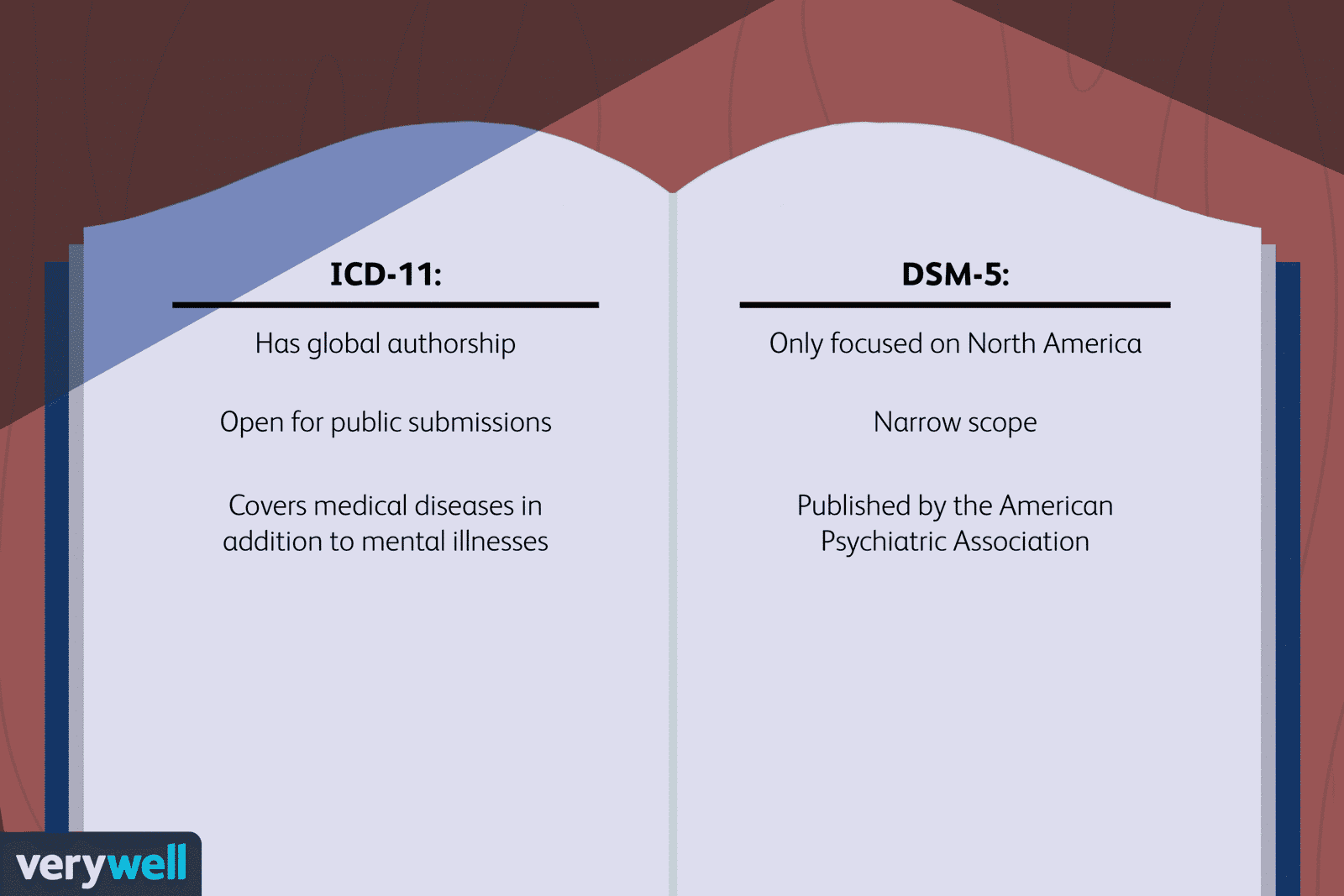
While the DSM is published by the American Psychiatric Association (APA) and has a rather narrow scope and authoritativeness as it’s focused on North America, the ICD draws its authorship globally and is open to the public for submissions. The ICD also covers medical diseases in addition to mental disorders.
Another difference is that the ICD provides codes for each diagnosis for insurance billing purposes. The DSM doesn’t have its own codes, but rather, publishes the corresponding ICD codes for each mental health diagnosis. For instance, the DSM-5 uses both ICD-9 and ICD-10 codes. The DSM-5-TR (DSM-5 text revision) uses codes from the ICD-10-CM, which is the ICD-10 Clinical Modification.
Changes in the ICD-11
The ICD-11 includes several changes to the mental health disorders that are listed, including some that may be considered controversial and others that may be long overdue in the eyes of clinicians. The following sections detail the diagnoses that were either added or deleted in the new ICD-11.
ICD-11 Added Diagnoses
The following diagnoses are now included in the ICD-11.
Complex PTSD
The definition of complex post-traumatic stress disorder in the ICD-11 involves the three symptoms of PTSD (re-experiencing, avoiding reminders, and a heightened sense of threat/arousal) along with broader problems in emotion regulation, shame, guilt, and interpersonal conflict, such that it affects the person’s entire life.
Compulsive Sexual Behavior Disorder
Compulsive sexual behavior disorder is defined in the ICD-11 as “characterized by a persistent pattern of failure to control intense, repetitive sexual impulses or urges resulting in repetitive sexual behavior.” It is classified as an impulse control disorder rather than an addictive disorder.
Gaming Disorder
Gaming disorder is newly defined in the ICD-11 as “a pattern of persistent or recurrent gaming behavior (‘digital gaming’ or ‘video-gaming’).”
Prolonged Grief Disorder
Prolonged grief disorder is defined in the ICD-11 as grief that extends beyond what most people would consider a reasonable or expected amount of time. Prolonged grief disorder is listed as a proposed disorder in the DSM-5 and is officially listed as a new diagnosis in the DSM-5-TR.
ICD-11 Deleted Diagnoses
The following disorders were removed from the ICD with the publication of the ICD-11.
Acute Stress Disorder
Acute stress disorder is no longer included as a mental disorder and instead is now classified as a reaction to trauma (factor influencing health). This is in contrast to the DSM-5.
Gender Incongruence
Gender incongruence (gender dysphoria in the DSM) is no longer listed as a mental disorder but rather a sexual health condition to avoid stigma about it being a psychological rather than medical condition.
Personality Disorders
The section on personality disorders has been completely overhauled. There is now one diagnosis of “personality disorder” as it was found that there was much overlap in clinical practice.
This diagnosis is labeled as mild, moderate, or severe, and measured in terms of six trait domain areas to retain some of the earlier specificity of the diagnosis. This is a fairly significant departure from the original ICD personality disorder diagnosis.
What’s Included in the ICD-11
The ICD-11 includes an implementation package with the following components that can be used to help ease the transition and better use the categorization system:
- Coding tool
- Manual
- Training material
- Transition tables from ICD-10 to ICD-11
- Translation tool
- Web services
All of these tools are accessible to those who register on the ICD-11 platform online.
Mental Health Disorders in the ICD-11
Within the ICD-11, each mental, behavioral, and neurodevelopmental disorder listed includes a description with guidance on meaning that you can access through the website. The following is a list of each of the disorders currently included in the ICD-11 available online:
A Word From Verywell
While it may be confusing that there are two systems for diagnosing mental health disorders, the important thing to remember is that the DSM is primarily used in the United States while the ICD is used internationally and for insurance coding purposes.
However, this new revision of the ICD could influence or alter standards for diagnosis and disease classification. Indeed, the move toward a dimensional approach is more in keeping with current research evidence and is in line with approaches to treatment and recovery that emphasize improvement rather than the presence or absence of a disorder.
If you’ve been diagnosed with an illness, be sure to ask your provider what diagnostic system was used for categorization and what specific disorder (and code) applies so that you have this information for future visits with health professionals and for your insurance provider.
