

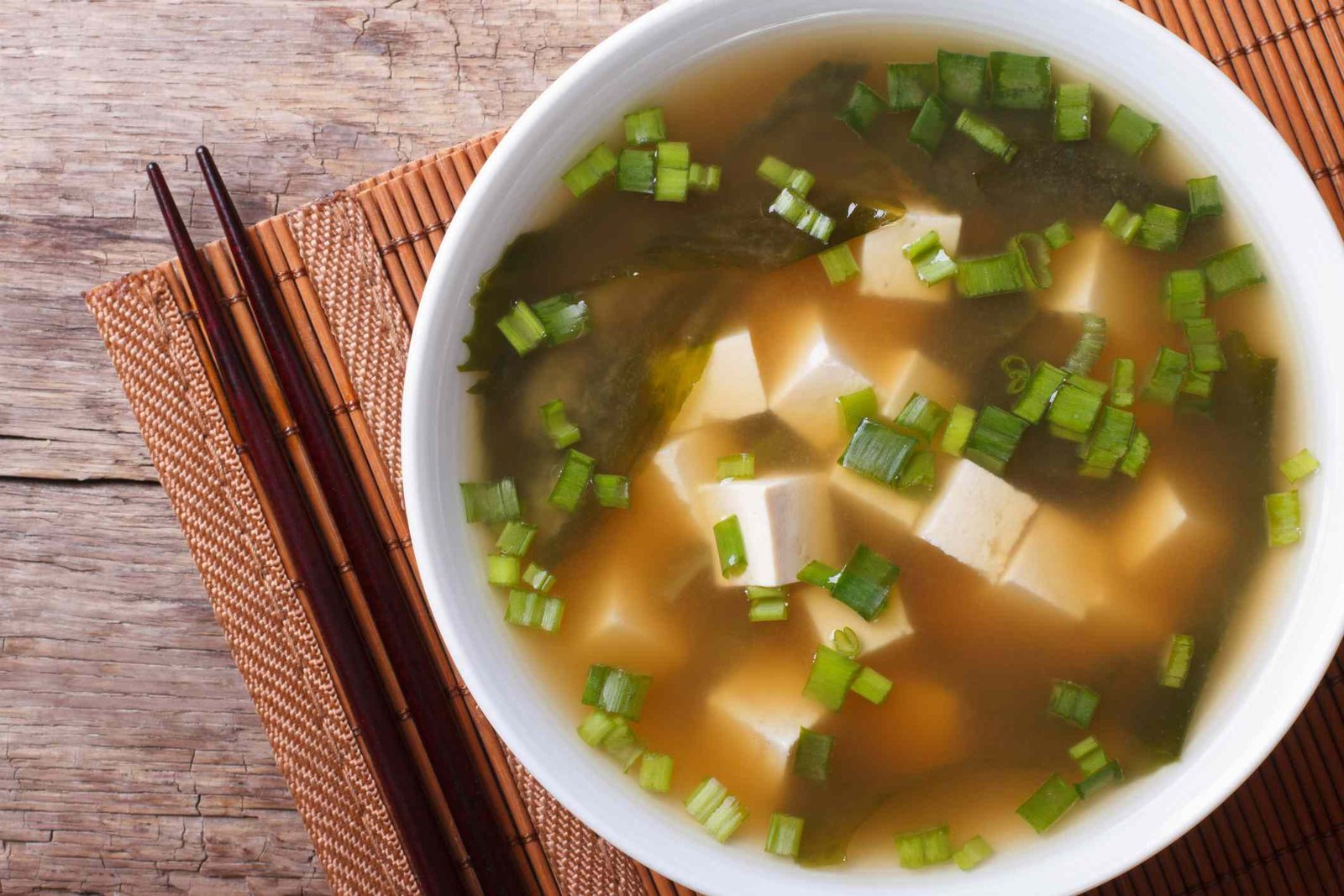
Miso soup is a traditional Japanese dish typically made with fermented soybean paste (miso), a broth made with dried fish and kelp (dashi), tofu, green onions, and seaweed. This combination is rich in beneficial plant compounds and probiotics. Eating miso soup regularly may improve gut and heart health and lower your risk of certain health conditions.
As a fermented food, miso paste contains beneficial bacteria, or probiotics, that help keep your digestive system healthy.
Both beneficial and harmful bacteria live in your gut. Having more beneficial gut bacteria helps your body absorb nutrients and digest food. Good bacteria also help your immune system stop harmful bacteria from overgrowing and making you sick.
When you eat miso soup, you’re getting several probiotic strains that benefit your gut health and strengthen your immune system. Studies show people who frequently eat miso soup have improved digestion and a lower risk of stomach illnesses.
Eating miso soup regularly may help lower cholesterol and prevent artery blockage that can lead to heart disease and stroke.
Miso paste contains compounds called plant sterols that help prevent the body from absorbing cholesterol. Tofu and miso also contain soy proteins that may help lower cholesterol and reduce the risk of heart disease.
A large 2019 study found that people who consumed 25 grams of soy protein every day reduced their LDL cholesterol levels (the “bad” cholesterol). Additionally, soy proteins contain antioxidants called isoflavones that may help prevent cell damage and support healthy blood vessels.
Isoflavones found in miso soup may also help reduce your risk of colon and breast cancer. Isoflavones are phytoestrogens, meaning they act like the hormone estrogen. Studies show that isoflavones’ phytoestrogenic and antioxidant effects may help reduce cancer cell damage and growth. Seaweed, an ingredient in miso soup, may also have anticancer properties.
Human research on miso soup and cancer risk is limited and sometimes mixed. An older study of men without health conditions and men with colon cancer found that eating two cups of miso soup per day reduced colon cancer risk.
Another older study in Japan found that females who ate miso soup daily had a lower risk of developing breast cancer. More recent research also links consuming soy isoflavones to a decreased risk of breast cancer.
Miso soup is naturally high in sodium because salt is used to ferment and preserve miso paste. The dashi broth used in miso soup is also typically high in sodium. Eating a lot of sodium increases your risk of developing high blood pressure, which can lead to heart disease and stroke.
If you eat miso soup regularly, you may develop high sodium levels. However, studies have found that miso soup contains a compound that may counteract sodium’s effect on blood pressure.
So, even as a high-sodium food, miso soup may not raise blood pressure. A study of Japanese men also found that frequent consumption of miso soup did not increase blood pressure. However, more research is needed to confirm this finding.
The nutritional information for miso soup can vary depending on the type of miso, broth, and added ingredients. One serving of miso soup is typically around 1 cup (240 grams) and contains 1 tablespoon (17 grams) of miso paste.
A traditionally prepared cup of miso soup—with dashi, tofu, green onions, and seaweed—may offer the following nutrients:
Nutrient
Amount
Calories
65
Protein
5 grams (g)
Fat
2 g
Carbohydrates
5 g
Fiber
1 g
Sugar
2 g
Sodium
895 g, or 39% of the Daily Value (DV)
Copper
0.07 milligrams (mg), or 8% DV
Iron
1.5 mg, or 8% DV
Manganese
0.15 mg, or 6% DV
Vitamin K
5 micrograms (mcg), or 4% DV
Zinc
0.44 mg, or 4% DV
Health.com uses only high-quality sources, including peer-reviewed studies, to support the facts within our articles. Read our editorial process to learn more about how we fact-check and keep our content accurate, reliable, and trustworthy.
Saeed F, Afzaal M, Shah YA, et al. Miso: A traditional nutritious & health-endorsing fermented product. Food Sci Nutr. 2022;10(12):4103-4111. doi:10.1002/fsn3.3029
Al Bander Z, Nitert MD, Mousa A, Naderpoor N. The gut microbiota and inflammation: An overview. Int J Environ Res Public Health. 2020;17(20):7618. doi:10.3390/ijerph17207618
Valdes AM, Walter J, Segal E, Spector TD. Role of the gut microbiota in nutrition and health. BMJ. 2018;361:k2179. doi:10.1136/bmj.k2179
MedlinePlus. High blood cholesterol levels.
Blanco Mejia S, Messina M, Li SS, et al. A meta-analysis of 46 studies identified by the FDA demonstrates that soy protein decreases circulating LDL and total cholesterol concentrations in adults. J Nutr. 2019;149(6):968-981. doi:10.1093/jn/nxz020
Zampelas A. The effects of soy and its components on risk factors and end points of cardiovascular diseases. Nutrients. 2019 Nov 1;11(11):2621. doi: 10.3390/nu11112621
Man B, Cui C, Zhang X, Sugiyama D, Barinas-Mitchell E, Sekikawa A. The effect of soy isoflavones on arterial stiffness: A systematic review and meta-analysis of randomized controlled trials. Eur J Nutr. 2021;60(2):603-614. doi:10.1007/s00394-020-02300-6
Boutas I, Kontogeorgi A, Dimitrakakis C, Kalantaridou SN. Soy isoflavones and breast cancer risk: A meta-analysis. In Vivo. 2022;36(2):556-562. doi:10.21873/invivo.12737
Yamamoto S, Sobue T, Kobayashi M, Sasaki S, Tsugane S. Japan Public Health Center-based prospective study on cancer cardiovascular diseases group. soy, isoflavones, and breast cancer risk in Japan. J Natl Cancer Inst. 2003;95(12):906-13. doi: 10.1093/jnci/95.12.906
Torrens-Mas M, Roca P. Phytoestrogens for cancer prevention and treatment. Biology (Basel). 2020;9(12):427. doi:10.3390/biology9120427
Minami Y, Kanemura S, Oikawa T, et al. Associations of Japanese food intake with survival of stomach and colorectal cancer: A prospective patient cohort study. Cancer Sci. 2020 Jul;111(7):2558-2569. doi: 10.1111/cas.14459
Fu Y, Xie D, Zhu Y, et al. Anti-colorectal cancer effects of seaweed-derived bioactive compounds. Front Med (Lausanne). 2022;9:988507. doi:10.3389/fmed.2022.988507
Watanabe H. Beneficial biological effects of miso with reference to radiation injury, cancer and hypertension. J Toxicol Pathol. 2013;26(2):91-103. doi:10.1293/tox.26.91
Ito K, Miyata K, Mohri M, Origuchi H, Yamamoto H. The effects of the habitual consumption of miso soup on the blood pressure and heart rate of Japanese adults: A cross-sectional study of a health examination. Intern Med. 2017;56(1):23-29. doi:10.2169/internalmedicine.56.7538
U.S. Department of Agriculture: FoodData Central. Dashi powder umami broth, dashi powder.
Centers for Disease Control and Prevention. About sodium and health.
U.S. Department of Agriculture: FoodData Central. Miso.
U.S. Department of Agriculture: FoodData Central. Miso soup.
