

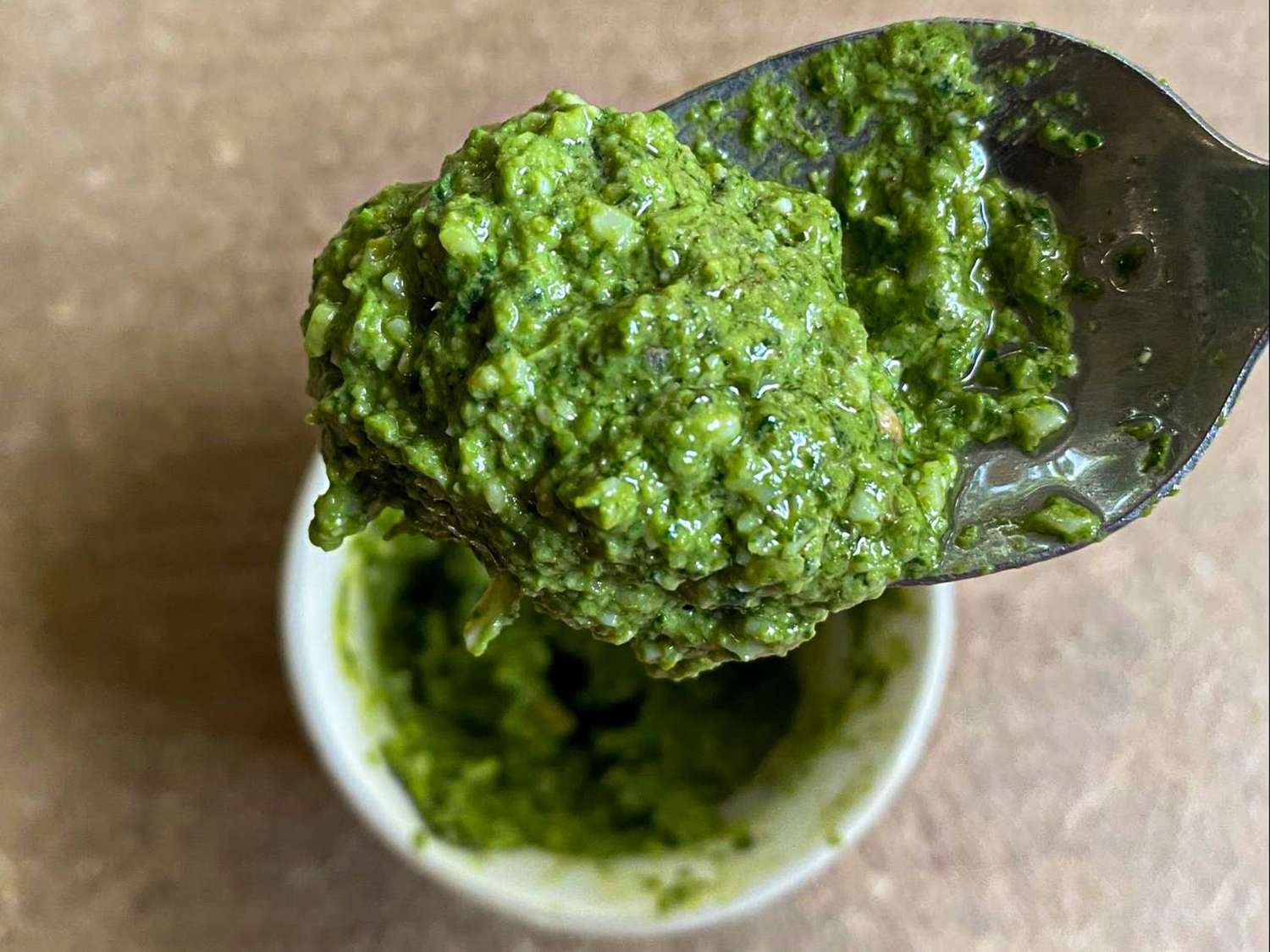
Pesto turns dull and muddy due to enzymatic browning triggered by oxygen and cell damage. To keep it green, use frozen or blanched basil, keep all ingredients cold, blend quickly, and store with a layer of oil in the fridge to block air.
For all the aroma and flavor basil brings to food, its leaves are surprisingly delicate and highly sensitive. Anyone who’s made pesto knows the heartbreak: You grind the leaves into a creamy, emerald-green paste, only to watch it dull and darken into a tired brown not long after. It smells great, but visually, it loses its appeal fast. It doesn’t even matter which tool you use, whether a mortar and pestle, food processor, or blender—browning is inevitable.
Why does this happen? What’s going on inside the basil leaf to trigger this rapid browning? And more importantly, how can this be prevented?
To find out, I tested several variables that might influence the browning reaction of basil leaves in pesto. I kept the process consistent for each trial: I used a spice grinder to make multiple small batches and kept all quantities and grinding times consistent. I also tracked ingredient temperatures throughout the process to understand their effect on enzymatic activity. Ultimately, I found that a combination of methods offered the best defense against basil’s browning instinct. But before diving into the fixes, let’s understand the science of what’s going on inside a basil leaf.
Serious Eats / Swetha Sivakumar
The Science of Basil Browning
Basil’s change in color from bright green to brown when its leaves are torn or cut is not arbitrary—it’s a defensive reaction. When basil leaves are crushed, ground, or even torn, the plant’s cells are ruptured, allowing two key elements that were previously kept separate inside each cell to mix and react with oxygen from the air, launching a chemical counterattack. These two components are:
- Phenolic compounds (stored in vacuoles)
- Polyphenol oxidase (PPO) enzymes (in the cytoplasm)
When these elements meet with oxygen, the PPO enzymes catalyze oxidation reactions that form brown pigments—what Harold McGee in On Food and Cooking calls “masses of spent weapons.” It’s plant biochemistry’s version of battle scars.
But the browning itself isn’t the goal—it’s a side effect. The oxidative reactions serve multiple purposes: they help seal the damaged area, creating a physical barrier to slow infection; they generate chemical signals that may alert neighboring cells or nearby plants to the presence of a threat; and they may alter the taste of the tissue, making it less appealing to herbivores. These defenses aren’t immediate deterrents, but part of a broader evolutionary strategy to limit damage and improve survival odds.
The more a leaf is damaged, the faster and more thoroughly this browning occurs. Blenders and food processors exacerbate the issue, both by mechanically damaging the leaves and by incorporating air (oxygen), more rapidly fueling the reaction.
So when I grind basil into pesto, I’m not just making a sauce. I’m launching a full-scale attack on the plant. And basil? It’s ready for battle. When it’s all said and done, the browned, muddy-tasting basil is what’s left over—the spent weapons on the battlefield.
I decided to test some variables to see what factors affect browning the most, and how to lessen the impact. As mentioned above, I set up a controlled testing environment by using my spice grinder to grind small batches of pesto, and I used a timer to ensure the leaves were ground to the exact same extent. Was there a way to make pesto and keep that beautiful green color? Here are the pathways I took that eventually led me to an answer.
The Conditions That Affect How Quickly Basil Turns Dark
To establish a baseline, I started by blending basil with room-temperature water, just to see what would happen. The smell of freshly crushed basil leaves was amazing, but the color began fading before my eyes, darkening into a dark green sludge within minutes. Clearly, the browning enzymes had kicked into gear. The measured blend temperature was 29°C.
This aligns with what we know about the PPO enzymes in the basil leaves: Warmer conditions speed up enzymatic browning, with the activity rising dramatically between 15–50°C, doubling or tripling with every 10°C increase. In other words, warm temps supercharge browning, and on a hot day, browning can begin in under 10 minutes.
Basil leaves are thin and delicate, unlike sturdier herbs like parsley or coriander. They rupture easily when crushed, quickly exposing enzymes and phenolic compounds to air. The more the leaves are broken down, the faster browning occurs. Using a blender or food processor adds to this effect by aggressively incorporating air into the mix, increasing oxygen exposure even further.
With no high heat, fat, or acid to discourage the reaction from happening, the leaves reacted as though an animal was busy chomping it up. And the pesto got dark really fast.
Serious Eats / Swetha Sivakumar
Test 1: Blanching the Basil
Onwards to a tried-and-tested technique: blanching. This is a well-known method in food circles (Serious Eats uses it in its pesto pizza recipe). Blanching basil—briefly boiling then shocking in ice water—denatures PPO, preventing browning.
It worked, and the color stayed stable. However, once blanched, basil takes on a spinach-like green and loses some of its signature fresh flavor. The process mutes the herb’s bright, volatile aromas and dulls its natural sharpness. Try chewing a blanched basil leaf next to a fresh one, and you’ll notice the difference immediately—it’s not a great option for pesto.
Serious Eats / Swetha Sivakumar
(Pro tip: If you want to skip the whole blanching process, pop the leaves in the microwave for about a minute. It’s a quicker way to deactivate the browning enzymes.)
Test 2: Adding Acid (Lemon Juice)
To explore another method of deactivating the browning enzymes, I turned to acid. In this test, I blended basil with pure lemon juice instead of water.
Acids like lemon juice or vinegar denature proteins—including PPO enzymes—by disrupting the bonds that maintain their three-dimensional structure. When the pH drops, the hydrogen ions (H+) released by the acid into the solution interact with charged amino acid side chains in the basil’s proteins. This interaction neutralizes those charges and breaks both ionic and hydrogen bonds, causing the proteins to unfold and lose their functional shape.
While lemon juice is not as ruthless as blanching in halting enzymatic activity, it still serves as a fairly effective deterrent. In this case, browning was noticeably delayed. The pesto retained its vibrant green color for significantly longer than the room-temperature water version.
However, the protection was temporary. Within a few hours, the bright green hue began to fade and was eventually replaced by the familiar dull brown. A bigger issue, though, was the impact on flavor. Traditional pesto recipes don’t include lemon juice, and the acidity stood out. While the acidity of lemon can be a welcome addition in condiments like chutney or guacamole, it felt misplaced here, disrupting the classic flavor profile.
So while lemon juice helped prolong the green color, it came at a cost: The flavor was no longer proper pesto.
Serious Eats / Swetha Sivakumar
Test 3: Blocking the interaction of Oxygen with Oil
Next, I tested whether eliminating oxygen exposure could preserve the pesto’s color. I blended fresh basil leaves directly in pure olive oil—no water, no acid.
Serious Eats / Swetha Sivakumar
The result was immediate and striking: a vivid, bright green paste that held its color for the longest time of any test—about two full days. The reason? Oil acts as a physical barrier, coating the basil particles and shielding the sensitive phenolic compounds and enzymes from oxygen. Without oxygen, the browning reaction simply couldn’t proceed.
This wasn’t pesto in the traditional sense—there were no nuts, cheese, or garlic—so the result was closer to a basil oil or puree. But it was a promising proof of concept: Fat alone can delay the onset of browning by denying enzymes one of their critical reactants. But, there is a risk of bitterness, though. The water from the basil leaves can leach out bitter compounds in the oil, as Daniel has written about, this effect isn’t guaranteed (it depends on the oil) but it could become a problem.
In short, adding oil up front limited oxygen exposure and bought us valuable time. That insight became a key building block for later tests.
Test 4: The Ice Cube Experiment
After testing the high-heat strategy of blanching, I wondered: What about the opposite? Kenji has tested and written about the flavor effects of freezing basil for pestos, but not on how it effects the rate of browning. Could extreme cold offer similar benefits by slowing the browning reaction instead of stopping it outright?
Harold McGee notes that enzymatic activity drops off significantly below 4°C. That got me thinking—what if I chilled the basil during blending using ice cubes?
Serious Eats / Swetha Sivakumar
Serious Eats / Swetha Sivakumar
At first, the idea looked promising. Ice cooled everything down immediately, and the basil stayed bright green far longer than expected. However, the experiment came with complications. Grinding ice is no easy feat in a small spice grinder—it really demands a high-speed blender to break down effectively.
More importantly, there’s the issue of water. Once the ice melted, it diluted the mix, negatively affecting the texture and intensity of the pesto. The resulting sauce was thinner and lacked the punchy, concentrated flavor of traditional pesto.
Still, the test revealed something valuable: Low temperatures do indeed slow the browning reaction. The icy basil mixture held its green color longer than any of the previous water-based blends. But once it returned to room temperature, the enzymes—like dormant robots waiting for a signal—reawakened. Browning resumed.
In short, cooling helps but only while the temperature stays low. Any benefit is temporary unless you maintain that chill immediately after blending.
Test 5: Freezing the Basil
Inspired Kenji’s tests and article noted above with freezing basil, and the cold-temperature effect of the previous test, I wondered: What if I froze the basil leaves entirely before blending? Could freezing preserve color without the dilution issues of ice?
To find out, I washed, dried, and froze fresh basil leaves in a flat layer—no blanching, no oil, just raw leaves. When I pulled them out the next day, they looked a little dull and brittle compared to fresh ones, but still usable. I figured that if the color held, freezing might offer a practical storage option for surplus basil.
Serious Eats / Swetha Sivakumar
For the first trial, I blended the frozen basil with cold, refrigerated water. The resulting temperature after blending measured 8°C—safely below the enzyme activation zone. The mixture stayed green and resisted the rapid browning seen with room-temperature leaves.
Encouraged, I moved on to a full pesto trial. This time, I kept everything cold: three ounces frozen basil leaves, two tablespoons chilled pine nuts, two tablespoons chilled grated Parmesan, and a frozen garlic cube, all blitzed together in a spice grinder. I deliberately avoided adding any water this time to eliminate dilution.
The result was a vibrant green pesto that stayed brilliantly colored well past the typical oxidation window of 10 to 30 minutes. Freezing hadn’t destroyed the enzymes entirely, but it had slowed them down enough to let me finish blending before they reactivated. The absence of added water also helped preserve texture and intensity.
This method was a clear success. It preserved both the color and flavor integrity of pesto while using a technique—freezing—that’s easy to replicate at home.
Serious Eats / Swetha Sivakumar
How to Store Pesto to Preserve Color
Once you’ve made your bright green pesto, proper storage is essential to keep it that way to prevent oxygen exposure reactivating the browning process. Here’s how:
- Use an airtight container: Prevents air from circulating and triggering oxidation.
- Top with a layer of olive oil: This acts as a sealant to block oxygen from reaching the surface.
- Refrigerate immediately: Lower temperatures slow enzyme activity and delay browning.
Even with these precautions, some browning may occur at the surface over time. But underneath the oil seal, the pesto can remain bright green and flavorful for days.
Serious Eats / Swetha Sivakumar
Serious Eats / Swetha Sivakumar
Conclusion: The Best Way to Make (and Keep) Pesto Green
So, what’s the verdict? After testing heat, acid, fat, and cold independantly, the most effective strategy turns out to be a thoughtful combination of methods.
If you’re making a large batch of pesto ahead of time—say, for a party or to store for later use—blanching is a viable option for longer term storage. It completely deactivates the browning enzymes and gives you peace of mind, no matter how long the pesto sits. Just keep in mind that blanching slightly mutes the basil’s fresh flavor, though strong supporting ingredients like garlic, cheese, and nuts may compensate.
The best option to balance fresh basil flavor while slowing the browning reactions is freezing the ingredients. Start with frozen basil leaves and use pre-chilled ingredients—cold cheese, garlic, and nuts—to keep the overall blend temperature low. Once processed, transfer the pesto to an airtight container and top it with a thin layer of olive oil to minimize oxygen contact. Store it in the refrigerator immediately.
In both cases, fat plays a crucial supporting role. Olive oil not only adds flavor and texture—it physically shields the pesto from air, delaying browning.
Ultimately, preserving pesto’s color isn’t about one magic step—it’s about controlling the environment. Limit oxygen, lower the temperature, and keep the enzymes out of commission. Do that, and your pesto will stay as green and vibrant as the day you made it.
