

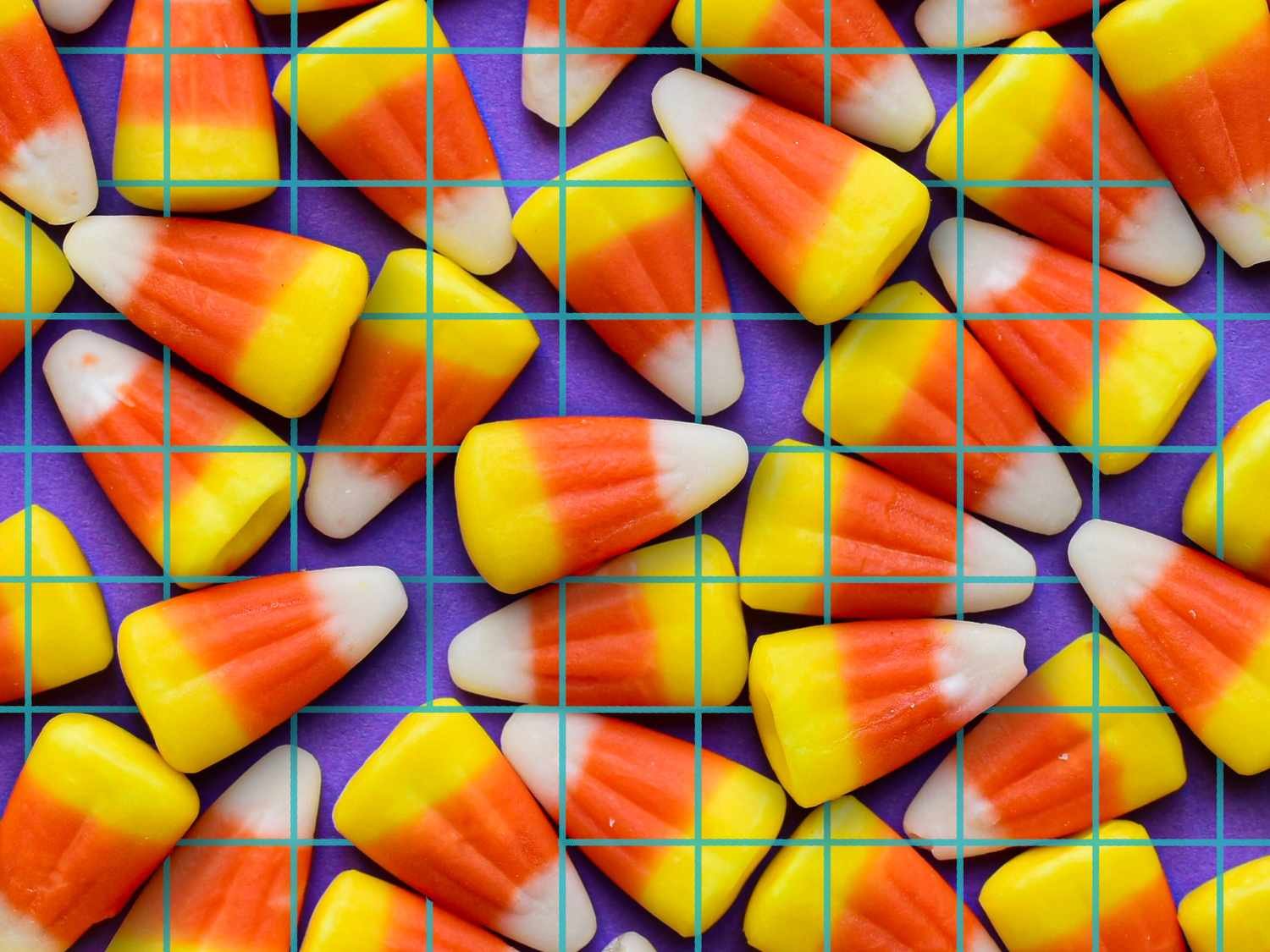
Candy corn may taste like pure sugar and nostalgia, but there’s real science behind why people have such extreme opinions about it. Its one-note sweetness and chewy texture divide us by overloading the brain’s reward system and confounding its expectations. Love it or hate it, that clash is exactly what has kept candy corn unforgettable for more than a century.
Every October, America divides into two camps: those who think candy corn tastes like candle wax mixed with sadness, and those who (like me) look forward to that first hit of mellowcreme the way others anticipate pumpkin spice. My dentist disagrees, my endocrinologist winces, but the chewy, honeyed sweetness of a candy pumpkin (the superior format—fight me) hits me right in the nostalgia cortex.
Candy corn has become Halloween’s easiest punchline: It seems like every year, social media erupts with ritualized mockery. Many call it waxy, gross, or say it tastes like crayons. But beneath the memes and molar damage lies an interesting truth: Our polarized relationship with candy corn isn’t just about taste—it’s about how our brains and tongues process texture, sugar, and nostalgia.
The Short Version of Its Long Story
Serious Eats has already chronicled candy corn’s full history—how it went from a late-19th-century innovation by the Goelitz family to Halloween’s most iconic kernel of controversy. You can read our deep dive into the origins of candy corn. The gist is that candy corn was once a marvel of sugar technology. It represented modernity, not mediocrity. That legacy still matters, especially if you consider that it’s a cleverly engineered piece of sugar science.
The Texture Engineering of Candy Corn
Perhaps the most common complaint against candy corn is its waxy texture. The glossy coating comes from a trace layer of carnauba wax to keep them from sticking, the same plant-based polish used on jelly beans, as well as the shiny protective layer that’s added to some apples you’ll find at the grocery store. Underneath that sheen is a substance called mellowcreme, a fondant-marshmallow hybrid that gives candy corn its distinctive dense and chewy texture.
The chew comes from sucrose (table sugar) and corn syrup, which creates a near-saturated sugar solution that cools into a semi-crystalline structure. The corn syrup’s glucose molecules interfere with sucrose’s tendency to form large, crunchy crystals, keeping the texture soft and fudge-like. Add gelatin and fondant for body, and it’s basically a shelf-stable marshmallow.
As Harold McGee explains in his seminal food science book, On Food and Cooking, “Fondants are systems of tiny sugar crystals suspended in a syrup; their smoothness depends on the fineness of those crystals.” When those microcrystals stay small and uniform, the candy feels creamy and rich. When moisture escapes, they grow larger and coarser—that’s when candy corn takes on its dreaded chalky or waxy texture. In other words, most people who hate candy corn are reacting to bad storage, not necessarily bad candy.
The Science of Candy Corn’s Sweetness
Texture explains part of the divide, but flavor tells even more. Candy corn’s polarizing flavor comes down to pure, uncut sweetness. Chemically speaking, it’s almost too efficient. At roughly 90% sugar by weight, candy corn is designed to hit every sweet receptor on your tongue at once.
That instant rush of sweetness triggers a dopamine burst (your brain’s “reward” signal), followed by sensory adaptation—a kind of tongue fatigue. The sweet receptors can temporarily desensitize when overstimulated. It’s why the second or third piece of candy corn often tastes flatter or cloying: Your taste buds are simply over it.
Food sensory scientists Dr. Harry Lawless and Dr. Hildegarde Heymann describe a related phenomenon, the contrast effect, in their textbook Sensory Evaluation of Food: Principles and Practices. When a food is overwhelmingly sweet, your brain dulls sensitivity to subtler flavors. That’s why a piece of candy corn can actually taste better after something salty or bitter—the contrast resets your sensory baseline.
To a “supertaster”—a term coined by Dr. Linda Bartoshuk in 1991 to describe someone with a higher density of taste buds—candy corn can feel almost aggressive. Their tongues experience more intense sweetness and a stronger aftertaste of vanilla and honey flavoring. For others, those same notes can register as comforting and nostalgic, a kind of boiled-sugar-pudding simplicity that’s nearly extinct in modern candy aisles.
It’s exactly that lack of complexity that makes candy corn so true to its historical roots. In the late 19th century, candy wasn’t about balance; it was about intensity. Candy corn is a direct descendant of that sugar-first philosophy.
So when people say candy corn “tastes like sugar and wax,” they’re not wrong; it’s just that both of those qualities are precisely the point.
The Texture–Color Mismatch
As Oxford psychologist Charles Spence explains in his book Gastrophysics: The New Science of Eating, we taste with our eyes first. It can be argued that the bright yellow-orange-white stripes signal “citrus,” “fruit,” or at least “something tangy.” What we get instead is honey-vanilla sweetness.
That mismatch triggers one sense (sight) to send the brain a prediction that another sense (taste) fails to fulfill. Spence’s experiments have shown that when a food’s color, texture, or even sound—such as expecting a crunch or snap and getting only the silence of a squish—doesn’t align with its flavor, the brain experiences a moment of “disconfirmation,” which can register as dislike or even disgust. It can be argued that candy corn’s flavor isn’t objectively bad—it’s just confusing.
Even the kernel shape plays tricks on us: Your brain anticipates buttered corn, but your tongue gets soft fondant. One of candy corn’s crimes is that it confuses our predictive coding system.
Candy Corn and Nostalgia
Candy corn lacks the sensory complexity our brains crave in a treat. It offers no contrasting textures—no snap or crunch—and no balance of flavors like salt or acid. A Snickers bar illustrates this contrast well: It has a tender chocolate shell, chewy caramel, and crunchy nuts. Candy corn has none of that. Its pleasure is static, and our brains lose interest quickly.
But as Ian Bogost wrote in a 2022 Atlantic article titled “You Must Respect Candy Corn, this lack of contrasts is precisely why candy corn deserves respect. It “has no texture but smoothness, no flavor but sweetness,” he writes. “It is pure candy, an embodiment of the idea of candy itself.” Which, to me, sounds like a fancy way of saying it’s the last honest sweet left in the bowl.
For candy corn loyalists, this predictability is comforting. The flavor never changes, the texture is consistent, and the experience is pure sugar nostalgia. Neuroscientists studying taste and memory have found that the same brain regions (the hippocampus and amygdala) light up during both taste recall and emotional memory. So if you loved candy corn as a kid, your adult brain experiences it not just as sweetness, but as a seasonal ritual.
But on the flipside, when we recall a food we dislike, we actually re-experience the disgust response. So one bad piece of stale candy corn in childhood can brand itself in your brain forever.
The Sweet End
In the end, candy corn’s real trick isn’t its flavor—it’s its psychology. It’s a sugar delivery system so efficient that it triggers both our pleasure centers and our disgust circuits, in varying ways for different people. The texture, the color, the one-note sweetness—they all work together to create a sensory feedback loop that’s hard to categorize and harder to forget.
And that’s the fun of it. Candy corn doesn’t need to be loved to be iconic. It earns its immortality by being impossible to ignore. So this Halloween, when someone says candy corn is gross, maybe they’re right, but they’re also proving its power.
