

Key Takeaways
- Doing things alone can help you learn more about yourself and bring more peace.
- Going for a hike by yourself can improve your mental and physical health.
- Traveling solo can be an exciting way to challenge yourself and learn new things.
Solitude gets a bad rap because it’s often equated with loneliness. But research has found real benefits to doing things alone. It allows you to enjoy activities you love at your own pace and in your own way, for instance. There are also mental health benefits of being alone, enabling you to learn more about yourself and reflect on your experiences.
If you’re wondering what you can do when by yourself, there are several activities good for solo individuals and many benefits of engaging in these solitary pursuits. First, it’s important to understand the difference between being alone and being lonely as they’re not the same thing.
Being Alone vs. Being Lonely
Loneliness involves being isolated despite wanting social connections, whereas being alone means taking time for yourself between regular social interactions. You can be lonely even when in the presence of others. You can also be alone without having feelings of loneliness.
While there are downsides to loneliness, evidence suggests that a certain amount of time alone is critical to well-being—especially as we get older. Doing things by yourself can increase your feelings of peace and solitude. It also helps you avoid the distractions, opinions, or influences of others.
Even though people sometimes fear seclusion, many prefer and actively seek solitude (often referred to as unsociability). Our desire for alone time is influenced by our personality. Where extroverts often dislike being alone, for instance, introverts tend to prefer it.
Of course, just because you may be introverted doesn’t mean you want to be alone all the time. Even the most introverted of people benefit from social engagement. Being an extrovert also doesn’t mean you aren’t capable of enjoying your own company. Even if you naturally seek a crowd, you can learn how to enjoy time to yourself now and then.
Times When Solitude Can Be Beneficial
- It’s voluntary
- You also maintain positive relationships
- You can engage with social groups when desired
- You feel good about spending time alone
Things to Do By Yourself
If you are naturally drawn to other people, finding activities to enjoy on your own might seem difficult at first. Adding some quiet moments where you can be alone can come with a number of benefits, particularly if you are always on the go and find it hard to slow down and take breaks.
Some things to try include:
Take yourself out to dinner. Dining out is often viewed as a social experience. However, treating yourself to a nice solo meal can give you a chance to relax and enjoy the experience in peace.
Go to the movies alone. It’s not like you spend a lot of time socializing in the middle of a film, but being with other people means you might be distracted wondering what they think of the movie and what they might have to say later. Seeing a film alone means you can fully focus on the story and visuals in front of you without wondering about what your companions might think.
See your favorite band or musician by yourself. Not only will you get to see your favorites without having to worry about finding people who want to go with you, seeing a concert alone can be a great way to meet other people with whom you share common interests. You might be doing something on your own but it can actually help widen your social circle.
Go for a hike. Spending time in nature can be great for your health, improving your mental and physical health. It can sometimes be tough to find people who want to join you. Going alone can give you a chance to connect with nature, challenge your body, and enjoy some peaceful solitude.
If you do hike alone, take necessary safety precautions. While the point is to be by yourself, make sure someone knows where you will be and always have the ability to contact the outside world if needed.
Travel solo. Vacationing alone may seem intimidating, but it can also be an exciting and rewarding way to challenge yourself and learn new things. Some people find that traveling alone is also a great way to bring more positivity and self-growth into their lives.
Learn something new. Sign up for a class where you can learn a new skill, whether it’s cooking, archery, art, dance, or some other hobby that has always interested you. Instead of being focused on doing what other people want to do, you can pursue something that satisfies your own interests.
Visit a museum. Wandering through a museum on your own is a great way to spend time looking at the exhibits you’re interested in and skip the ones you’re not. It also means that you can check out things at your own pace and react to exhibits without wondering what other people are thinking.
Volunteer. Research has shown that volunteering provides many positive benefits, including improved life satisfaction and higher self-esteem. Look for opportunities in your community where you can devote time to a cause you are passionate about.
Press Play for Advice On Challenging Yourself
This episode of The Verywell Mind Podcast, featuring Human Performance Expert Steve Magness, shares how to push yourself to do hard things. Click below to listen now.
Follow Now: Apple Podcasts / Spotify / Google Podcasts / Amazon Music
Benefits of Being Alone
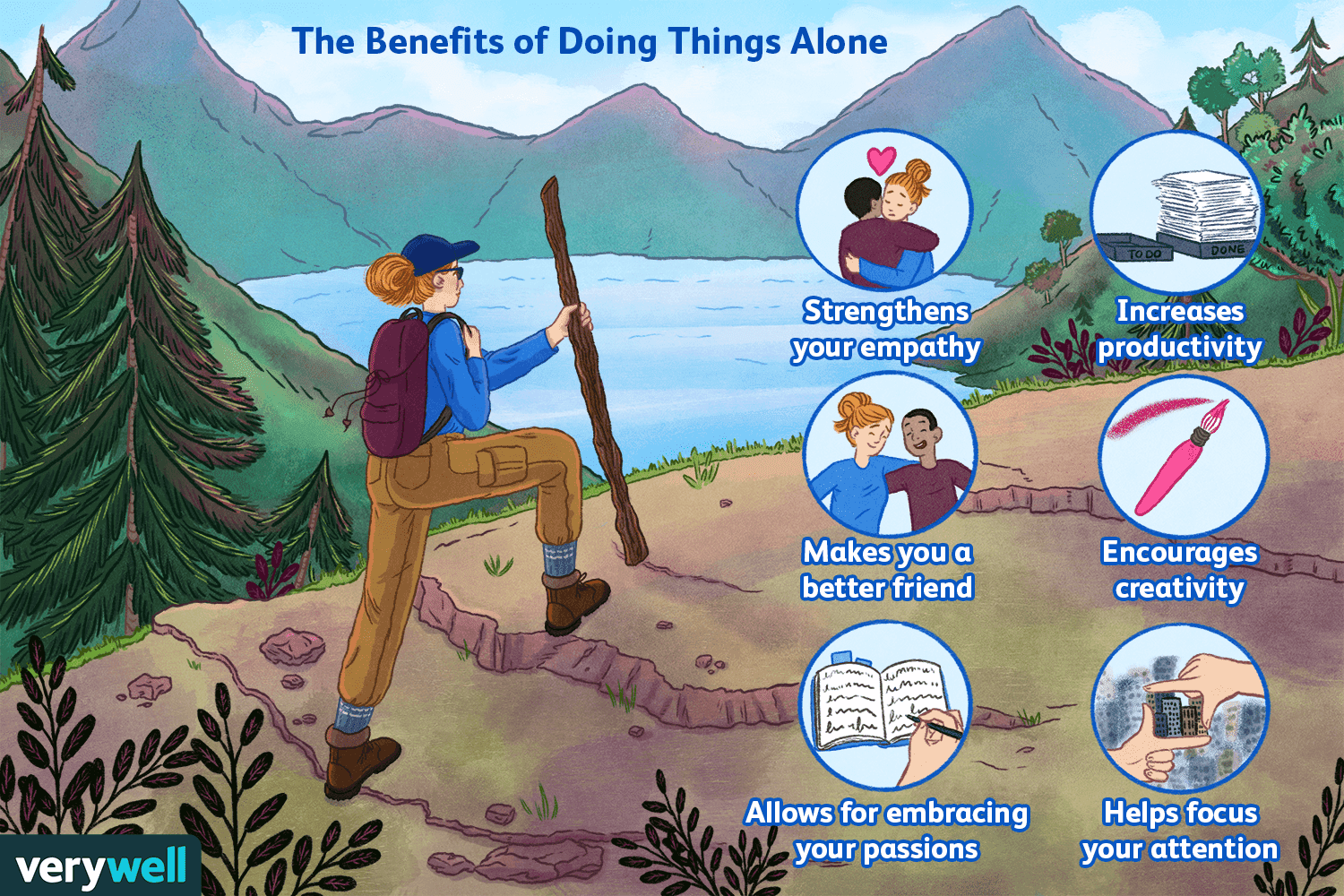
There are benefits to spending time on your own, as long as you balance it by maintaining strong and supportive social connections. Here are several to consider.
Improves Concentration and Memory
When you are working in a group, you might exert less effort to memorize information because you assume that others in the group will fill in the gaps, a phenomenon known as social loafing. Working on things alone can help you focus your attention, which can improve your retention and recall.
In one study published in the journal Psychological Bulletin, researchers found that groups working collaboratively to recall information performed worse than individuals recalling things on their own.
Your Interests Are a Priority
Spending time alone gives you time to focus on your interests. It’s an important part of self-development and allows you to get to know yourself.
When you are surrounded by others, you might set your own ideas and passions aside to appease the wants and needs of friends and family. Taking time on your own gives you the opportunity to make creative choices and focus your attention without worrying about what other people are thinking.
Boosts Creativity
Collaborative brainstorming is often seen as one of the best ways to generate new ideas. However, research has found that people are just as good at solving difficult problems when they work on their own. Where group efforts are often about achieving consensus and fitting in with the crowd, solo work encourages innovation without added social pressure.
Improves Your Relationships
Relationships are often strongest when each person takes time to take care of themselves. Even when it comes to friendships, the old adage may be true—a little absence might really make the heart grow fonder.
A study published in the British Journal of Psychology found that highly intelligent people actually become less satisfied the more time they spend socializing with friends.
Having friendships and a strong social support system is important for your mental health and well-being. At the same time, taking a break and going solo once in a while may help you appreciate those connections all the more.
Makes You More Empathetic
A certain amount of alone time can help you have greater empathy for the people around you. Of course, getting time alone isn’t always easy, particularly when technology has transformed how people spend time alone. Even when you are by yourself, you may never take a break from communicating with others. After all, they’re just a text, tweet, or DM away.
In cases where you are not able to get time completely by yourself, cutting back on digital communication for a brief time might be helpful. In one study, researchers found that when teens went five days without communication devices, they improved their ability to interpret emotions and facial expressions.
How to Be Alone
Being alone doesn’t come naturally to everyone. If you are used to surrounding yourself with friends and family or even prefer the company of strangers, learning to appreciate the joys of going solo may take some time.
- Make a plan. The best alone time often happens when you set aside a specific period to be by yourself. It shouldn’t be forced isolation that leaves you feeling withdrawn or anti-social. Instead, set aside an evening or a weekend for a little refreshing “me time.”
- Eliminate distractions. If you find yourself tempted to work, check out social media, or talk on the phone when alone, start by turning off any potentially distracting devices. Leave your laptop and phone aside and focus on doing something you don’t normally get to do on your own.
- Learn to value solitude. In an ever-connected world that often devalues being alone, it is important to remember the importance of taking time to spend with just your own thoughts.
Of course, you don’t need to completely escape all forms of external stimulation when you are alone. The key is to engage in activities that allow you to feel a sense of inner solitude. Some people can achieve this feeling while listening to music or reading a book, while others might require the quiet of a peaceful meditation session.
Find what works for you. Then, make sure you have regular moments where you can retreat to this quiet mental space.
Summary
Whether you are an introvert who thrives on solitude or a gregarious extrovert who loves to socialize, a little high-quality time to yourself can be good for your overall well-being. Choosing to be alone at times can be rejuvenating, especially if it is something you choose and something you enjoy.
The trick is to remember that this alone time is for focusing on you—for cultivating your passions, finding new inspirations, getting to know yourself better, or even engaging in some much-needed rest and relaxation. Even when you are busy, pencil in a little time each week for some moments of seclusion.
