

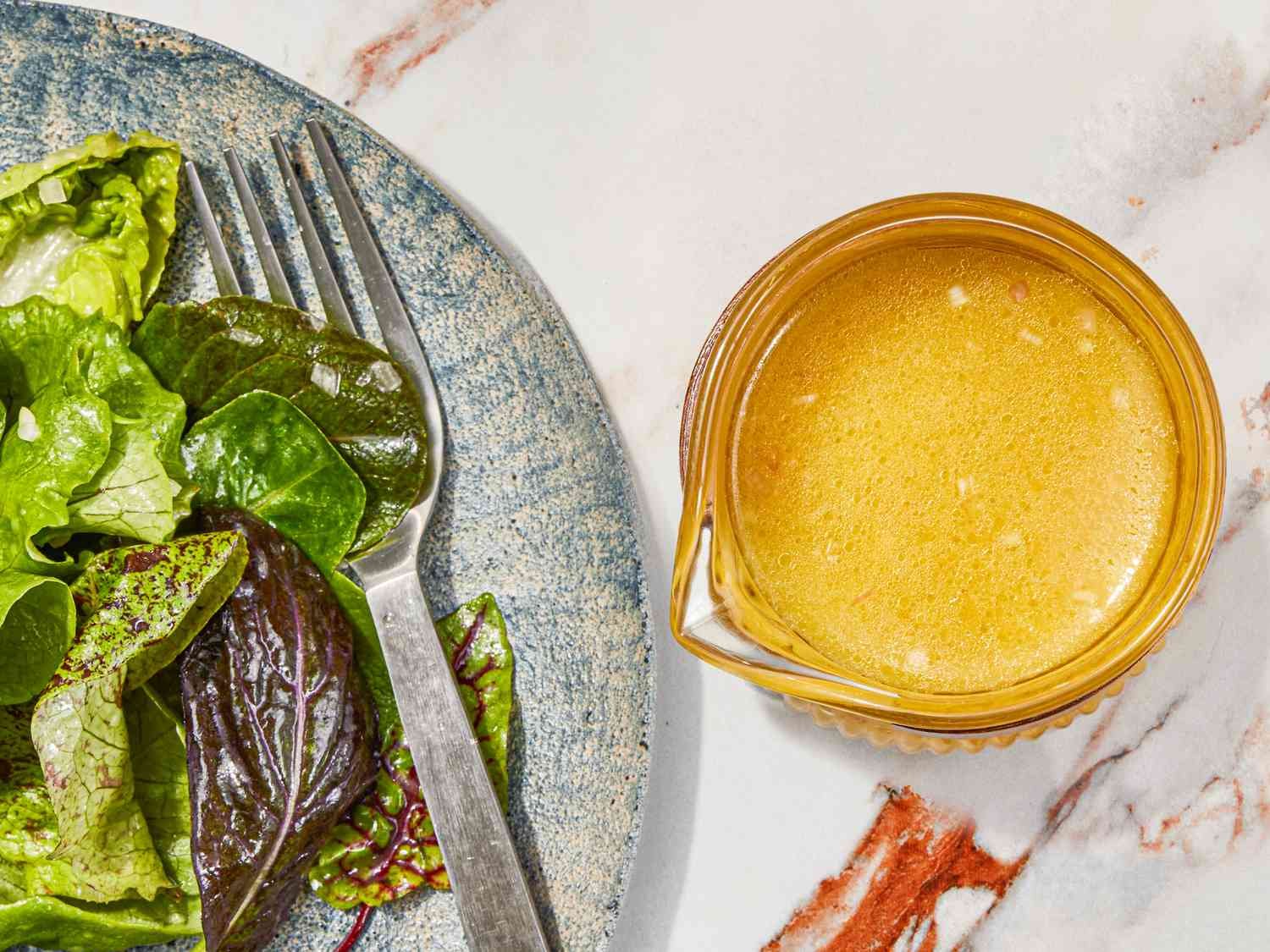
- Mustard is the key to a vinaigrette that doesn’t break, thanks to its natural emulsifiers that bind oil and vinegar into a stable suspension.
- Slowly drizzle in oil while whisking vigorously to create smaller, more stable droplets the emulsifier can coat.
- Other emulsifiers like tahini, miso, egg yolk, and even molasses can add body, flavor, and longer shelf life—just choose based on your salad’s needs and your dressing’s flavor profile.
There’s no reason a homemade vinaigrette should ever break. Not on my watch. Not on your plate.
Store-bought dressings are convenient, sure, but they’re also full of stabilizers, thickeners, and “natural flavors” that tend to blunt the bright snap of real vinegar and bury the nuance of good oil. A homemade vinaigrette, on the other hand, is fast, fresh, endlessly customizable, and—when made right—a thing of silky, tangy beauty that clings like it was engineered to remain on romaine.
The problem? Most vinaigrettes aren’t made right. They break. They pool. They slide off as if the salad is made of Teflon. And that’s because oil and water-based acids don’t naturally mix without the help of an emulsifier. There are many ways to mix those two liquids and keep them mixed, but my favorite is an everyday, humble ingredient that ensures a perfectly stable vinaigrette every time.
Why Vinaigrettes Break
A vinaigrette is an emulsion: a suspension of tiny droplets of one liquid (usually oil) within another (usually vinegar or another water-based acid like lemon juice). But oil and water, as you might’ve noticed, are not natural friends. They’re molecularly incompatible, like a cat and a cucumber.
When you combine them and shake vigorously, you temporarily force the oil into small droplets dispersed throughout the water phase. But without help, those droplets quickly find each other again and separate. That’s called coalescence, and it’s the vinaigrette death spiral.
To stop that, you need an emulsifier—a substance that can stabilize those oil droplets and keep them from glomming back together. One ingredient that does this beautifully while also tasting great: mustard.
Mustard: The Hero of Stable Dressings
Mustard (particularly Dijon) is loaded with natural emulsifiers like mucilage (a plant-based polysaccharide goo) and proteins from mustard seeds. These molecules are amphiphilic, meaning they have a water-loving (hydrophilic) side and an oil-loving (hydrophobic) side.
When you add mustard to the vinegar, it disperses into the watery phase. As you slowly add oil and whisk, the emulsifying molecules form a coating around each tiny droplet of oil, preventing them from recombining. Mustard is the glue that keeps oil and acid in a functional, if slightly tense, molecular marriage.
Building a Better Vinaigrette
Here’s my base vinaigrette method. It’s fast, it’s flexible, and—thanks to mustard—it doesn’t break.
1. Start with your acid. You have lots to choose from: Red wine vinegar, sherry vinegar, lemon juice, Champagne vinegar, whatever is your preference.
2. Add a teaspoon or two of Dijon mustard. This is the emulsifier, and it also makes an even more delicious vinaigrette.
3. Add aromatics, seasoning, and sweeteners. Think minced shallot, crushed garlic, honey, or maple syrup. A pinch of salt here helps the shallots macerate and the acid mellow.
4. Whisk it all together. Or shake it in a jar if you’re averse to whisking. But don’t skip this step—you need the mustard fully dispersed in the acid before adding oil.
5. Slowly drizzle in your oil while whisking vigorously. This is the moment where emulsion happens—or doesn’t. Slowly introducing the oil while vigorously agitating it creates smaller droplets while giving your emulsifier time to surround and stabilize them. The smaller the droplets, the more stable the emulsion.
Add the oil too fast, and those droplets will remain large and prone to coalescing. The emulsifier can’t keep up, and your vinaigrette separates before it hits the greens.
6. Taste and adjust. This is your opportunity to tweak the vinaigrette to your tastes, maybe a touch more vinegar, more salt, or perhaps a tiny drizzle of water if it feels too thick or sour.
The Role of Sweeteners In Vinaigrette
You’ve probably seen vinaigrettes with honey or maple syrup that seem to stay together nicely. And while these ingredients do help with texture and cling, it’s essential to understand their actual role.
These sugar-based thickeners don’t contain amphiphilic molecules—the critical compounds that bind oil and water. That means they don’t actively emulsify, but they do increase viscosity, thickening the water-based phase (vinegar, lemon juice, etc.), which slows down how quickly oil droplets move, bump into each other, and eventually separate. In effect, sweeteners slow down the coalescing process, buying time but not fundamentally improving the emulsion’s stability.
Of the most common sweeteners, molasses is one of the most effective at slowing down the separation of the oil and water phases. Unlike other sweeteners, molasses contains melanoidins—large, complex compounds formed during the Maillard reaction (aka browning). These molecules not only deepen flavor but increase the viscosity of a vinaigrette enough to significantly delay separation.
Sweeteners can therefore work in tandem with emulsifiers like mustard to keep the dressing emulsified (in the case of molasses, for up to a week). You don’t need much, just a teaspoon or two, which won’t make the dressing noticeably sweet.
Other Emulsifier Options
Mustard is my go-to emulsifier for vinaigrettes because it’s one of the most effective and accessible emulsifiers. It strikes a rare balance of strong emulsifying power (thanks to mucilage and proteins), versatile-enough flavor that plays well in a variety of dressings, shelf stability (no refrigeration or perishability), and immediate availability in most home kitchens.
But that doesn’t mean there aren’t other excellent choices—they just serve slightly different functions or work better in specific contexts. Here’s a breakdown of some of the most common emulsifier options and how they work.
Emulsifier
How It Emulsifies
Strengths
Limitations
Mustard
Contains mucilage and seed proteins; amphiphilic compounds bind water and oil
Powerful, stable, accessible, complements many acids/oils
Can be assertive in large amounts
Tahini
Contains proteins and natural emulsifiers from sesame seeds
Adds creamy texture and nutty flavor; good option for creamy vinaigrettes
May seize if not balanced properly with water
Miso
Fermented soybean paste with proteins and natural polysaccharides
Deep umami flavor, helps suspend oil droplets
High salt content, strong flavor
Nut Butters
Contain fats, proteins, and fiber that slow separation and create suspension
Rich, cohesive texture, good for Asian or fusion dressings
Heavy texture, not suitable for lighter emulsions
Egg Yolk
Rich in lecithin, a potent phospholipid emulsifier
Excellent emulsifier, classic in Caesar and aioli
Perishable, raw egg concerns, richer flavor
Mayonnaise
Pre-emulsified mixture of egg yolk, oil, and acid
Extremely stable base, easy to extend with more liquid
Creamy texture may overwhelm if not thinned
Xanthan Gum
Like sweeteners, xanthan is technically not an emulsifier, but its ability to stabilize an emulsion is so strong that it’s worth including here
Works in minute quantities, has no impact on flavor.
When added in larger amounts, its viscosity-creating properties can lead to a slime-like texture, so be careful
Most of the above contain emulsifying agents, such as proteins or lecithin, that help form stable dressings. Choose based on flavor, texture, and the kind of salad you’re making.
What If It Still Breaks?
Let’s say you rushed the oil or forgot the mustard (how dare you) and the vinaigrette doesn’t emulsify properly or breaks almost instantly. All is not lost. Try this:
- Whisk in another teaspoon of mustard. It can re-coat the oil droplets and restore stability.
- Add a teaspoon of warm water and whisk like you mean it. Water helps loosen the mixture and can encourage re-emulsification.
- Use a blender. Mechanical force can shear those oil droplets back into suspension, which is especially useful for creamy or thicker vinaigrettes.
The Bottom Line
A great vinaigrette isn’t just oil and vinegar—it’s a carefully engineered emulsion, one that relies on smart technique and the right supporting players.
Mustard is my favorite supporting player of all: Packed with natural emulsifiers, it stabilizes dressings and adds depth of flavor. But it’s not alone. Other emulsifiers like tahini, miso, and even mayo can bring structure and richness to the table, depending on your flavor goals.
And while sweeteners like honey, maple, and especially molasses don’t actively emulsify, they can play a critical role—boosting viscosity and helping a vinaigrette hang together longer. Molasses, in particular, with its melanoidin content, goes above and beyond, assisting vinaigrettes to stay emulsified for days.
The secret to a dressing that doesn’t break is a slow drizzle of oil, vigorous whisking, a strategic emulsifier, and a little viscosity support when needed. So skip the bottled stuff. With just a few ingredients and a little know-how, you can make vinaigrettes that are bright, bold, and beautifully stable like our simple vinaigrette and lemon vinaigrette.
