

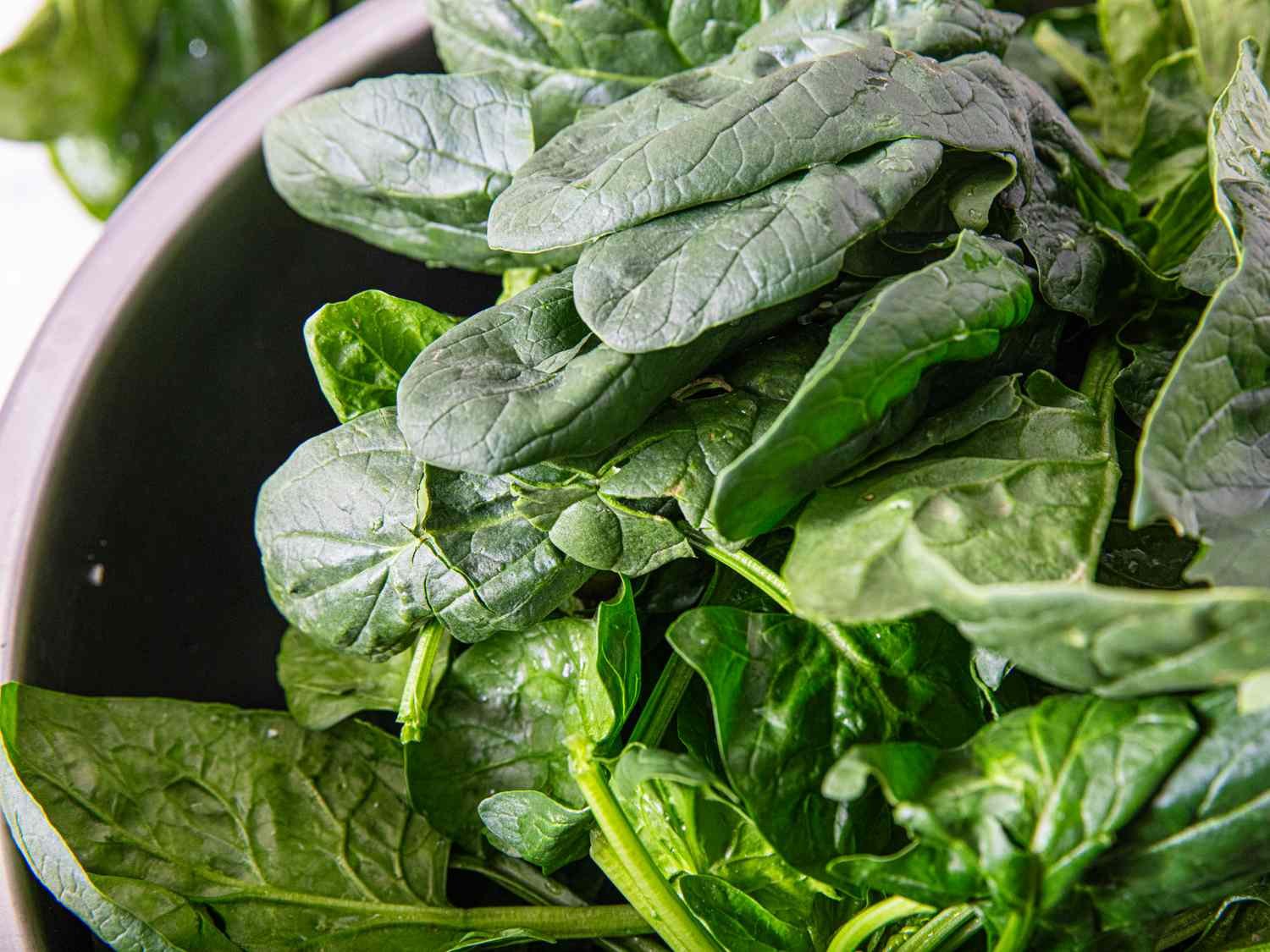
Bunches of mature spinach used to be the norm, but now they’re disappearing from grocery shelves, replaced by packaged bags and clamshells of younger spinach. We dig into the reasons why and what has been lost in the transition.
I was recently shopping for a recipe that required mature spinach—you know, the kind sold in bunches of supple, fleshy dark-green leaves connected at the base—when I realized it had disappeared. Supermarkets had none in their refrigerated produce cases, and the Instacart app indicated it was unavailable at all the stores within delivery distance that I checked. The app had other ideas: baby spinach.
I’d been aware for years that mature spinach had been waning in favor of the baby spinach leaves sold pre-washed in plastic clamshells; anyone who shops can see that. But this was the first moment I fully understood just how dramatic the shift had been. Like Zeus overthrowing his father, Cronus, baby spinach has successfully committed vegetal patricide and assumed the throne. You may have to descend to Tartarus to find mature spinach today. Well, that or the supermarket freezer aisle.
Serious Eats / Amanda Suarez
I exaggerate slightly. You can still find bunched spinach in some stores, but it has lost considerable shelf space to its younger, less-sandy usurper, its availability so reduced that it’s often not there at all. “There has been a shift from bunched spinach…to bagged spinach, which…happened 30 years or more ago,” Richard F. Smith, emeritus farm advisor at the University of California Cooperative Extension (UCCE) in Monterey County, wrote in an email. His message underscored that the transition from bunched mature spinach to bagged or packaged younger spinach has been a long time coming.
Many industry reports don’t distinguish between young and mature spinach, but according to Donald Russo, senior category manager for vegetables at Baldor Specialty Foods, a major New York–based wholesaler, the shift continues to this day. Baldor’s most recent internal sales figures aggregated across its foodservice, retail, and national-account customers show full-size (mature) spinach down 11% year over year, while baby spinach is up 2.6%.
Based on U.S. retail data, the trend is even more striking. According to Circana Integrated Fresh, a data insights company, between 2021 and 2024, 98% of dollar sales of spinach were packaged, while only 2% was bulk spinach (the data doesn’t track spinach by its maturity at harvest, but generally speaking, packaged spinach will be baby and the slightly more mature “teenage” leaves, while bulk will be more fully mature bunches). And while total retail spinach dollars fell 9.1% during that time, bulk spinach took the biggest hit, down 17%. Clearly, mature spinach is on the outs.
Serious Eats / Amanda Suarez
On the one hand, it’s good if people are eating spinach in any form—baby, teenage, or mature. It’s a very nutritious vegetable. On the other hand, this shift from mature bunches to the younger leaves has had unfortunate culinary consequences. Baby spinach may be convenient in a salad, but it’s not the best when cooked. We need mature spinach, and I implore you all to go out and buy some. Send a signal to growers and packagers that there’s still demand for the full-grown stuff, that there’s room on the shelf for both. It’ll be good for your cooking, and also for your wallet—prices vary, but packaged baby spinach can cost two to three times as much as an equivalent weight of full-grown bunched spinach.
Why the Shift From Mature to Baby Spinach?
Much of this change is due to the two Cs: convenience and consistency. “Surveys show that 40–56% of shoppers prefer packaged (in plastic bags or clamshells) produce when given the option, with spinach among the leading examples. As a result, most major retailers now dedicate the majority of spinach shelf space to pre-washed, ready-to-eat baby spinach, while mature spinach has declined significantly in both space and sales,” Gina Jones, vice president of global intelligence at the International Fresh Produce Association (IFPA), said in an email.
IFPA surveys have found that consumers perceive washed, packaged baby spinach as both more convenient and more consistently fresh. Pre-washed, packaged spinach means home cooks don’t have to deal with removing sand and grit from the vegetable’s leaves, and they’re unlikely—heaven forbid—to encounter a living creature hidden among them. They can just pop open the clamshell lid, grab a handful of spinach, and throw it in their salad for lunch. It’s undeniably easier.
Serious Eats / Amanda Suarez
It can also be advantageous for business. While washing, drying, and packaging add production costs, young spinach saves money in the field: it’s seeded more densely, has a shorter growing period, and can be harvested mechanically, unlike mature bunches, which are cut by hand. Those advantages in the field don’t necessarily mean it’s cheaper overall to produce packaged baby spinach. Still, the result is a premium-seeming, ready-to-eat product that justifies a higher price tag.
What’s the Downside?
As I said before, I’m happy people are eating spinach in any form. Better that than not at all. But that doesn’t mean I’m all for it. I’ve registered my displeasure with how baby spinach cooks in many of my own recipes before: In the presence of heat, baby spinach’s more delicate leaves melt into a texture I often describe as wet toilet paper, limp, mushy, and lacking substance. All spinach cooks down a ton and loses texture, but mature spinach retains some semblance of substance and bite. I can’t say the same for the immature leaves.
I also find that baby spinach has a remnant of a muddy flavor that I often associate with other, less mature leafy vegetables, like microgreens: the plant hasn’t fully come into its own; it’s still carrying traces of the generic flavor of its more embryonic form. Mature spinach, meanwhile, tastes fully of spinach. And spinach, in case you’ve been feeding on too much baby spinach in recent years to remember, is delicious.
Recipes
Malfatti (Italian Spinach Dumplings)
There’s another downside: the environmental one. All those clamshells of baby spinach and other leafy green salad mixes are contributing significant amounts of plastic to our landfills. What used to arrive in a crate or cardboard box in its natural state, at the most tied with a string or maybe secured with a hefty rubber band, is now surrounded by a protective shell of petroleum. It’s a sad reality that today, even the green things in our lives are decidedly less green.
What to Do
The next time you’re shopping for spinach, especially if you plan to cook it, try to buy mature bunches instead of the plastic clamshells of young spinach, and if you can’t find it, let the produce manager know that you want them to start stocking it again.
Washing the bunched spinach leaves isn’t difficult: Just put them in a large bowl, fill it with cold water, and swish them around. Then lift the leaves out of the bowl and into another one. Dump out the sandy water from the first bowl, rinse it, and then repeat. After three passes through cold water, the leaves should be sand-free. (It’s important to lift the leaves out of the washing water before draining and not drain the sandy water through the leaves, as you’ll just put the sand right back on them.)
Serious Eats / Amanda Suarez
And if that sounds like too much of a pain to you, remember that frozen spinach is made from mature leaves. It’s already been washed and cooked down before freezing, making it an incredibly convenient option for many soups, stews, and spinach-based sauces (such as for palak paneer). You’ll get all the flavor and texture of mature spinach with none of the work.
If you still want to grab some baby spinach to toss into a lunch, please do—I’m not trying to guilt you about it. Just make an effort to remind yourself how good mature, bunched spinach is, quickly, before it’s too late.
