

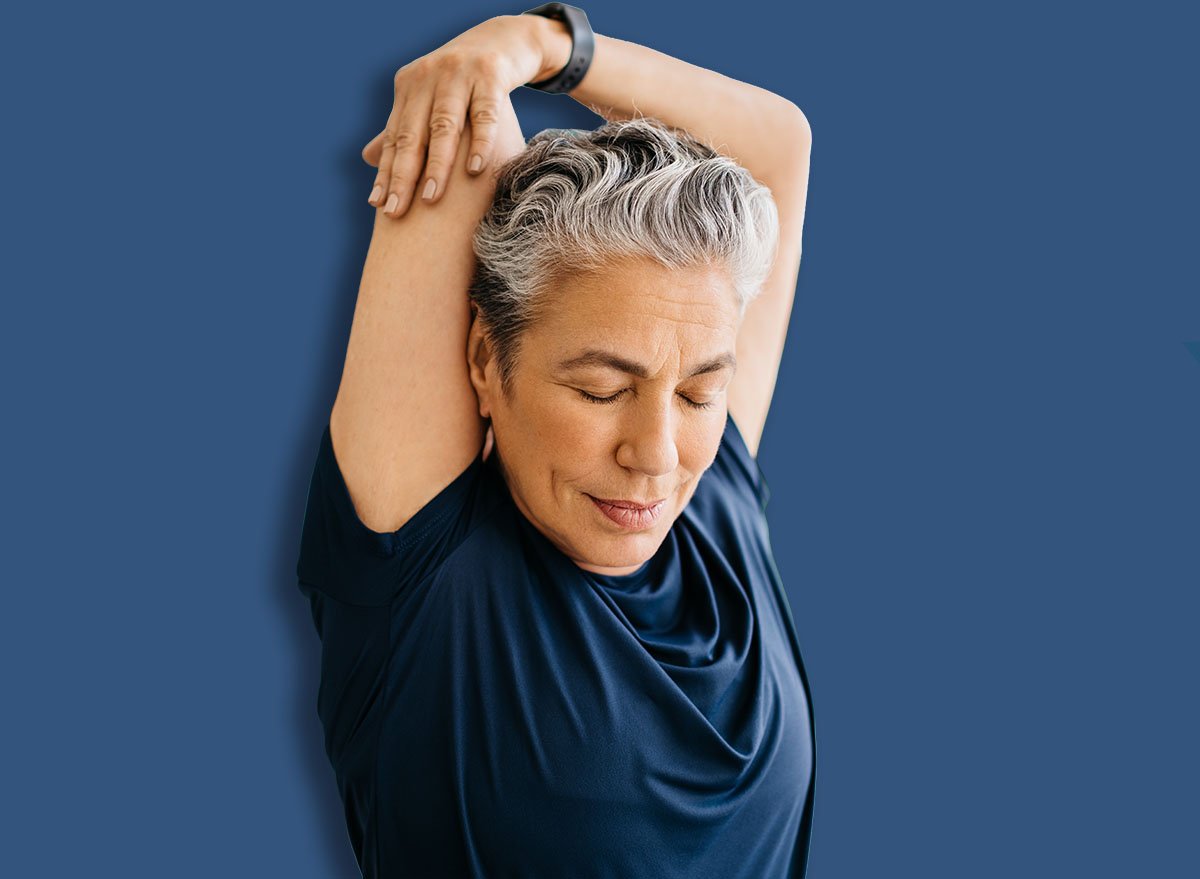
A trainer’s 6 standing moves that target arm jiggle better than weight training after 60
One of the biggest misconceptions I hear, especially when it comes to firming up the arms, is that it’s just about doing more exercises or more reps. But before we even talk about exercise, we have to understand what’s happening in the body as we age. Arm jiggle isn’t just about fat. It’s influenced by hormonal changes, protein intake, and sarcopenia. Once you understand why the tissue is changing, you can train in a way that actually gives your body a reason to adapt. These six standing exercises target all three heads of the triceps and improve the tissue quality around them, no gym required.
Why Your Arms Change After 60
Copyright piercefamilywell/YouTube
As we age, levels of estrogen, testosterone, and growth hormone naturally change. These changes lead to reduced collagen production, decreased skin elasticity, and a reduced ability to build and maintain muscle.
Nutrition is also a major consideration. It’s important to ensure that you’re eating enough protein to support tissue repair. Without enough protein, the body simply doesn’t have the raw materials it needs to maintain muscle and connective tissue.
Another factor is sarcopenia, the natural loss of muscle mass with age. Dynapenia, the loss of strength and the ability to produce force in the muscle, also needs to be considered. So it’s not just that muscles get smaller. They lose their ability to activate, create tension, and support the joint.
Load, Tension, and Strain
Shutterstock
When it comes to building muscle, your body responds to three key things: load, time under tension, and strain.
Load is simply how much weight you’re asking your body to handle. One common mistake I see, especially in women, is using weights that are too light to actually challenge the tissue. If the load is too low, the body has no reason to adapt, no reason to build muscle, no reason to strengthen connective tissue, and no reason to improve tone. So even though you feel like you’re working, nothing is really changing at the tissue level.
Time under tension is how long the muscle is actually working during a movement. Not just how many reps you do, but how much meaningful tension you’re creating over time. If you’re moving quickly, swinging weights, or just going through the motions, you’re not keeping the muscle under tension long enough to create a change. What we want is controlled movement, where the muscle is engaged the entire time, especially through the hardest parts of the motion. That sustained tension is what signals the body to adapt.
Strain is a mechanical concept: how much the tissue deforms under load. In simple terms, it’s how the muscle, tendon, and fascia respond when you apply force to them. When you apply the right amount of load, over enough time, you create strain in the tissue. And that strain is what stimulates adaptation. It tells the body: we need stronger muscle, more resilient connective tissue, better structural support.
Why Tissue Pliability Matters
Shutterstock
If a muscle and its surrounding fascia aren’t able to lengthen, adapt, and glide, they can’t accept load properly. And if they can’t accept load, you can’t create meaningful strain.
This is where myofascial stretching becomes critical. Myofascial stretching doesn’t just stretch a muscle. It changes the quality of the tissue itself. When done correctly, myofascial stretching:
- Improves the ability of the muscle and fascia to lengthen under load
- Increases time under tension in a much more specific, targeted way
- Allows you to apply load through a greater range of motion
- Helps rehydrate the tissue
- Begins to reorganize the fascial structure around the muscle
That last part is huge. Your fascia acts like a container around the muscle. If that container is stiff, restricted, or disorganized, it actually limits how the muscle can function and even how it can grow. But when you improve fascial organization and pliability, you create more space, better load distribution, and better force transmission. The muscle doesn’t just get stronger. It has the potential to develop more fully.
Exercise 1: Lateral Head Kickback (Pronated Grip)
This first variation targets the lateral head, the outside part of the tricep. By pronating the wrist and forearm (turning the palm to face behind you), you isolate the lateral head through the full extension of the elbow.
Muscles Trained: Lateral head of the triceps
How to Do It:
- Stand and hinge forward slightly at the hips.
- Line your upper arm up with your back, not below it, not above it, right in line.
- Pronate your wrist and forearm (palm faces behind you).
- Extend the elbow joint, keeping everything else fixed.
- Control the weight back down slowly.
Avoid These Mistakes:
- Don’t swing the weight or use momentum.
- Don’t let your upper arm drift below or above your back line.
- Don’t rush through the lowering phase. Control both directions.
Recommended Sets and Reps: 8 to 12 reps per arm, 1 to 3 sets.
Form Tip: Keep the upper arm locked in position. The only joint moving should be the elbow.
Shutterstock
Same position, same motion, but now I’m changing from pronation to supination. By turning the palm to face upward, you shift the emphasis to the medial head, the most inside part of the tricep.
Muscles Trained: Medial head of the triceps
How to Do It:
- Stay in the same hinged-forward position.
- Keep your upper arm lined up with your back.
- Supinate your wrist and forearm (palm faces the ceiling).
- Extend the elbow, keeping your arm tight to your body.
- Lower the weight back down with control.
Recommended Sets and Reps: 8 to 12 reps per arm, 1 to 3 sets.
Form Tip: The only change from Exercise 1 is the grip. Everything else stays the same.
Exercise 3: Long Head Kickback (Neutral Grip)
Shutterstock
For the long head of the tricep, I’m no longer pronated or supinated. I go neutral at the forearm (palms facing in, like a hammer grip). Same concept, same controlled extension of the elbow.
Muscles Trained: Long head of the triceps
How to Do It:
- Stay in the hinged-forward position with your upper arm in line with your back.
- Hold the weight with a neutral grip (palm faces your body).
- Extend the elbow smoothly and fully.
- Control the weight through the entire movement. Don’t let it swing. Don’t let it drop.
Recommended Sets and Reps: 8 to 12 reps per arm, 1 to 3 sets.
Form Tip: Nice and smooth and controlled throughout the entire movement. That’s how you keep time under tension high.
Exercise 4: Myofascial Tricep Stretch (Pinky to Spine)
After strengthening all three heads, we want to stretch them. I prefer myofascial stretching to create pliability of the tissue. It’s not just about range of motion. It’s about how well you can create gliding, not only within each individual muscle head, but between the triceps and everything that surrounds them.
Muscles Trained: All three heads of the triceps, surrounding fascia
How to Do It:
- Reach your hand behind your head and place your pinky finger toward your spine.
- Do a slight pelvic tilt.
- Use your opposite hand to gently pull your elbow across.
- At the same time, think about reaching your elbow to the ceiling while pulling your shoulder blade (scapula) toward the floor.
- Hold for 30 seconds per side.
Form Tip: You’re creating length in two directions at once: up through the elbow and down through the scapula.
Exercise 5: Myofascial Tricep Stretch (Thumb to Spine)
Shutterstock
Same concept as Exercise 4, but now place your thumb toward your spine instead of your pinky. This changes the angle of the stretch and targets a different portion of the tricep and fascial tissue.
How to Do It:
- Reach behind your head and place your thumb toward your spine.
- Gently pull on the elbow with your opposite hand.
- Push up through the elbow and pull down through the scapula.
- Hold for 30 seconds per side.
Exercise 6: Myofascial Tricep Stretch (Palm to Spine)
Shutterstock
For the final variation, place your full palm against your spine. Everything else stays the same: gentle pull on the arm, pushing down with the scapula, pushing up through the elbow.
How to Do It:
- Reach behind your head and press your palm flat against your spine.
- Gently pull the elbow across with your opposite hand.
- Push up through the elbow and pull down through the scapula.
- Hold for 30 seconds per side.
Recommended Stretching Protocol: One set, three positions per side, 30 seconds each. That’s 90 seconds total time under tension per side.
The Full Picture
Copyright piercefamilywell/YouTube
When you look at the full picture, arm jiggle isn’t just one issue. It’s a combination of hormonal changes, low protein intake, sarcopenia and dynapenia, poor load, not enough time under tension, insufficient strain, and reduced tissue quality.
So instead of thinking “I just need more exercises” or “I just need to do more reps,” start thinking in terms of: Am I creating enough load? Am I keeping the muscle under tension long enough? Am I applying the right level of strain to actually stimulate change? Is my tissue pliable enough to accept that load? And am I giving my body the nutrition and hormonal environment it needs to rebuild?
Because when all of those pieces are in place, your training stops being random and your body finally has a reason to adapt. And when the body adapts, the muscles don’t just get stronger. They start to take shape.
