

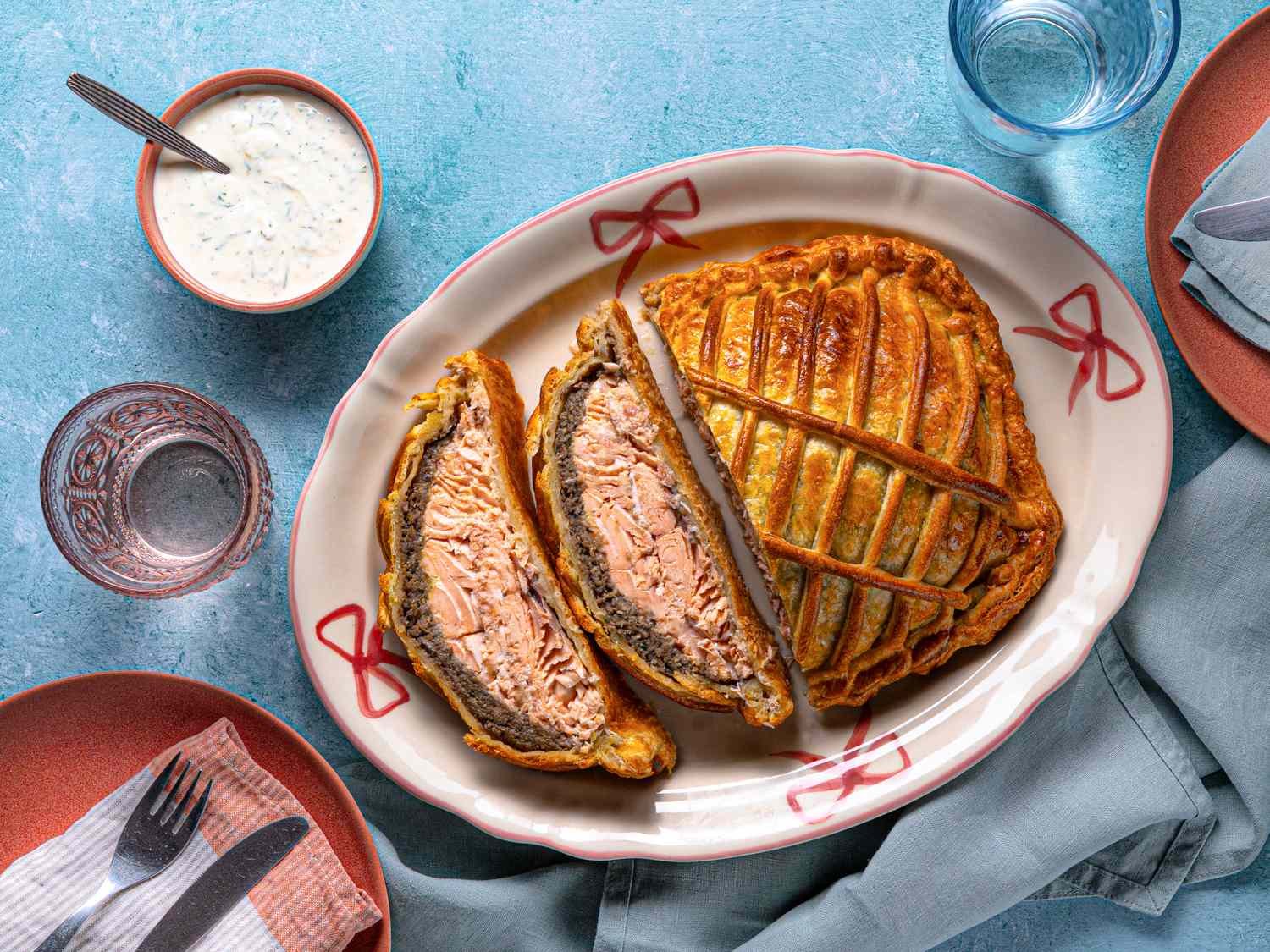
Why It Works
- Cooking the mushrooms until they’re fully dry drives off excess moisture, creating a compact, savory layer that prevents the salmon’s juices from soaking into the pastry while concentrating the mushrooms’ deep umami flavor.
- Resting the assembled roast before baking keeps the butter in the pastry dough cold, leading to a perfectly crisp shell.
Every December, beef inevitably steals the spotlight. Prime rib, tenderloin, Wellington—big, browned roasts strut onto the holiday table like they own the place. And honestly, good for them. But I’d argue that a showstopping presentation of fish can just as easily steal the limelight, especially when said fish is a rich, center-cut salmon fillet blanketed in savory mushroom duxelles and swaddled in golden pastry. Think of this dish as Beef Wellington’s chic coastal cousin: less brooding, more glamorous; hearty without being heavy; and capable of making your guests forget the beef altogether.
Salmon en croûte (or salmon Wellington, depending on whom you’re trying to impress) is, at its heart, a celebratory “roast.” There’s the indulgence of puff pastry, the deeply savory duxelles, and the satisfaction of carving into a bronzed, sculptural package to reveal perfectly roasted fish inside. Below, I break down the components and the techniques that turn a lovely piece of salmon into a truly showstopping centerpiece. Because yes, salmon absolutely deserves main-character status at the holiday table.
Serious Eats / Mateja Zvirotić Andrijanić
Choosing the Right Salmon
Let’s talk salmon strategy, because not all fillets are created equal—and in a pastry-wrapped situation, the fat content of the salmon can become your best insurance policy. Unlike a pan-seared fillet, where you control every second of doneness, salmon en croûte operates on pastry time. The fish has to stay in the oven long enough for the puff pastry to fully rise and turn deeply golden. That means we’re baking the salmon longer than we otherwise would, which pushes the fish closer to medium-well. That’s not a problem, as long as the salmon you use has a higher fat content: As it cooks, the fat melts and bastes the flesh, leaving it velvety and pink inside. A richer, fattier cut of salmon keeps the texture supple, the flakes tender, and the final slice glossy and luxurious, even if it spends a few extra minutes in the oven while the crust reaches peak puff.
The takeaway here is that you will want to avoid leaner cuts of salmon, including many wild Pacific varieties. Better here is well-marbled, responsibly farmed Atlantic salmon, or a particularly buttery wild variety like king (Chinook). Leaner species—coho, sockeye, the overachievers of the salmon world—are wonderful in almost every other context, but here they simply don’t have the cushioning power of fat we need.
While you’re shopping, also look for a center-cut fillet. It’s uniform thickness cooks evenly under the pastry, giving you consistent doneness from end to end. Avoid the thin tail portion—the little tapering flap that wants to overcook in even the gentlest preparations. Wrapped in puff pastry, that tail cooks even faster, which means it will dry out long before the rest of the roast is ready.
The Duxelles
If you’ve made Beef Wellington, you know the purpose of a duxelles: It adds savory depth and protects the protein from the pastry, preventing sogginess. Here, the same principle applies, but with salmon, the mushroom mixture serves another role—it balances the fish’s natural richness with earthy, aromatic intensity.
The key is cooking the duxelles until it is fully dry. Moisture is the enemy of crisp pastry, and mushrooms release a remarkable amount of it. I pulse mine until finely chopped, then cook them with butter, shallot, garlic, thyme, and a whisper of Madeira (it’s OK to omit) until the skillet is nearly silent and the mixture darkens and concentrates. Once cooled, it forms a flavorful, protective cap that adheres easily to the mustard-painted salmon.
Serious Eats / Mateja Zvirotić Andrijanić
How to Seal the Puff Pastry So It Doesn’t Betray You
If you’ve ever had puff pastry burst open in the oven like a lava vent, you know the heartbreak. And it almost always happens when you take the bad route: laying the salmon on one sheet of pastry, folding the other half over it like a blanket, and pinching a single seam along the top or side. That lone seam becomes a pressure point; once the steam inside starts looking for an exit, it blows open.
This recipe takes the safer route, using two full sheets of puff pastry—one underneath, one on top—sealed all the way around so the package has even support and no weak spot that can pop mid-bake. You get a tighter, more uniform wrap, fewer steam blowouts, and far more structural integrity as the pastry puffs. Pressing gently around the salmon helps eliminate air pockets, which can expand during baking and create weak spots.
Serious Eats / Mateja Zvirotić Andrijanić
Here are a few sealing rules to live by:
- Use egg wash as glue. It helps bond the layers at the seams.
- Trim to a rounded shape.
- Crimp with purpose. Don’t just press—flute the edges so they fuse and look intentionally decorative.
Once sealed, the entire bundle needs to chill. Cold pastry puffs; warm pastry slumps. Give it an hour in the fridge to firm up so it can rise tall and crisp in the oven.
Creating Decorative Flair
A lattice or crisscross design on the puff pastry is classic and easier than it looks. Rolling out the pastry scraps and slicing them into thin strips creates a diagonal pattern reminiscent of a traditional Wellington. Press the strips on gently (the egg wash will help them adhere), and don’t be afraid to trim any overhang for the cleanest presentation. You want the design to accent the roast, not suffocate it. A final brush of egg wash—top, sides, seams, all the way down—ensures a deep golden finish.
Baking, Resting, and the Tangy Sauce That Brings It All Together
Cooking the pastry-wrapped salmon in the upper third of a 400°F oven gives you rapid lift and even browning. Once it hits temperature, resist the urge to slice immediately. Resting for 10 to 20 minutes allows the juices to redistribute and the pastry shell to firm up enough for clean cuts.
And while the roast is the star, the tangy dill sauce is its ideal co-star. It’s cool and bright enough to cut through both the richness of the salmon and the butteriness of the pastry.
For all its drama, salmon en croûte is wonderfully forgiving. The components can be made ahead, the assembly is surprisingly meditative, and the oven does most of the work. So yes, beef may get the glory. But this year, let salmon take its rightful place as the holiday showstopper.
