

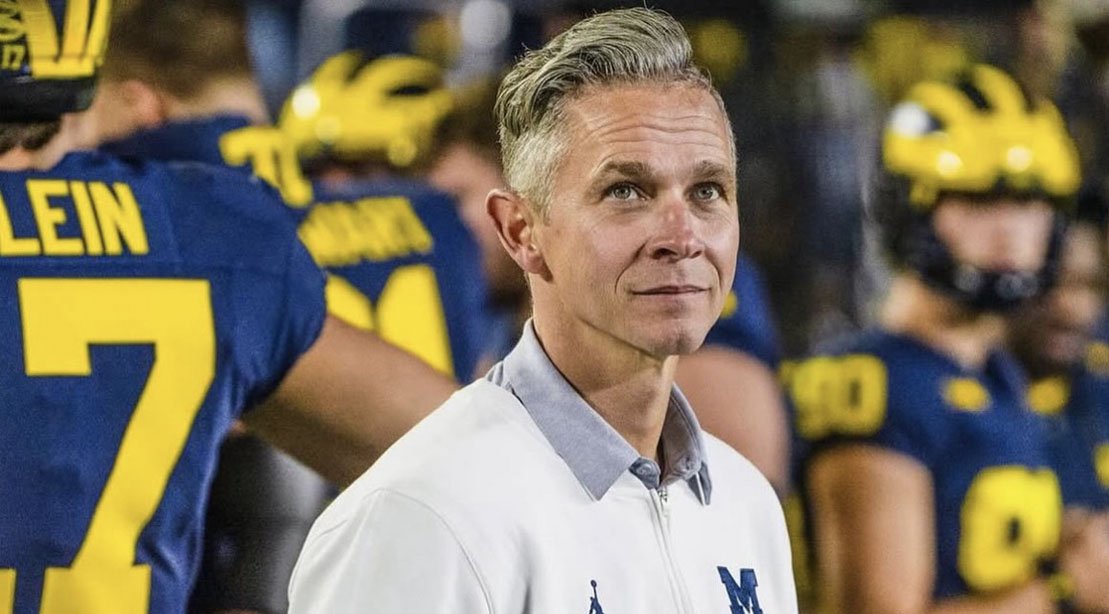
In college athletics, attention gravitates toward the visible: the head coach pacing the sideline, the star player under stadium lights, the results posted on scoreboards and social feeds. What rarely makes headlines is the work happening quietly in the background—the conversations without cameras, the mentorship without metrics, the leadership that doesn’t announce itself until years later. Yet it’s often this unseen work that determines whether a program merely wins or truly endures.
Robby Emery has spent much of his life operating in that space. A pastor, public speaker, and Michigan Football’s Director of Character Development, Emery doesn’t measure success in championships alone, nor does he believe influence requires visibility. In fact, his philosophy runs counter to the modern economy of attention. “As soon as you choose to be a fan, you can’t be a friend,” he says. “But if you choose to be a friend, you actually have the influence you’re supposed to have.”
At a time when collegiate athletics is navigating unprecedented complexity—NIL money, social media pressure, constant scrutiny—Emery’s work has become more essential, not less. His role isn’t about managing perception. It’s about shaping people. And as Michigan Football has faced moments of both triumph and turbulence, Emery’s steady presence offers a reminder that character, unlike reputation, is built slowly—and tested when no one is watching.
A Calling Rooted in People
Emery didn’t set out to work in high-performance environments. In fact, he’s quick to clarify that elite platforms were never the draw. “I wasn’t drawn by high performance,” he says. “I was drawn by people.”
That instinct traces back to his teenage years. At 14 or 15, long before social media turned influence into a commodity, Emery prayed a simple prayer: to become a person of influence to people of influence. The idea wasn’t proximity to power for its own sake, but multiplication—impact that traveled further by traveling through others.
“If I can influence the one who influences a million,” he explains, “then I don’t have to be that one.”
Over time, Emery noticed a pattern. People in high-profile positions often had plenty of fans, but few true friends. Admiration created distance; relationship closed it. “As soon as you take a selfie
with someone, you can’t operate as a friend anymore,” he says. Friendship, he believes, requires privacy, trust, and the willingness to be present without agenda.
That posture—friend before fan—would quietly shape everything that followed.
Danielle EmeryDanielle Emery
From Church Plant to the Heart of the Program
Emery’s path to Michigan Football didn’t begin with a job offer or a strategic career move. It began with a church plant.
In 2016, Emery and his family moved back to Michigan from Houston to start a church. Like most church plants, it involved evangelizing, listening, and building relationships with people who needed support. One of those people was a young man who had recently moved from Houston to play football at Michigan.
The connection wasn’t about star power. The athlete wasn’t a household name. He was third on the depth chart. But he needed guidance, community, and someone willing to invest in him without expectation. Emery became that person—inviting him into his home, sharing meals, studying scripture together.
“Student-athletes can’t go to church on Sunday,” Emery says. “So we just brought church to them.”
That one relationship led to others. Slowly, organically, Emery became a mentor not just to one athlete, but to several. And eventually, those relationships opened the door for him to serve the program more formally.
What’s striking about the story is what isn’t there: ambition. Emery wasn’t trying to leverage connections or climb an institutional ladder. He was simply doing what he had always done—showing up for the next person in need. The scale came later.
University of Michigan
Culture Under Pressure: Trust, Accountability, and Leadership in Adversity
College football rarely allows a program to struggle in private. When scrutiny intensifies, the noise gets louder, and every decision feels amplified—inside the building and out. Michigan has felt that pressure in recent seasons, the kind that forces an organization to confront what it values when the spotlight is harshest. For Emery, those moments aren’t detours from the work; they are the work.
“The foundation of everything is trust,” he says. “It’s not a communication problem—it’s a trust problem.” In moments of scrutiny, Emery argues that leaders must first ask why they arrived there in the first place. What doors were left open? What expectations went uninspected? Accountability, he notes, is popular in theory but uncomfortable in practice—especially when it turns inward.
His framework for healthy culture is deceptively simple: trust, healthy conflict, commitment, accountability, and results. Miss the order, and the structure collapses.
“Conflict isn’t bad,” Emery says. “Unresolved conflict is bad. Healthy conflict leads to commitment. Commitment leads to accountability. Accountability produces results.”
Underlying all of it is a sober view of human nature. Emery doesn’t believe culture has a ceiling because people don’t. Everyone is flawed. Everyone carries selfishness. Maturity, he says, often comes not through intention, but through responsibility—marriage, family, leadership, consequence.
“You don’t know how selfish you are until life puts weight on you,” he says.
In high-stakes environments, where pressure magnifies behavior, Emery’s work centers on closing the gap between values spoken and values lived. Not with condemnation, but with clarity.
Danielle EmeryDanielle Emery
Identity Beyond the Jersey
For today’s college athletes, identity is under constant assault—not only from performance expectations, but from the endless feedback loop of social media, NIL opportunities, and public opinion. Emery believes one of his most important responsibilities is helping young men separate who they are from what they do.
He often illustrates this with a ladder.
“I want them to climb,” he says. “I want them to succeed. I want them to get everything they can from their talent.” But he’s equally insistent that they climb down just as quickly. Praise, he explains, is intoxicating—and dangerous if internalized too deeply.
“If you stay at the top, you’re going to fall,” he tells them. “And falling from that height hurts.”
To drive the point home, Emery uses another metaphor: juggling glass and rubber balls. Some things—family, faith, integrity—are glass. Drop them, and they shatter. Others—jobs, roles, seasons—are rubber. They bounce back.
“You want to drop the rubber one,” he says.
Growth, Emery reminds them, doesn’t happen on mountaintops. Nothing grows there. Growth happens in valleys, in humility, in the unglamorous work of becoming grounded. In an environment that rewards elevation, Emery teaches descent.
Danielle Emery
Being Ready When You’re Chosen
The themes Emery teaches daily—preparation, humility, readiness—are at the heart of his book, Pick Me
Midway through the show, the band invited someone from the audience to play guitar. A young man fought his way to the stage, pulled a guitar pick from his pocket, and played flawlessly in front of 40,000 people. What struck Emery wasn’t the performance—it was the preparation.
“That kid didn’t know he’d be chosen,” Emery says. “But he was ready just in case.”
The message resonated deeply with the athletes Emery mentors. Opportunities don’t announce themselves in advance. You don’t get ready in the moment—you prepare long before it arrives.
That same philosophy shapes Emery’s vision for events like the Olympia Performance Weekend and for the future of character development in collegiate athletics. With more money, more freedom, and more exposure than ever, athletes need disciplines that anchor them when life squeezes.
“What comes out when you’re bumped,” Emery says, “is what’s already in you.”
Legacy, for Emery, isn’t something you declare. It’s something people observe. It’s being the same person on good days and bad ones. It’s tipping well even after bad service. It’s giving your family the best of you, not the leftovers.
“I don’t want to have to speak to say something,” he says. “I want people to see it.”
In a results-driven industry, that may be the most countercultural stance of all. And perhaps the most enduring.
