

Key Takeaways
Positive reinforcement involves adding something good after a behavior to make it happen more often.
Reinforcement works best when given right after the behavior happens to keep the right connections.
When you are trying to teach a new skill, whether it’s teaching your dog to sit or getting yourself to stop doomscrolling before bed, rewarding good behavior is often better than punishing mistakes. Positive reinforcement involves rewarding desirable behaviors, making such actions *more* likely to be repeated.
It’s a common concept in behavioral psychology that can be used to teach and strengthen behaviors. Think about it this way: when you do one thing and something good happens as a result, you’ll probably want to do the same thing again (and again) in the future so you can get those same effects. It’s why we show up at work every day and put in a little extra effort when preparing for a big exam. The payoffs for those actions (yay, money! good grades!) act as positive reinforcers, making the behavior more likely to occur again.
What Is Positive Reinforcement?
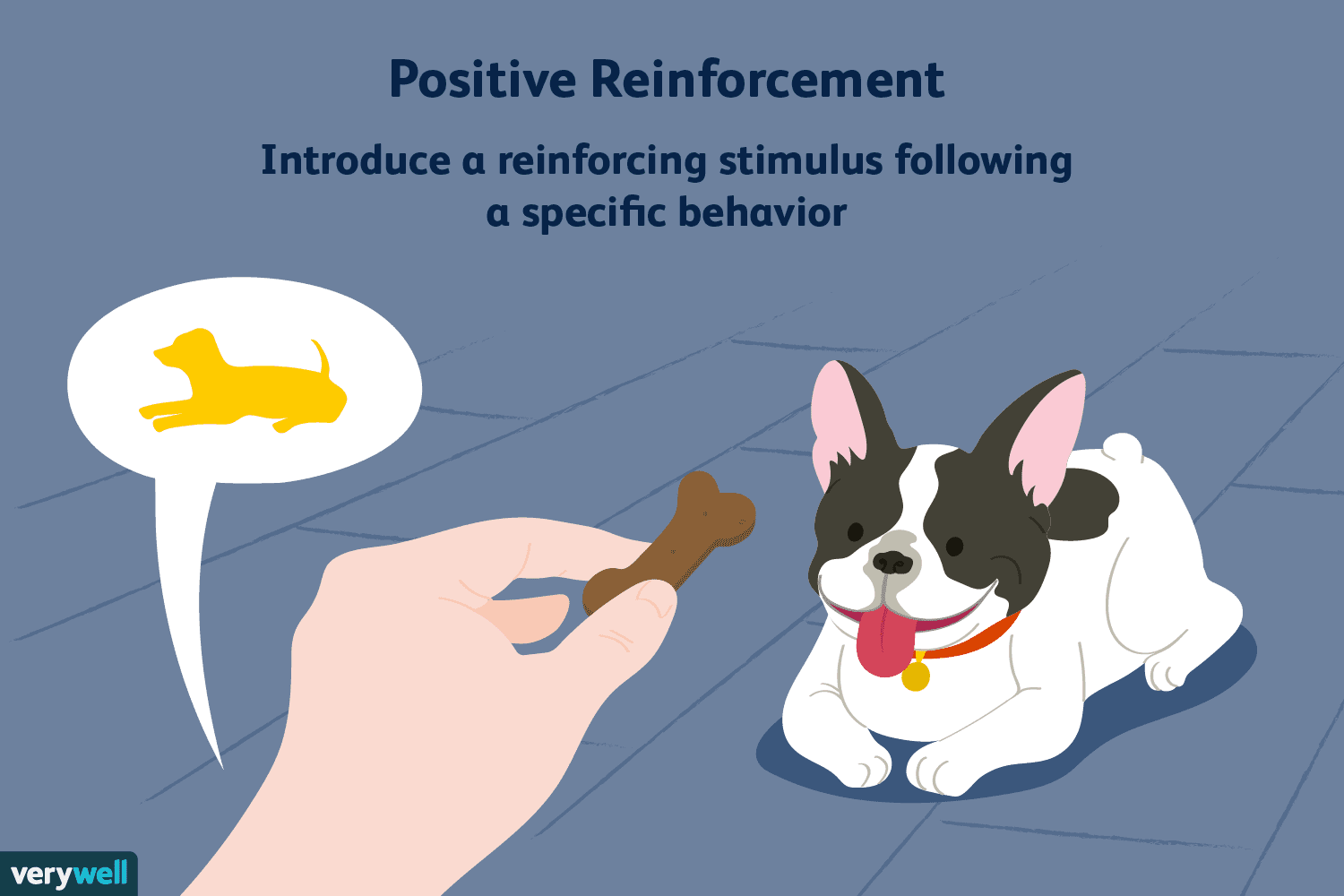
In operant conditioning, positive reinforcement involves the addition of a reinforcing stimulus following a behavior that makes it more likely that the behavior will occur again in the future. When a favorable outcome, event, or reward occurs after an action, that particular response or behavior will be strengthened.
You can probably think of quite a few positive reinforcers. Such reinforcers are sometimes just natural consequences of our actions, but they can also involve social (praise), tangible (money), or token (points) rewards.
No matter what type, research suggests that positive reinforcement can be highly effective for teaching and modifying behaviors in home, school, and therapy settings. If you’re interested in trying it, remember that timing matters. Rewards should be given quickly and on a schedule that encourages consistent, lasting responses.
What makes positive reinforcement positive?
Positive reinforcement is positive because it involves something being added. By thinking of it in these terms, you may find it easier to identify real-world examples of positive reinforcement.
Sometimes positive reinforcement occurs quite naturally. For example, when you hold the door open for someone, you might receive praise and a thank you. That affirmation serves as positive reinforcement and may make it more likely that you will hold the door open for people again in the future.
In other cases, someone might choose to use positive reinforcement very deliberately in order to train and maintain a specific behavior. An animal trainer, for example, might reward a dog with a treat after the animal shakes the trainer’s hand and pauses for a count of five.
Basics of Operant Conditioning
Operant conditioning was introduced by the psychologist B. F. Skinner, who based the idea on Thorndike’s law of effect. The basic idea behind the law of effect is that the consequences of behavior determine whether that behavior happens again. Reinforced behaviors become strengthened, while punished behaviors are weakened.
Both reinforcement and punishment can either be positive or negative:
- Positive reinforcement is the addition of a positive outcome to strengthen behavior.
- Negative reinforcement is the removal of a negative outcome to strengthen a behavior.
- Positive punishment involves taking away a desired stimulus to weaken a behavior.
- Negative punishment involves applying an undesirable stimulus to weaken a behavior.
There are four main types of reinforcement in operant conditioning: positive reinforcement, negative reinforcement, punishment, and extinction. Extinction occurs when a response is no longer reinforced, which leads to the disappearance of the behavior.
Examples of Positive Reinforcement
There are many examples of positive reinforcement in action. Consider the following scenarios:
- Praise: After you execute a turn during a skiing lesson, your instructor shouts out, “Great job!”
- Monetary rewards: At work, you exceed this month’s sales quota, so your boss gives you a bonus.
- Other rewards: For your psychology class, you watch a video about the human brain and write a paper about what you learned. Your instructor gives you 20 extra credit points for your work.
In each situation, the reinforcement is an additional stimulus occurring after the behavior that increases the likelihood that the behavior will occur again in the future.
Types of Positive Reinforcement
There are many different types of reinforcers that can be used to increase behaviors, but it is important to note that the type of reinforcer used depends on the individual and the situation.
- Natural reinforcers occur directly as a result of the behavior. For example, a student studies hard, pays attention in class, and does their homework. As a result, they get excellent grades.
- Social reinforcers involve expressing approval of a behavior, such as a teacher, parent, or employer saying or writing, “Good job” or “Excellent work.”
- Tangible reinforcers involve presenting actual, physical rewards such as candy, treats, toys, money, and other desired objects. While these types of rewards can be powerfully motivating, they should be used sparingly and with caution.
- Token reinforcers are points or tokens that are awarded for performing certain actions. These tokens can then be exchanged for something of value.
While gold stars and tokens might be very effective reinforcement for a second-grader, they are not going to have the same effect on a high school or college student.
For positive reinforcement to be effective, it needs to involve a reward that the individual wants or needs.
Positive Reinforcement vs. Negative Reinforcement
The goal of both positive and negative reinforcement is to increase the likelihood that a behavior will occur again in the future. The difference is in how each accomplishes this.
Positive reinforcement adds something to strengthen behavior, while negative reinforcement removes something.
Example of Positive vs. Negative Reinforcement
For example, allowing a child to play on their tablet if they finish their homework is an example of positive reinforcement. Negative reinforcement would be a child finishing their homework to avoid having their tablet taken away.
Uses for Positive Reinforcement
When used correctly, positive reinforcement can be very effective. It can be used in various settings to make desired changes to behavior or teach new behaviors.
- At home: Parents can use positive reinforcement to encourage kids to engage in all kinds of positive, desirable behavior. For example, a parent might use praise or other rewards to get a child to brush their teeth, get ready for bed, or clean up their room.
- In school: Teachers can also use positive reinforcement to help kids engage in desired classroom behavior. An example of positive reinforcement in the classroom would be praising a child for raising their hand or giving them a sticker on their reward chart for turning their homework in on time.
- In therapy settings: Therapists also use positive reinforcement to help teach new behaviors and coping skills. For example, positive reinforcement is commonly used as part of behavior modification, an intervention that focuses on reducing or eliminating maladaptive behaviors.
While different strategies can be used depending on the situation, some experts suggest that positive reinforcement should be used more often than negative reinforcement or punishment.
How to Use Positive Reinforcement
Positive reinforcement can be a useful learning tool in a wide variety of settings. There are things that you can do to make sure that it is used effectively.
Be Aware of Reinforcement Timing
Positive reinforcement is most effective when it occurs immediately after the behavior. Reinforcement should be presented enthusiastically and should occur frequently.
- Deliver reinforcement quickly. A shorter time between a behavior and positive reinforcement makes a stronger connection.
- Waiting risks reinforcing the wrong behaviors. The longer the time, the more likely an intervening behavior might accidentally be reinforced.
Use the Right Reinforcement Schedule
In addition to the timing and type of reinforcement used, the presentation schedule can also play a role in the strength of the response. Schedules of reinforcement can have a powerful influence on how strong a response is and how often it occurs.
When you first teach a new behavior, you would likely use a continuous reinforcement schedule, where you deliver positive reinforcement every single time the behavior occurs. Once the response is established, you would then switch to an intermittent or ratio schedule.
Avoid Reinforcing the Wrong Behaviors
It is important to note that positive reinforcement is not always a good thing. It can lead to desirable behaviors, but it can also strengthen undesirable behaviors.
When used incorrectly, positive reinforcement can sometimes contribute to undesirable behaviors. Waiting too long to deliver reinforcement or reinforcing the wrong behaviors can lead to the wrong associations.
For example, when a child misbehaves in a store, some parents might give them extra attention or even buy them a toy in an effort to stop the behavior. Children quickly learn that by acting out, they can gain attention from their parents or even acquire objects they want. Essentially, parents are reinforcing the misbehavior.
A better solution would be to use positive reinforcement when the child is displaying good behavior. Instead of rewarding the misbehavior, the parents would want to wait until the child behaves well and then reward that good behavior with praise, treats, or even a toy.
Takeaways
Positive reinforcement can be an effective learning tool when used appropriately. Sometimes this type of learning occurs naturally through normal interactions with the environment.
In other cases, parents, teachers, and therapists can use this behavioral technique to help teach new behaviors. When using positive reinforcement, it’s important to be thoughtful about the type of reinforcers and the schedule that you use to train the new behavior.
Verywell Mind uses only high-quality sources, including peer-reviewed studies, to support the facts within our articles. Read our editorial process to learn more about how we fact-check and keep our content accurate, reliable, and trustworthy.
American Academy of Pediatrics. Positive reinforcement through rewards.
American Psychological Association. Positive reinforcement.
Barata R. Positive reinforcement. In: Vonk J, Shackelford T, eds. Encyclopedia of Animal Cognition and Behavior. Springer International Publishing; 2020:1-2. doi:10.1007/978-3-319-47829-6_761-2
Fitriati SW, Fatmala D, Anjaniputra AG. Teachers’ classroom instruction reinforcement strategies in English language class. EduLearn. 2020;14(4):599-608. doi:10.11591/edulearn.v14i4.16414
Hardy JK, McLeod RH. Using positive reinforcement with young children. Beyond Behavior. 2020;29(2):95-107. doi:10.1177/1074295620915724
Sprouls K, Mathur SR, Upreti G. Is positive feedback a forgotten classroom practice? Findings and implications for at-risk students. Prev School Fail. 2015;59(3), 153-160. doi:10.1080/1045988X.2013.876958
Johnson AR, Christensen BA, Kelly SJ, Calipari ES. The influence of reinforcement schedule on experience-dependent changes in motivation. J Exp Anal Behav. 2022;117(3):320-330. doi:10.1002/jeab.755
Thanks for your feedback!
What is your feedback?
Helpful
Report an Error
Other
