

Hate squats? Build stronger legs after 60 with 5 joint-friendly moves from CSCS Jarrod Nobbe.
Squats are known for building strong legs, but that doesn’t mean they work for everyone. Maybe you’ve never loved them. Perhaps your knees, hips, or lower back no longer tolerate the movement. Or perhaps you want options that still build serious strength without forcing your body into a pattern that feels off. The truth is, squats are effective, but they’re not mandatory.
After 60, leg strength still hinges on simple yet effective training. Compound exercises remain the foundation because they train multiple joints and muscle groups at once. Adding unilateral work helps clean up imbalances that quietly build over decades. When you blend both, you challenge your legs in ways that support real-world movement, such as walking, climbing stairs, and maintaining balance on uneven ground.
Movement variety matters just as much. Your legs don’t work in a straight line all day, so your training shouldn’t either. Training through multiple planes helps strengthen connective tissue, improve joint control, and spread stress more evenly across your muscles. That balance often leads to better strength gains with less wear and tear.
The exercises below check every box. They hit your quads, hamstrings, glutes, and stabilizers. They build strength through different angles. They feel joint-friendly while still demanding effort. If squats aren’t your thing anymore, these five moves give you a smarter path forward.
Kettlebell Deadlift
The kettlebell deadlift builds lower-body strength without forcing a deep knee bend. It lets you load your hips and hamstrings while keeping your torso upright and controlled. That setup often feels far more comfortable on aging knees and backs. It also teaches strong hinge mechanics that carry over to picking up items, standing tall, and protecting your spine. Because the weight stays close to your body, it’s easy to control and scale.
Muscles Trained: Glutes, hamstrings, quadriceps, core, and lower back
How to Do It:
- Stand with your feet hip-width apart and the kettlebell centered between them.
- Push your hips back while keeping your chest tall.
- Bend your knees slightly and grip the kettlebell handle.
- Drive through your heels and stand tall as you squeeze your glutes.
- Lower the kettlebell with control by hinging your hips back.
Recommended Sets and Reps: Knock out 3 sets of 8 to 12 reps. Rest for 60 seconds between each set.
Best Variations: Goblet deadlift, suitcase deadlift, elevated kettlebell deadlift
Form Tip: Keep your ribs stacked over your hips throughout the movement.
Step-ups
Step-ups train leg strength on one side at a time, helping correct imbalances that build over years of daily habits. They closely mimic real-life movements, such as climbing stairs or stepping onto curbs. This exercise challenges your quads and glutes while improving balance and coordination. You control the height, making it easy to adjust intensity without straining your joints.
Muscles Trained: Quadriceps, glutes, hamstrings, and calves
How to Do It:
- Stand facing a sturdy step or box.
- Place one foot entirely on the step.
- Drive through your front heel to stand tall.
- Bring your opposite foot up under control.
- Step back down slowly and switch sides.
Recommended Sets and Reps: Perform 3 sets of 6 to 10 reps per leg. Rest for 60 seconds between each set.
Best Variations: Low box step-ups, weighted step-ups, lateral step-ups
Form Tip: Control the lowering phase instead of dropping back down.
Lateral Step-downs
Lateral step-downs strengthen your legs in a direction most people neglect. They load your hips and knees while improving control in the frontal plane. This builds joint resilience and helps protect against slips, missteps, and awkward landings. The slow, controlled movement also strengthens your stabilizers without heavy loading.
Muscles Trained: Quadriceps, glutes, hip stabilizers, and calves
How to Do It:
- Stand sideways on a low step with one foot hanging off
- Slowly bend your standing knee as the free foot lowers toward the floor
- Tap the heel lightly without shifting your weight
- Press through your heel to stand back up
- Complete all reps before switching sides
Recommended Sets and Reps: Knock out 3 sets of 6 to 8 reps per leg. Rest for 60 seconds between each set.
Best Variations: Assisted lateral step-downs, tempo step-downs, and weighted step-downs
Form Tip: Keep your knee tracking in line with your toes.
Lateral Lunge
Lateral lunges train your legs through side-to-side movement that squats rarely touch. They stretch and strengthen your inner thighs while building strong hips and glutes. This movement improves mobility and strength simultaneously, which becomes increasingly valuable with age. It also helps distribute force more evenly across your legs.
Muscles Trained: Glutes, quadriceps, hamstrings, and adductors
How to Do It:
- Stand tall with your feet together.
- Step wide to one side and sit your hips back.
- Keep your opposite leg straight as you load the stepping leg.
- Push through your heel to return to standing.
- Alternate sides under control.
Recommended Sets and Reps: Perform 3 sets of 6 to 10 reps per side. Rest for 60 seconds between each set.
Best Variations: Bodyweight lateral lunge, goblet lateral lunge, sliding lateral lunge
Form Tip: Sit your hips back instead of letting your knee drift forward.
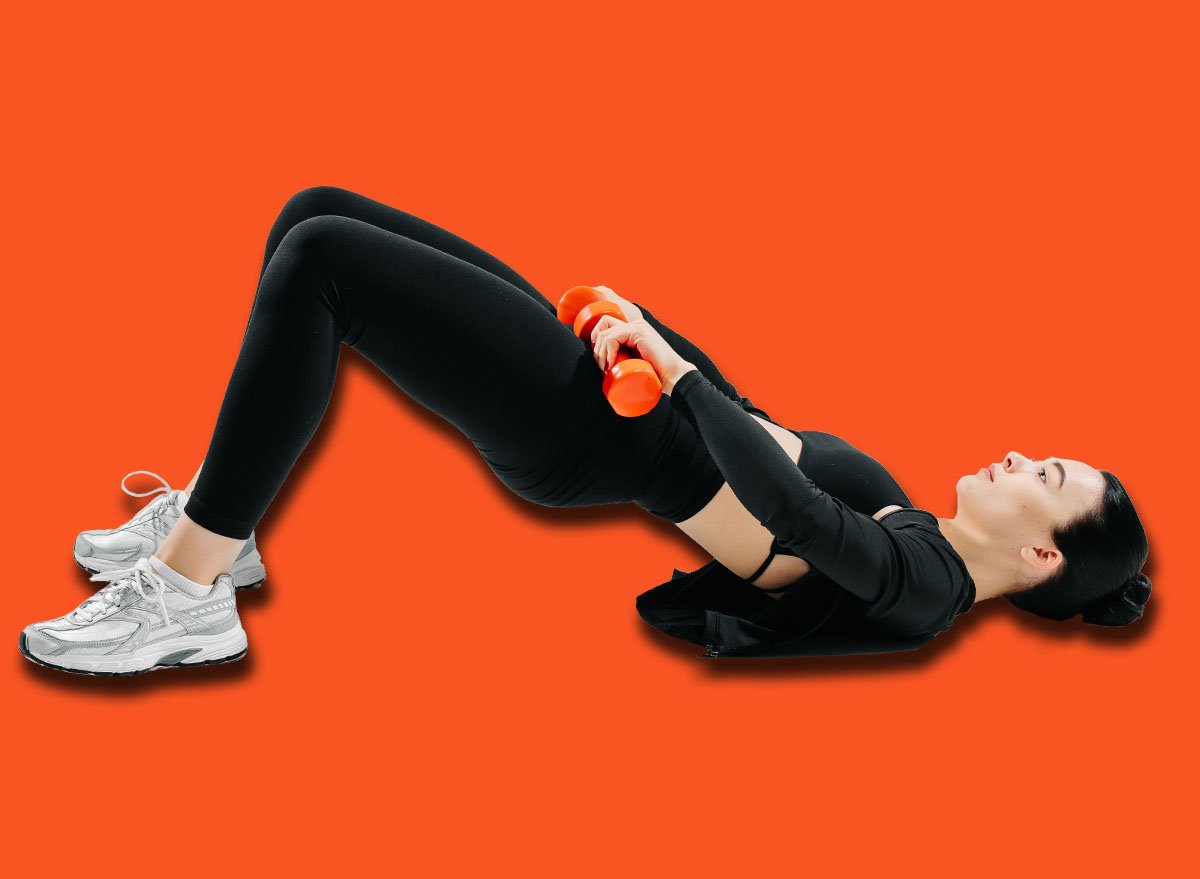
Dumbbell Glute Bridge
Glute bridges strengthen your posterior chain without loading your spine. They target muscles that support posture, walking speed, and overall stability. Strong glutes help reduce strain on your knees and lower back during daily movement. This exercise also allows you to build strength while staying grounded and supported.
Muscles Trained: Glutes, hamstrings, and core
How to Do It:
- Lie on your back with your knees bent and feet flat.
- Place a dumbbell across your hips and hold it steady.
- Drive through your heels to lift your hips.
- Squeeze your glutes at the top.
- Lower your hips slowly back to the floor.
Recommended Sets and Reps: Knock out 3 sets of 10 to 15 reps. Rest for 60 seconds between each set.
Best Variations: Bodyweight glute bridge, single-leg glute bridge, elevated glute bridge
Form Tip: Pause briefly at the top to reinforce full hip extension.
The Best Tips for Building Leg Strength After 60
Shutterstock
Building strong legs after 60 depends on consistency, effective exercise selection, and recovery. Endless volume or punishing workouts to make progress aren’t the genuine keys to success in your fitness journey. Focus on quality movement and steady effort.
- Train across multiple planes: forward, lateral, and unilateral movements help build balanced strength and joint resilience.
- Prioritize control: Slow reps and clean technique protect your joints and improve muscle engagement.
- Progress gradually: Increase reps, load, or range of motion over time rather than rushing into heavier weights.
- Stay consistent: Two to three focused leg sessions per week beat sporadic high-intensity workouts.
- Listen to your joints: Mild muscle fatigue is fine, but sharp joint discomfort means it’s time to adjust.
These five exercises give you everything you need to build strong, capable legs without relying on squats. Stick with them, and you’ll feel the difference where it matters most.
References
- Paoli, Antonio et al. “Resistance Training with Single vs. Multi-joint Exercises at Equal Total Load Volume: Effects on Body Composition, Cardiorespiratory Fitness, and Muscle Strength.” Frontiers in physiology vol. 8 1105. 22 Dec. 2017, doi:10.3389/fphys.2017.01105
