

What if your exhaustion wasn’t just because of family stress, work tasks and social obligations? While those things can certainly cause fatigue, it turns out iron deficiency ― which is present in roughly one-third of women who get a period ― can be the culprit.
“Many people think [iron is] just another vitamin, like you just didn’t take your iron, or you didn’t get enough in your diet, but it’s totally not that. Iron is a very important mineral … that’s involved with every cell in the body utilizing energy,” said Dr. Steven Fein, a hematologist and owner of HemeOnCall, women’s health centers that treat iron deficiency, abnormal blood counts and more hematology issues.
“Your muscles cannot contract without iron. Your brain cannot think without iron,” he explained.
The issue is most prevalent in premenopausal women. “We think that about 30 million U.S. women have iron deficiency,” Fein said.
Iron deficiency can cause a host of issues, including a condition called iron deficiency anemia. “You can imagine it like a spectrum where iron deficiency without anemia is the milder version, and then if you get to a point where you have iron deficiency anemia … if you get to that point where you’re that severe, then the symptoms are all the worse — more fatigue, more tiredness,” Fein said.
About 15% of American women have iron deficiency anemia, and another 15 or 20% have iron deficiency without anemia, according to Fein.
“Anemia … means that the iron is low enough that the bone marrow has essentially failed to keep up. It needs iron to make red blood cells, and it just can’t make enough because it doesn’t have the right supplies,” explained Dr. Joseph Shatzel, a classical hematologist and associate professor in the school of medicine at Oregon Health and Science University.
Neither iron deficiency or iron deficiency anemia should be ignored, as they both can cause health problems. Both can be diagnosed via blood tests ordered by your doctor.
But getting diagnosed may take some self-advocating. “We do not have a routine recommendation in the U.S. to screen for iron deficiency,” Shatzel said. As a result, the problem often goes unaddressed.
Here’s what to know about iron deficiency and iron deficiency anemia, including the signs you should bring up with your doctor:
Fatigue and brain fog are frequently reported symptoms of iron deficiency and iron deficiency anemia.
Women are often saddled with the mental load when it comes to caring for children, partners, parents and completing must-do tasks around the home. This is often associated with more fatigue and lower mood. And while that is certainly true, iron deficiency can play a role here as well.
The most common symptom of iron deficiency and iron deficiency anemia is fatigue, “but difficulty concentrating, or poor concentration, that sort of mental fog … is well noted,” Shatzel explained.
Signs of iron deficiency also include impaired memory and mood-related complications, Fein added. Research shows that low iron can worsen depression and anxiety, too. People may also have trouble catching their breath after exercise or going up stairs, according to Fein. It may also cause you to feel dizzy or lightheaded.
“Sometimes, people have weird cravings like chewing ice or craving ice,” said Fein, who noted that restless leg syndrome is also reported. Hair thinning is another indicator, according to Shatzel.
Bevan Goldswain via Getty Images
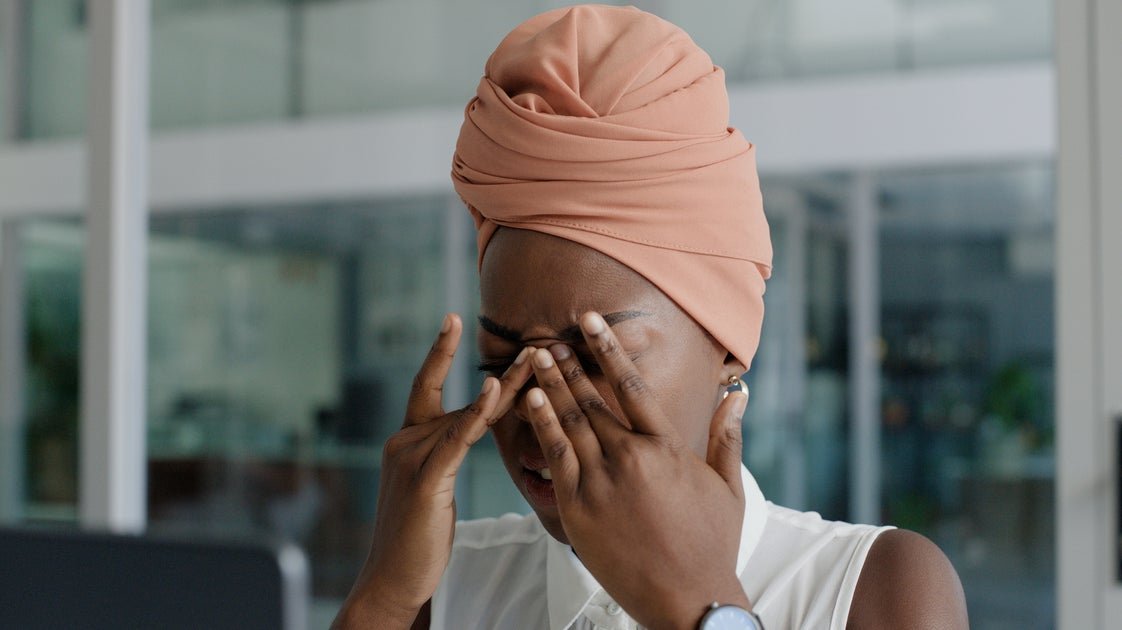
Tiredness, brain fog and low mood are all signs of iron deficiency.
Iron deficiency and iron deficiency anemia are common in people who menstruate because of the blood loss.
“Every time you have a menstrual cycle … you lose blood. Blood is really your main store of iron,” said Shatzel, noting that it only takes a small amount of blood loss to spark the problem.
The body absorbs iron very slowly, and this is intentional “because if you do get excessive iron, that can be a health risk as well,” Shatzel explained.
“Probably about half of the women who have low iron have heavy periods that they don’t even realize a lot of the time,” Fein said.
There are also other causes of iron deficiency, including inflammatory bowel disease and Crohn’s disease, Fein noted. The problem can also be a sign of colon cancer, a gastric ulcer or even Celiac disease, according to Shatzel. These issues can happen in both men and women, but in men, the underlying cause of iron deficiency is often more severe.
There’s also been a rise in people getting gastric bypass weight loss surgery, “which causes iron deficiency on purpose by causing malabsorption of all nutrients,” Fein said.
But it’s largely an issue among women with periods and bleeding disorders, Fein added.
Iron deficiency and iron deficiency anemia is common in pregnancy and can cause complications.
Iron deficiency and iron deficiency anemia is also common (and under-diagnosed) in pregnant people, according to both experts, which can be particularly dangerous.
Research shows that iron deficiency can cause complications in pregnancy for both the mother and the baby, Shatzel noted. These include complications like preterm birth, low birth weight and developmental delays. If moms are fatigued already from low iron, they’re less able to push, resulting in more C-sections, Fein said. C-sections are more risky than vaginal delivery.
“And this is a public health problem that affects Black people disproportionately, because it turns out that half of [pregnant] Black people have iron deficiency, and a third of non-Black [pregnant] people have iron deficiency,” Fein added.
Iron deficiency is common in pregnancy and can lead to problems for both the mother and the baby if untreated.
Treating low iron can improve quality of life.
Getting iron levels to a healthy range not only brings your body back to where it should be, but can make life more enjoyable, too.
Treating iron deficiency is done in one of two ways, either by oral iron pills or IV therapy, Shatzel explained. The best remedy depends on the person. Your doctor can help you get the right treatment, but experts say IV iron often tends to be more effective.
If left untreated, in rare cases, blood transfusions are necessary, Shatzel said.
It’s also important to treat the underlying cause of iron deficiency, which for many women is heavy periods, and can benefit from birth control and other medical interventions, according to Shatzel. But since low iron can also be caused by GI issues, GI workups are sometimes necessary to figure out the best treatment plan.
“I think the biggest thing in the general population is the quality of life. It’s pretty clear people feel better when they’re not anemic and their iron is at a good level,” Shatzel said.
Iron deficiency can make folks tired, unfocused and anxious, which impedes day-to-day functioning, whether that’s spending time with loved ones, going to work or heading out for a hike.
With normal iron levels, athletic performance will likely improve, making that run, dance class or HIIT class a little less tiring. Or you may find you have enough energy for better performance at work, said Fein, as heavy periods, tiredness and brain fog can result in missed work days and trouble concentrating on tasks.
20 Years OfFreeJournalism
Your SupportFuelsOur Mission
Your SupportFuelsOur Mission
For two decades, HuffPost has been fearless, unflinching, and relentless in pursuit of the truth. Support our mission to keep us around for the next 20 — we can’t do this without you.
We remain committed to providing you with the unflinching, fact-based journalism everyone deserves.
Thank you again for your support along the way. We’re truly grateful for readers like you! Your initial support helped get us here and bolstered our newsroom, which kept us strong during uncertain times. Now as we continue, we need your help more than ever. We hope you will join us once again.
We remain committed to providing you with the unflinching, fact-based journalism everyone deserves.
Thank you again for your support along the way. We’re truly grateful for readers like you! Your initial support helped get us here and bolstered our newsroom, which kept us strong during uncertain times. Now as we continue, we need your help more than ever. We hope you will join us once again.
Support HuffPost
Already contributed? Log in to hide these messages.
“At the very least, it’s a quality of life issue for all these women,” Fein said. “And not only that, it’s a gender inequality issue to the point [where] a woman may not be able to function well at work. They may not get the job promotion or the salary that they deserve because they have this [issue], whereas men do not have this problem.”
“My general sense of this is that it hasn’t really been as important as it should be to the medical community because this is a very common thing that the majority of people suffering from are women,” Shatzel said.
If you get a period and suffer from brain fog, fatigue or any of the symptoms associated with iron deficiency and iron deficiency anemia, it’s worth talking to your doctor about potential testing. It may be the step you need to take to start living a more enjoyable life.
