

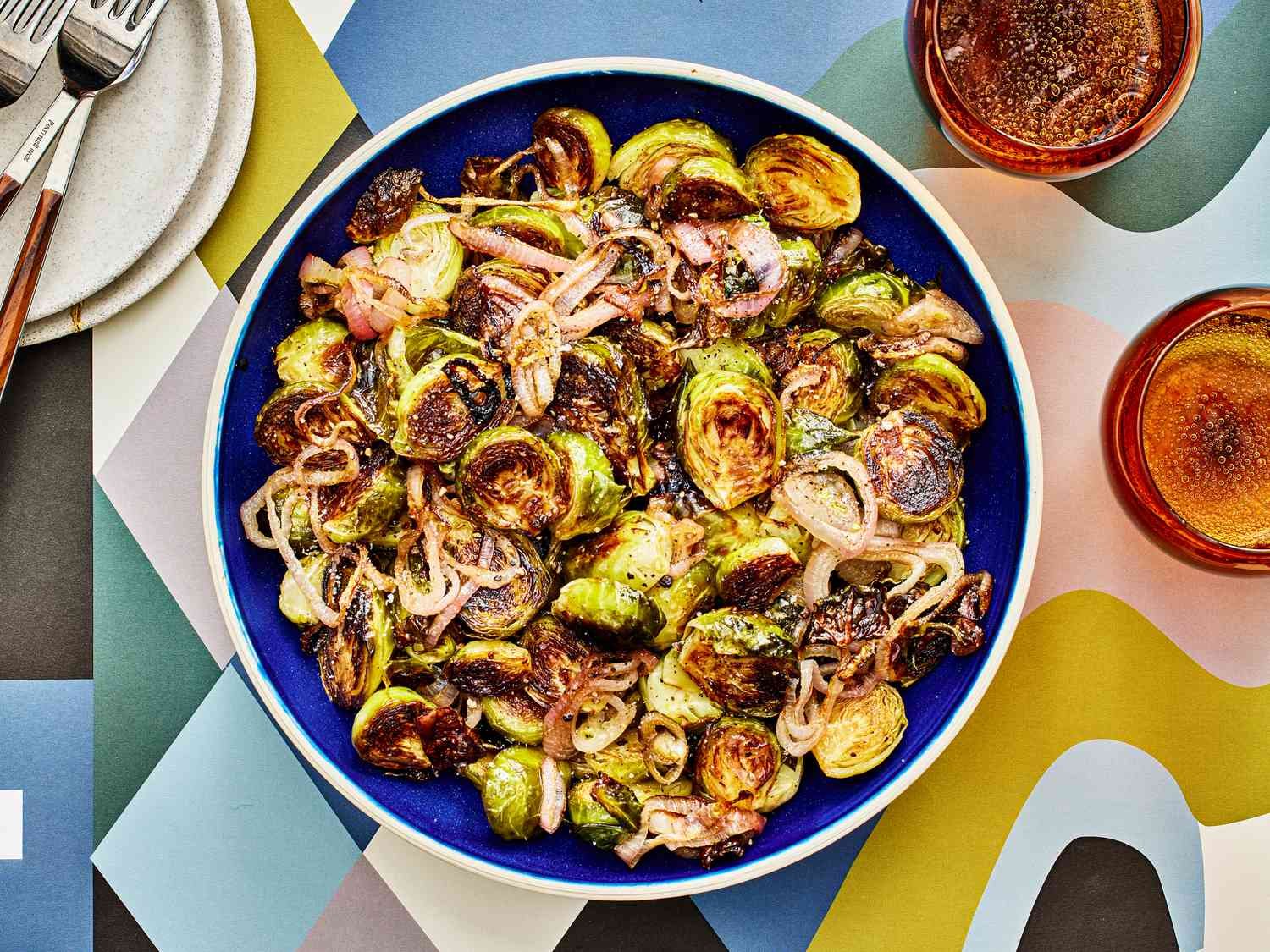
Not all pans roast alike. A simple swap from a shiny sheet pan to a dark cast iron pan can completely change how your vegetables brown, even when everything else stays the same. Here, I put that idea to the test to see just how much pan material matters and explain the science behind why.
When roasting vegetables—whether it’s broccoli, potatoes, or Brussels sprouts—most of us fuss over oven temperature and roasting time to achieve perfectly golden, crisp results, but one of the most important factors that’s often overlooked is the pan itself.
It’s easy to assume a pan is just a vehicle, a place to put the food. We tend to blame the oven when vegetables burn or refuse to brown, but sometimes the real difference is what’s under them.
In a previous article on roasting vegetables, I explored how lining a baking sheet with parchment or foil can dramatically affect browning and texture. Parchment, I found, acts as an insulator, reducing heat transfer and yielding paler, softer vegetables, while bare metal or foil delivers crisp, caramelized results.
But even if you skip the parchment, how much does the pan itself matter? Does cast iron’s dark, heavy surface behave differently from a shiny aluminum sheet? Could the material alone push a recipe from golden perfection to burnt bitterness? To find out, I put it to the test with one of Serious Eats’ most beloved sides, Kenji’s easy roasted Brussels sprouts.
The Test
To test how much a pan’s material really matters, I needed a recipe that would exaggerate those effects—a method that pushes vegetables to their limits. For testing, I selected Kenji’s easy roasted Brussels sprouts, one of Serious Eats’ most popular Thanksgiving sides, and a master class in high-heat roasting.
Kenji’s method starts by tossing the sprouts with olive oil, salt, and pepper, then preheating a foil-lined baking sheet in a blazing-hot 500°F (260°C) oven. The sprouts go in cut-side down so they make direct, sizzling contact with the hot metal—maximizing browning and minimizing steaming. It’s what Kenji calls a “full-on, frontal-assault, no-prisoners-taken, blast-the-sh*t-out-of-’em approach” to roasting.
That technique is brilliant for flavor, but also unforgiving. The recipe teeters on a narrow edge between deep caramelization and outright burning, making it the perfect laboratory for pan testing. Even slight variations in how each pan absorbs, conducts, or reflects heat can tip the sprouts from crisp perfection into charred oblivion.
So, I ran three batches of the same recipe using different pans:
- A cast iron skillet
- A carbon steel roasting pan
- The foil-lined, aluminum rimmed baking sheet Kenji uses in the original
The goal wasn’t to change the recipe, just to see how each pan material would affect the outcome.
The Results
All three batches were roasted for 20 minutes, but the differences were striking.
- Foil-lined, aluminum baking sheet: Produced sprouts just as Kenji promised—deeply caramelized, crisp-edged, tender within.
- Carbon steel roasting pan: The sprouts browned aggressively; some edges veered toward burnt.
- Cast iron skillet: Gorgeous for a moment, and then disaster. Within minutes, those golden sprouts turned blackened and bitter.
The recipe, as it turns out, walks a razor-thin line between deeply caramelized and irretrievably charred—and the pan’s material is what decides which side you land on.
Serious Eats / Swetha Sivakumar
Why Some Pans Burn and Others Don’t
Why the difference? It comes down to physics. One main reason is a property called emissivity, which measures how efficiently a surface absorbs and emits radiant energy inside the oven.
Every surface in your oven constantly emits infrared radiation, exchanging heat with the surrounding environment. When that radiation hits a pan, some of it’s reflected, some is absorbed, and some is re-emitted. How much depends on the metal’s color, texture, and finish.
- Cast iron is dark and matte, with a high emissivity (around 0.6–0.7). It behaves like a heat sponge, soaking up infrared energy and then radiating it intensely back toward the food. That makes it perfect for searing steaks or cornbread—but in a 500°F oven, that same efficiency can quickly turn Brussels sprouts from caramelized to charred.
- Carbon steel sits somewhere in the middle. It’s thinner and more responsive than cast iron, so it heats and cools faster, but it shares cast iron’s dark surface and relatively high emissivity. That combination means it absorbs radiant heat aggressively but also transfers it quickly through its thinner body, so food browns faster and more unevenly. In my tests, the sprouts in the carbon steel pan developed great color on their cut sides, but a few browned too much before the centers softened—a sign of localized overheating.
- Shiny aluminum or foil-lined baking sheets, by contrast, have a low emissivity (around 0.1–0.3). Their reflective surfaces bounce much of the oven’s infrared radiation, so they heat primarily by conduction from the metal itself rather than by radiation from the oven walls. The result is steadier, gentler heating and a more forgiving window between “deeply golden” and “burnt.”
In simpler terms, dark, dull metals act like radiators; shiny metals act like mirrors. The cast iron and carbon steel both ran “hotter” in terms of radiant energy, while the shiny foil-lined aluminum reflected much of it away. That’s why the foil-lined tray delivered sprouts with deep, even browning, while the dark pans went over the edge.
Serious Eats / Swetha Sivakumar
But it’s not just the surface that matters. The whole construction of a pan—its size, thickness, color, and metal composition—shapes how it behaves in the oven. A roasting vessel’s physical properties determine how it absorbs, conducts, and retains heat, and together they can dramatically affect timing, browning, and evenness. In other words, the pan’s material, mass, and color all work together to set the stage for how your food cooks.
There’s also a mass and thickness factor at play. Cast iron’s heft means it stays hot once it’s hot, continuing to transfer heat to the food even after the oven door opens. Aluminum, on the other hand, sheds heat quickly, helping prevent overshoot. In high-heat recipes that already push ingredients to their limit, that difference can make or break the result.
The Takeaway: The Pan Is Part of the Recipe
You don’t need to overhaul your cookware collection to make better roasted vegetables—but understanding how each pan behaves helps. When a recipe specifies a particular pan material, its timing and temperature are tuned for that surface. Swap the pan, and you change the heat equation.
If you’re using a darker or heavier pan—like cast iron or carbon steel—start checking early. Those pans absorb and radiate more heat, so food tends to brown (and burn) faster. If you’re using a shiny or reflective tray, like aluminum or a foil-lined sheet, expect gentler, slower browning.
If you are using a pan that’s different from what the recipe calls for and your vegetables always come out too pale or too dark, try swapping your pan to better align with he recipe or adjusting the cooking time to account for the different material’s behavior.
In high-heat recipes like Kenji’s, where the difference between “golden and sweet” and “blackened and bitter” might be 90 seconds, these details can make all the difference. The pan is an active player in the recipe—once you understand that, you can fine-tune your results simply by choosing the right surface.
