

Why Are Boundaries So Important?
Boundaries are the healthy limits that define and separate us from others (Katherine, 2010). They’re what create and sustain the conditions for the meaningful relationships we all desire and are essential for our mental health and wellbeing (Chernata, 2024; Ryder & Bartle, 1991).
Clear interpersonal boundaries are associated with healthier relationship functioning and improved emotional wellbeing (Ryder & Bartle, 1991).
Rooted in our differing values, everyone’s boundaries are different. Therefore, what might feel OK for one person may feel like a complete violation for another.
Similarly, what felt OK in the past may no longer feel OK in the present, because our values can change across time. This makes it important to routinely check in with our boundaries to make sure they’re still appropriate.
How Do You Know if Your Boundaries Need Work?
Unfortunately, many of us don’t notice that our boundaries need attention until we reach a crisis point.
By then, the signs may have been present for some time. Often, we simply haven’t slowed down enough to notice them.
For example:
- You notice resentment building beneath the surface of your interactions.
- You feel a sense of exhaustion that rest can’t resolve.
- You notice a pattern of automatically saying “yes” followed by regret.
- Your relationships feel draining instead of nourishing.
Similarly, practitioners may find themselves broaching the subject of boundaries when their clients:
- Have difficulty expressing their needs
- Exhibit people-pleasing tendencies
- Repeatedly find themselves in situations where they feel disrespected or overlooked
Ideally, it’s best to set aside time regularly to analyze your boundaries. That way you can avoid the suffering that accompanies feeling drained and the damage that flows from relational resentment.
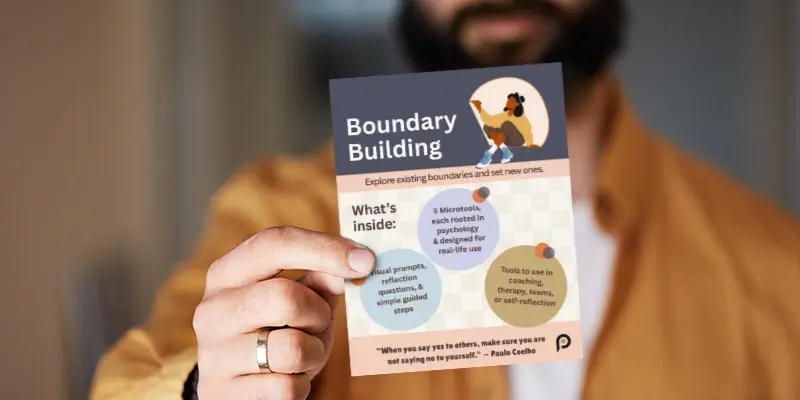
Thankfully, our collection of Boundary-Building Anchor Cards makes this process simple.
Available in physical format from our store, these beautifully designed cards make boundary setting visual and fun, helping you guard against boundary breakdowns before they even arise.
What Are the Boundary-Building Anchor Cards?
These handy cards offer a series of evidence-based, ready-to-use micro tools. They’re designed to help you become clearer on boundaries and plan strategies to assert them in the situations that matter most.
Here’s what’s inside the deck.
1. Boundary mapping
This first card offers a structured way to help you map out your boundaries.
It’s a helpful card for anyone who is confused about why they feel drained and overwhelmed in different dimensions of their lives, as it helps you identify and visualize your limits using different “zones.”
This card is also perfect for therapy or coaching clients who need an explicit starting point for exploring their boundaries.
2. Boundary maintenance
The boundary maintenance card works as a diagnostic tool to understand why you struggle to uphold a particular boundary.
If you know your boundaries but repeatedly find yourself crossing them, this card will help reconnect you with your core values and emotions.
This card is the perfect tool for helping overcome patterns of self-abandonment or creating a plan for reinstating eroded boundaries.
3. Flexibility in boundaries
Boundaries are living agreements that grow alongside you. That’s why the third Anchor Card presents a structured way to review and revise existing boundaries.
This card is perfect for anyone navigating life transitions, like a new relationship or career change, or anyone who feels their boundaries may have become outdated.
It can also be a helpful tool for clients who struggle to distinguish between healthy protection and avoidance to strike a better balance.
4. Romantic boundaries
The fourth card guides you through an exploration of boundaries with your romantic partner.
This is a particularly helpful card for anyone looking to strengthen communication around needs and limits in an existing relationship or set healthy boundaries early on in a new relationship.
For clients who exhibit patterns of codependency or enmeshment, this card will help by addressing all types of boundaries ranging from emotional to physical to financial and beyond.
5. Internal boundaries
Lastly, the final card invites you to explore where in life you may be lacking limits or structure so that you can set better boundaries with yourself.
If you’re someone who struggles with procrastination, overcommitment, or self-discipline, this card will help you put the right guardrails in place.
It is a useful tool for practitioners to explore the gap between clients’ goals, values, and behaviors in ways that spark self-insight and make it easier to access consistent motivation.
Taken together, these five cards offer a comprehensive tool kit for understanding, strengthening, and leveraging your boundaries across the situations and relationships that shape your daily life. Learn more about the cards in our store.
How to Use the Boundary-Building Anchor Cards
There’s no fixed way to use any of our Anchor Cards.
Rather, they’re a flexible tool that you can integrate into your self-development practice any way you choose.
Here are some ideas:
- Try drawing a card and journaling about the prompt.
- Pull a relevant card when you notice tension arising in a relationship.
- Set a card as a visible reminder on your fridge, desk, or mirror.
For practitioners, the cards offer a smooth entry point for exploring boundaries in session.
- Use the cards to introduce the language of boundary setting, helping clients to articulate limits they’ve never expressed before.
- Use a card to plan boundaries together in session. After implementing those changes in their life, debrief their insights when you reconvene.
- Use the cards as discussion prompts in group settings or workshops to normalize boundary challenges and invite shared reflection.
Helpful Tips for Building Better Boundaries
Building better boundaries takes practice, not perfection. Here are some useful tips to support you in making the small, intentional shifts that protect your energy and create meaningful change over time:
- Remember that setting boundaries isn’t about keeping people at a distance. It’s about creating conditions for closer, more authentic connection to occur.
- Truly healthy boundaries possess a harmonious balance. They should not be so rigid that they block connection, nor so lax that they leave you resentful and drained. Aim for balance.
- People can’t know your boundaries if you don’t communicate them. So practice expressing your limits with clarity and kindness, even when it feels uncomfortable.
- Remember to revisit your boundaries as you grow. What protected you in one chapter of life may need adjusting in the next.
Whether you’re an individual looking to strengthen your own boundaries or a practitioner seeking ready-to-use tools for client sessions, we hope you will value this collection.
We can’t wait to hear how you put the Boundary-Building Anchor Cards to work in your life or practice.
Explore the Boundary-Building Anchor Card deck in our store, and let us know in the comments how you plan to use the cards — we’d love to hear your ideas.
You can either purchase a deck of five Anchor Cards or invest in the popular bulk pack of 25 identical decks (five cards per deck).
We hope you enjoyed reading this article. Don’t forget to download our five positive psychology tools for free.
