

What Happens When Stress Gets Out of Control?
It’s natural to feel stress in response to life’s challenges and demands. Everyone encounters moments when external pressures activate a stress response.
Have you faced the following?
- Feeling like there is much to do, but insufficient time
- Worrying about upcoming situations that may challenge you
- Dealing with unexpected setbacks or events
- Managing difficult interactions with others
No matter the cause, when stress becomes chronic, it fundamentally changes how our minds and bodies operate (Melamed et al., 2006).
It keeps the nervous system in a heightened state that drains physical and emotional resources (Schaufeli & Taris, 2005).
How Do You Know if Your Stress Levels Are Too High?
For many, the negative effects of stress begin with mental and emotional symptoms.
These symptoms can take the form of changes in your mood, level of energy, or mental clarity.
Does this describe you?
- Experiencing irritability or emotional outbursts that are out of character
- Feeling exhausted even after a full night’s sleep
- Struggling to concentrate or make decisions that used to feel straightforward
- Feeling emotionally numb or detached from activities or relationships you used to enjoy
When stress is persistent, these issues may even escalate to physical symptoms, such as:
- Headaches
- Digestive problems
- Muscle tension with no clear medical cause (Pozos-Radillo et al., 2024)
It’s always best to monitor stress levels regularly and intervene early. Thankfully, there are plenty of strategies to both plan ahead for stressful times and regulate stress as you experience it in the moment, giving your nervous system the support it needs.
That’s where our Anchor Cards come in.
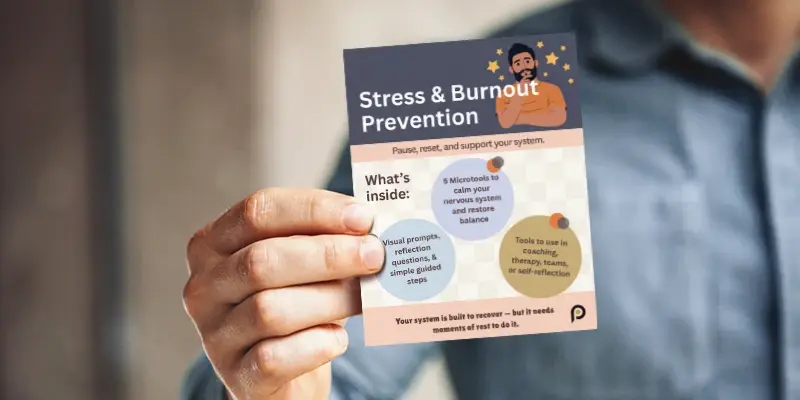
Available in physical format from our store, our Stress & Burnout Prevention Anchor Cards put the strategies for better stress management directly in your hands.
Thoughtfully designed, compact, and convenient, these cards make stress management visual and accessible, helping you build resilience before stress spirals out of control.
What Are the Stress & Burnout Prevention Anchor Cards?
Our portable Stress & Burnout Prevention Anchor Cards offer a series of evidence-based, ready-to-use micro tools for identifying stress patterns, grounding your nervous system, and cultivating the resilience you need to thrive under pressure.
Here’s what’s inside the deck.
1. SOBER pause
The first card is designed to help you interrupt stress in the moment.
If you’re someone who gets overwhelmed easily or reacts impulsively to stress, this card will teach you a simple acronym — SOBER — to help you step out of autopilot and get back in the driver’s seat (Bowen et al., 2011).
If you’re a practitioner, this card provides useful homework for clients to begin building a buffer between stimulus and response during stressful situations in their daily life.
2. Eye of the hurricane
The eye of the hurricane card offers a powerful practice that helps you to remain grounded even when circumstances feel turbulent (Grossman et al., 2004).
It’s a useful card for anyone who feels swept up by multiple demands at once as it helps you perceive a clear distinction between you and these simultaneous stressors.
This card is also perfect for therapy or coaching clients who struggle with anxiety, rumination, or feeling consumed by their circumstances, as it teaches them to observe stress without being overtaken by it.
3. Stress emergency plan
Stress is easier to manage when you can pinpoint its source. That’s why the third Anchor Card presents a structured taxonomy to categorize your stressors and select appropriate solutions (Albrecht, 1974).
This card is helpful for anyone who feels a vague sense of overwhelm but confusion about what to tackle first or how to go about it.
It’s also a great card for coaching clients stuck in generalized anxiety or burnout, as it provides a bird’s-eye view of stress patterns that enables a differentiated approach to stress management.
4. Nature reset
The fourth Anchor Card leverages what we know about the grounding effects of nature to help you return to your senses during times of stress (Kaplan, 1995).
If you’re someone who spends most of your time indoors or in front of screens, this card is powerful for helping you get out of your head and reconnect with the natural world.
For clients with access to natural spaces, this is also an excellent and accessible way to calm anxiety or chronic dysregulation.
5. Be the mountain
The final card invites you into a grounding visualization that allows thoughts, emotions, and stressors to pass like weather through the sky (Kabat-Zinn & Zinn, 2013).
It’s a helpful card for those who feel easily destabilized by difficult circumstances, as it allows you to connect with a sense of inner strength.
For practitioners, this is a useful visualization you can teach clients to help them cultivate a sustainable sense of resilience they can draw on at any time.
In combination, these five strategies can help anyone minimize the symptoms and suffering that accompany stress and avoid the longer periods of recovery that are often required once burnout sets in. Learn more about the cards in our store.
How to Use the Stress & Burnout Prevention Anchor Cards
The beauty of our Stress & Burnout Prevention Anchor Cards is their versatility.
They’re designed to be flexible stress-management tools that you can integrate into your life or practice any way you choose.
Here are some great ways to get started:
- Try drawing a card in the morning and setting an intention for how you’ll manage stress that day.
- Pull a relevant card when you notice physical signs of stress, like tension, rapid heartbeat, or shallow breathing.
- Set a card as a visible reminder on your workspace, bathroom mirror, or car dashboard.
If you’re a practitioner helping clients better manage stress, here are some ways to integrate the cards into your work:
- Use the cards to help clients identify their unique stress patterns and early warning signs they may have been overlooking.
- Integrate the cards into a broader mindfulness intervention aimed at teaching clients to ground and access presence.
- Show clients how to use the cards within a larger dialectical behavior therapy distress tolerance tool kit.
Final Advice for Thinking About Stress Management
Looking to strengthen your stress-management practice? Effective stress management begins with reframing how you think about stress itself.
Here are some useful pointers to keep in mind:
- Remember that your body offers some of the first cues when stress is taking over. Treat sweaty palms, muscular tension, or a clenched jaw as early signs to take action.
- Stress prevention is not about removing all demands from your life, as challenge is important for growth. Instead, it’s about developing the ability to handle life’s obstacles without depleting yourself.
- Similarly, remember that stress management isn’t about becoming invulnerable to stress. Rather, it’s about learning to recognize when you’re approaching your breaking point and responding with self-compassion.
Whether you’re creating your own tool kit for resilience or providing practical interventions for your practice, we hope that these cards will become dependable allies on your path to better stress management.
View our Stress & Burnout Prevention Anchor Card deck in our store, and let us know in the comments how you plan to use the cards — we’d love to hear your ideas.
You can either purchase a deck of five Anchor Cards or invest in the popular bulk pack of 25 identical decks (five cards per deck).
We hope you enjoyed reading this article. Don’t forget to download our five positive psychology tools for free.
