

Key Takeaways
- Mood trackers help you be honest about your feelings, check in regularly, and note factors that might affect your mood.
- These tools can help you understand mood changes, recognize triggers, assess the impact of healthy habits, and find ways to improve mood.
- You might consider a daily journal, mood chart, mobile app, or online program.
A mood tracker is a tool for recording moods regularly so that you can identify patterns and better understand your mental health conditions. Whether you are managing a condition like depression or want to know more about recent mood changes, tracking can be a helpful way to spot trends and identify patterns. You can use anything from a paper handwritten journal to an online app, depending on your preference or goals.
How to Track Your Mood
To get the most out of a mood tracker, choose a tool that works for you and then use it regularly. Consistency, honesty, and timing can all affect how well your mood tracker helps you understand and regulate your emotional and mental states.
- Be honest. While it may be tempting to gloss over negative feelings and only record the positive ones, it is important to be as candid as possible.
- Track happy moods, too. Sometimes, it’s easier to remember to track your moods when you’re feeling low and ignore your mood tracker when you’re feeling better. But it’s important to get an overall look at your mood patterns, both good and bad. Interestingly, one study found that many people actually prefer to record positive moods.
- Check at regular intervals. One way to ensure you’re capturing mood patterns is to note your mood at regular intervals throughout the day, including morning, midday, and evening. This can be useful for seeing how your feelings fluctuate over time. If multiple updates per day are too much, a simple daily check-in might be more useful.
- Add context when you can. Make sure that you note what you’re doing, when you are doing it, who you are with, and other factors that might give you insights into your moods. Over time, these clues can help you better recognize trends and triggers affecting your mood.
- Use reminders or prompts. Try setting daily alarms or using app notifications to remind you when it’s time to record your mood. This helps build the habit, especially when you are just getting started.
Why Tracking Your Mood Matters
Mood tracking can be useful for a number of different reasons. For example, it might help you:
- Identify external and internal triggers that cause mood changes or mood swings
- Learn more about how factors such as sleep, diet, and daily activities affect your moods
- Develop coping techniques to help deal with negative moods and unwanted behaviors
- Spot patterns and better understand shifts in mood
- Determine what is helping improve your mood
One study found that people are often motivated to try mood tracking apps following negative life events or changes in their mental health. For many, the goal is to increase self-awareness and understand what’s happening in their life.
Studies have also shown that mood tracker apps can be helpful for reducing harmful behaviors. One study found that a mood tracking app was useful for reducing thoughts of self-harm in adolescents.
What Kind Works Best for You?
The right mood tracker for you depends on your preferences. If you are working with a therapist, ask for their recommendations or consider the following:
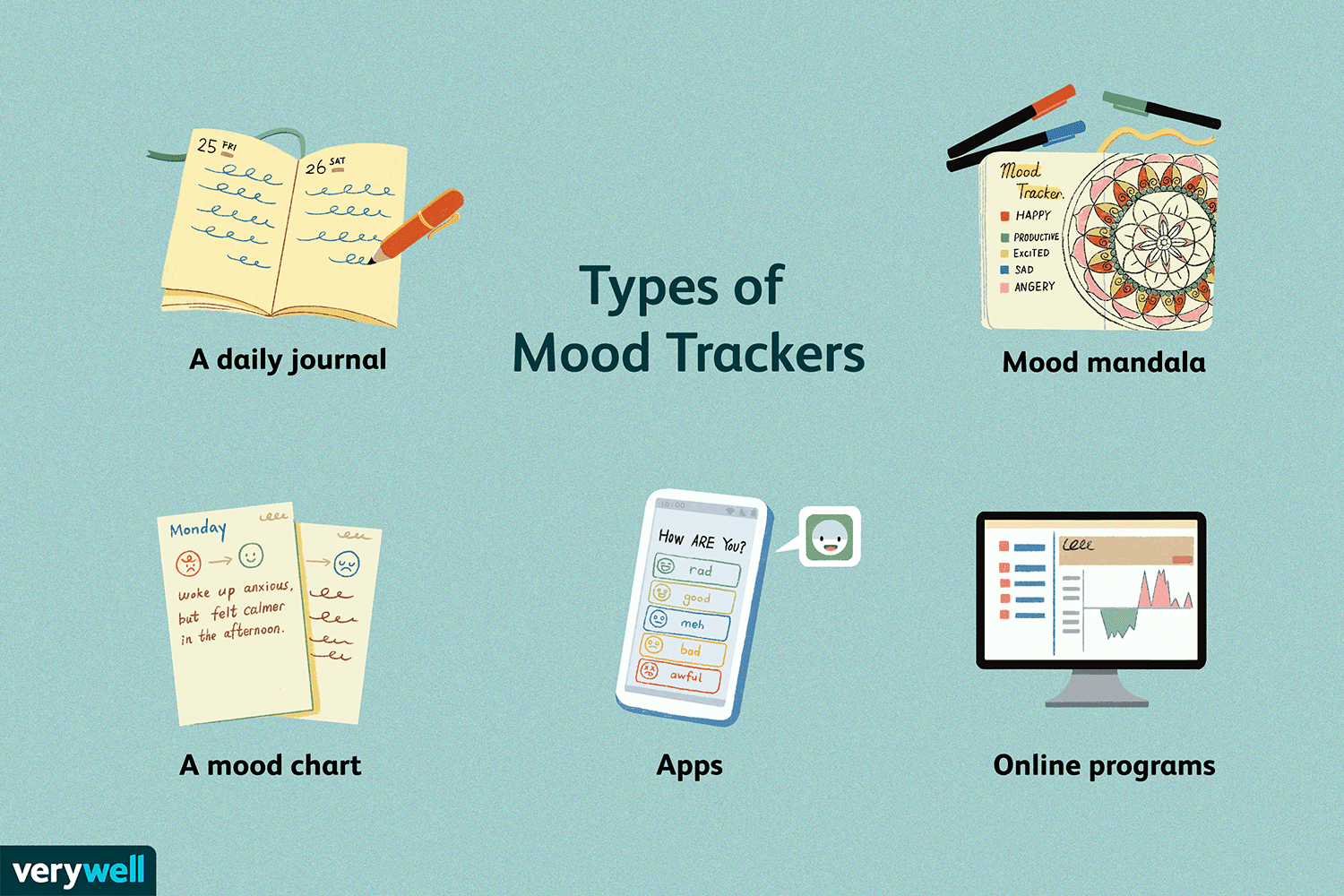
- A daily journal: Tracking your mood can be as simple as writing in a daily planner or journal. You might try a DIY journal using a notebook, a calendar-style daily planner, or a bullet journal system. This type of system may also provide the added benefits of keeping a journal.
- A mood chart: A daily chart that involves checking your mood and noting any external factors that may be related to your mood can also be a quick and convenient way to look for patterns.
- A visual tracker: If you’d prefer a more visual tool, there are a number of graphic and illustrated options for keeping track of your mood. Mood mandalas, for example, allow you to color in areas of an image with colors that correspond to a mood. Over time, the colors of the image you create allow you to form a picture of your general mood and mood patterns.
- Mobile apps: Several different mood tracker tools are available for various mobile devices. Such apps can vary considerably in terms of complexity and price. Some options are free, while others require a subscription. Features often focus on recording mood, feelings of happiness, events related to moods, and daily activities such as sleep and diet.
- Online programs: There are also websites that feature tools that help people track their moods and emotions.
What Makes a Good Mood Tracker
Choosing the right mood tracker for your needs depends on a variety of factors including your preferences and budget. Here are some features to consider before you use a mood tracker.
- Convenience: Look for a mood tracker that is easy to update and maintain. You should be able to quickly access your tracker when you need it and make updates without dealing with a lot of hassle. If it’s too difficult to keep up with, you’re less likely to use it often, which can defeat the purpose of tracking your moods.
- Personalization: The ability to personalize your mood record can also be helpful. This might range from including notes about things that you think played an important part in causing a certain mood to noting mixed feelings at a certain moment.
- Price: Some mood trackers are available for free, but they may lack all of the features of the pricier options. However, you also don’t want to spend a lot of money on a mood tracker that you later find doesn’t work for you. Consider the price and look for a free trial version before you commit to buying the full-featured premium tool.
- Tracking options: It’s essential to connect those moods to external factors that may be affecting your emotions. Look for a mood tracker that allows you to input information about things such as sleep, diet, exercise, medications, and therapy. Connecting moods to specific interventions can help you better understand what’s working and what isn’t.
Top Mood Tracker Apps and Websites
Why It Might Be Challenging
Of course, a mood tracker is only as useful as you make it. Like many mental health tools, adherence is perhaps the most pressing challenge for many people. Other factors that often make it more difficult include:
- Forgetting: It’s easy to skip entries, especially when you are stressed, tired, or dealing with a particularly intense mood.
- Inconsistency: Failing to accurately record moods can make spotting patterns more challenging.
- Lack of time or motivation: You might find it difficult to find time to write in your mood tracker when you are dealing with a busy schedule.
- Overcomplicating the process: Trying to track too many details can make it hard to see what’s most important.
- Discomfort: Self-reflection can sometimes be uncomfortable and create feelings of distress.
- Trouble identifying emotions: Not everyone has an easy time identifying or labeling what they are feeling, which can make recording moods more challenging.
- Technology problems: Mood tracking can be more difficult if you don’t understand the tools you’re using or if there are connection problems with the app or program.
- Privacy concerns: You might not be completely honest if you are worried about someone else accessing your records, whether it’s a handwritten journal or an app.
It’s not always easy to keep track of your moods regularly, although apps that allow you to set reminders and notifications can help overcome some of these challenges.
If you struggle to keep up with your mood tracker, consider setting a daily reminder or notification on your phone.
Press Play for Advice On Boosting Mental Health
Hosted by therapist Amy Morin, LCSW, this episode of The Verywell Mind Podcast shares ways you can boost your mood if you’re feeling down. Click below to listen now.
Follow Now: Apple Podcasts / Spotify / Google Podcasts
Verywell Mind uses only high-quality sources, including peer-reviewed studies, to support the facts within our articles. Read our editorial process to learn more about how we fact-check and keep our content accurate, reliable, and trustworthy.
Schueller SM, Neary M, Lai J, Epstein DA. Understanding people’s use of and perspectives on mood-tracking apps: Interview study. JMIR Ment Health. 2021;8(8):e29368. doi:10.2196/29368
Caldeira C, Chen Y, Chan L, Pham V, Chen Y, Zheng K. Mobile apps for mood tracking: an analysis of features and user reviews. AMIA Annu Symp Proc. 2018;2017:495-504.
Grist R, Porter J, Stallard P. Acceptability, Use, and Safety of a Mobile Phone App (BlueIce) for Young People Who Self-Harm: Qualitative Study of Service Users’ Experience. JMIR Ment Health. 2018;5(1):e16. doi:10.2196/mental.8779
Thanks for your feedback!
What is your feedback?
Helpful
Report an Error
Other
