

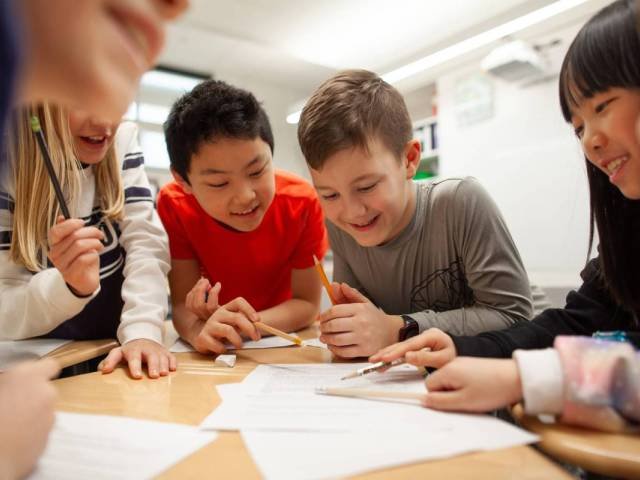
When fifth-grade teacher Sharri Conklin first invited her students to lead a daily mindfulness moment, she didn’t expect it to spark a quiet revolution. What began as a single child asking to read a meditation script grew into a classroom tradition of student-led calm and joyful clapping after lessons—not because it was required, but because it felt good.
In a school year marked by pressures to catch up, keep pace, and push forward, Conklin found that the most transformative moments came not from rigor or routine, but from pausing to notice what brought her and her students joy.
“Observing, and pausing, and noticing things that your classroom community brings to you, and then expanding on them and being willing, as a teacher, to be a complete goof,” Conklin says. “My pride is out the window, and that’s OK. And I think kids respect you for that, because they can see authenticity.”
Advertisement
X
Keep Up with the GGSC Happiness Calendar
Celebrate growth and change this month
In her classroom, joy isn’t a break from work; it is an essential addition. In the face of feelings of burnout and disconnection that both students and teachers are experiencing, being able to laugh and smile becomes an act of resistance.
Why joy?
Research has found that joy and curiosity are deeply linked to learning. The more that students can find wonder and interest in a topic, the more driven they are to want to discover new information. Positive moments are crucial to learning environments that emphasize academic rigor and performance culture.
Additionally, joy is a way of acknowledging that students deserve more than just survival. They deserve happiness, fun, and care.
“The role of emotional experiences like joy, boredom, and anxiety is a significant aspect of learning environments that is often underestimated,” writes Swedish professor Marita Cronqvist. “Positive emotions affect students’ engagement, which in turn provides a positive cycle for both motivation and results, as well as students’ emotional well-being.”
Especially for those who have had difficult or discouraging experiences in school, joy can help students to develop a more positive relationship with learning and rekindle curiosity and confidence. Additionally, joyful moments in the classroom allow students to develop self-awareness and empathy. For example, they can practice the ability to find joy in others experiencing joy, also known as sympathetic or appreciative joy.
Aicha Sharif, cofounder of InnerJoy, has seen firsthand how joy, connection, and emotional safety can transform not just individual classrooms, but entire school cultures. Students can begin to find joy in becoming active participants in their learning and not just passive recipients of information.
“When you look at children’s experiences in schools, everything was kind of measured,” Sharif says. “There’s a grade. Math, science, reading, everything’s measured. But nobody puts a number or a goal for the human being. How is the human being doing? How are they thriving? How are the other skills that are not just about cognitive abilities doing?”
Sharif’s reflections highlight how joy can be both a learning tool and a path to healing when students are taught to not only be aware of their feelings and thoughts, but to take action to influence how they feel.
“Humor, joy, love are all crucial primers as emotions to feeling safe,” Sharif says. “Our parasympathetic system is turned on, the rest-and-digest is turned on, and when that is turned on, we’re able to process information better. We’re able to regulate better.”
Joy in practice
For Conklin, joy is a way to make learning more meaningful, connected, and resilient. For example, she created “Make Someone’s Monday,” where students write an appreciation to someone in the class every Monday. Another tradition she has is laying out stickers on a table and having her students choose one for a fellow classmate—in addition to the Calm Classroom mindfulness practices they do three times a day.
Over time, her students became more engaged. They volunteered to read the mindfulness scripts, and it organically evolved into inviting students to not only be part of these joyful teaching moments, but to lead them.
“I had a very shy student who wanted to do one, and I said to the class, ‘Get yourself settled for this mindful moment,’” Conklin says. “When she finished, this one student clapped, and then everybody else clapped—this was probably three weeks ago or so—and then we started clapping after things. . . . It was this cheeky, funny thing that broke any sort of tension there might be in the room.”
The clapping, sticker exchanges, and collaborative moments aren’t breaks from education, but essential parts of creating a supportive, vibrant learning environment where students feel seen and valued.
Bringing joy into the classroom doesn’t have to be a huge added weight on the educators’ end. Playing a fun song, engaging in a learning celebration like a dance party after a hard test, or inviting students to share a moment that made them smile can be manageable even during a hectic school day.
Joy even in hard times
As an educator for the past 24 years, Dori King has had experience working with pre-K to undergraduate-level students. The one thing that has stayed consistent throughout all her years of teaching is the importance of cultivating community and connection among her students, and moments of joy have played a major role in that, especially amid grief or challenge.
“It’s always so thrilling to see the children so excited about celebrating their learning,” King says. “Learning celebrations, done well, will give the children a sense of autonomy as well as a sense of like, isn’t this great? We just learned this together.”
Finding ways to incorporate celebration, dance, and laughter into the school day has become pivotal in maintaining a healthy and collaborative environment in King’s classrooms. In addition to incorporating celebrations, for the past five years, she has sent letters to her former elementary school students on their high school graduation day to share a memory of them and congratulate them on their achievement.
“One of the notes I shared this year was about joy, because so many kids have had so many things going on,” King says. “I mean, they’ve lived through COVID, they’ve lost parents, they’ve lost siblings. So, it was really about how grief and joy can coincide at the same time, and don’t feel guilty for being joyful while you’re missing somebody who’s not present with you physically.”
Teaching students that joy can coexist with every other emotion they may be feeling, both pleasant and unpleasant, helps them engage in joyful moments in ways that feel authentic and meaningful.
In upper grades where joy and play can feel risky or even discouraged, incorporating these moments is not always an easy task. Specifically, in high school, King found that “toxic optimism”— when positive thinking is regarded as more important than actually feeling your genuine emotions—was a huge turnoff for students and often made them shut down.
Similarly, as a lead guide and mindfulness director at a Montessori school in Asheville, North Carolina, Lucy MacGregor has found that to truly nurture joy, you must acknowledge all the feelings that students are experiencing.
“You can’t have joy if you can’t let the difficult in, as well,” MacGregor says.
Creating space for students to express how they’re feeling and not forcing them to always “look on the bright side” can allow them to feel more open to joy when it arises naturally. And these moments don’t have to be elaborate or performative; just leaning into the unexpected can be enough to add a little bit of light into the day.
“Laughing together is really powerful, or just being amazed,” MacGregor says. “It builds a stronger community.”
