

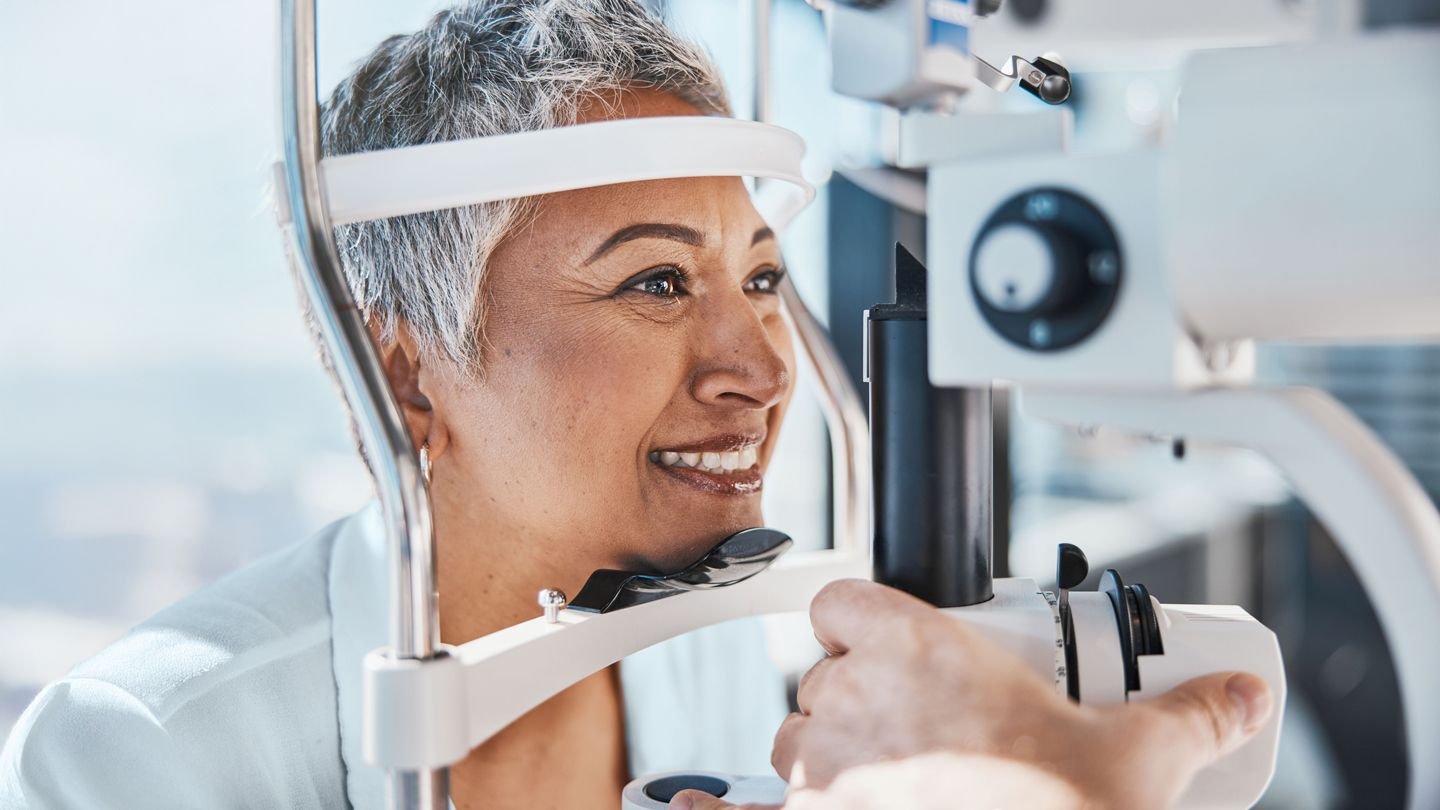
A new study found that people taking a GLP-1 medication for weight loss may lower their risk for a type of vision loss called age-related macular degeneration (AMD).
Adults without diabetes on a GLP-1 like Wegovy (semaglutide) or Saxenda (liraglutide) were much less likely to develop AMD than those on other types of weight loss drugs.
[1]
What Is AMD?
AMD is the top cause of irreversible vision loss in older adults, affecting nearly 20 million people in the United States. As the name suggests, age is the biggest risk factor: About 2 percent of adults ages 40 to 44 have early AMD. That rate goes up to 35 percent for adults 85 and older.
[2]
The macula, the central part of the retina, is responsible for sharp vision. AMD causes irreversible macular damage, which leads to the loss of the sharp and detailed straight-ahead vision needed for reading, driving, recognizing faces, and seeing the world in color.
[3]
About 90 percent of cases are considered dry AMD; the remaining 10 percent are a faster-developing, more advanced form of the condition called wet AMD.
GLP-1s May Reduce the Risk of Dry AMD by More Than 90 Percent
Because GLP-1 drugs have been shown to reduce inflammation and improve blood vessel health, researchers are studying the medications’ impact on many inflammatory diseases, including AMD.
[4]
For the new study, researchers followed about 91,000 participants for up to 10 years. Around half were taking a GLP-1, and the other half were taking a non-GLP-1 weight loss drug. All participants were 55 or older (61 on average) and didn’t have diabetes. That matters because diabetes is a risk factor for AMD.
After 5 years, GLP-1 users had an 84 percent lower risk of developing dry AMD than the group taking other types of weight loss drugs.
Over time, the associated risk reduction continued to drop: At 7 years, GLP-1 users had an 87 percent lower risk; at 10 years, the risk was 91 percent lower.
The association persisted even after researchers adjusted for age, sex, race, smoking status, and other risk factors.
“We were quite surprised by the strength of the association between GLP-1 medication use and the lower risk of developing macular degeneration,” says Benjamin Young, MD, a corresponding author and an assistant professor of ophthalmology at OHSU Health in Portland, Oregon.
The Study Does Have Some Limitations
Dr. Young says people should keep in mind that this study was done using a large dataset, which means it’s possible that the findings were a result of some statistical issue that couldn’t be controlled for.
He emphasizes that the study shows an association, not cause and effect. “We can’t say that these medications directly caused the reduction in AMD risk. The findings suggest a possible link that should be tested in a randomized clinical trial,” says Young.
But this study does confirm other research suggesting that GLP-1 medications could have a protective effect when it comes to conditions like dry AMD, says Aleksandra Rachitskaya, MD, an ophthalmologist and retina specialist at Cleveland Clinic’s Cole Eye Institute in Ohio.
Dr. Rachitskaya wasn’t involved in this study, but she was part of a team that first reported on the potential association earlier this year.
[5]
All the currently available data comes from large analyses looking at millions of patients, she says. That kind of evidence can show links, but more research — including placebo-controlled trials — are needed to confirm the findings.
“These results are exciting, but it is too early to draw conclusions,” says Rachitskaya.
GLP-1s Didn’t Affect the Risk of Wet AMD
In people who already had dry AMD, taking a GLP-1 didn’t slow progression to wet AMD, says Young.
“The association between GLP-1s and wet AMD is less clear, with different studies showing conflicting results,” says Rachitskaya.
While Rachitskaya’s research found a reduced risk of both kinds of age-related macular degeneration, not all the associations have been positive.
[5]
A recently published study using health data of people with diabetes found that people taking GLP-1s had roughly double the risk of developing wet AMD than nonusers.
[6]
GLP-1s Appear to Lower Inflammation in the Eye
The effects of the GLP-1s on eye health are caused by various mechanisms, says Rachitskaya: The drugs reduce cardiovascular measures like blood pressure, and they also decrease inflammation generally in the body, she says.
Young agrees that lower inflammation could be part of the effect of GLP-1s.
He points to a new study that suggests GLP-1 medications reduce eye inflammation (uveitis).
[7]
“We also recently published that GLP-1s might reduce incidence of cataracts, which we also speculate may be related to reduced ocular [eye] inflammation,” says Young.
[8]
But he emphasizes that “speculative” is the key word; this theory warrants further study, he says.
Do Experts Recommend GLP-1s for Eye Health?
Although these early findings on GLP-1s and dry AMD are encouraging, it’s too soon to view GLP-1 medications as vision-protecting drugs.
“I don’t think this study should play any role in physicians recommending weight loss drugs to prevent macular degeneration. If a patient asks if it’s safe to take if they think they are at risk for macular degeneration, I think these results might help physicians suggest it is likely safe to take in that situation,” says Young.
Rachitskaya adds that given the potential systemic and eye effects of GLP-1s, it’s important to tell all your healthcare providers — including your eye doctor — if you’re taking one.
“The patients and the ophthalmologists should work together with primary care physicians and endocrinologists to monitor patients on these medications,” she adds.
People concerned about AMD or other eye diseases should stay tuned for more robust studies to show if this is a real effect, says Young.
“There are many different eye diseases; macular degeneration is only one. We hope further studies shed more light on this complicated picture,” he says.
