

Why It Works
You can follow the same rice recipe exactly and still get completely different results. The reason might not be your water ratio—it’s your pot. I tested how pot depth affects rice texture, and the results reveal a hidden variable most cooks overlook.
It’s a familiar scenario for many: You follow every step of your go-to rice recipe—rinse, soak, measure, simmer—yet still end up with a bottom layer of rice that’s gluey while the top stays fluffy. It’s easy to blame the water ratio or the heat, but what if the real culprit is the pot itself?
At Serious Eats, we’ve tested rice in more ways than most people care to count. In his deep dive on basic white rice, Tim Chin explored how water ratios, timing, and evaporation interact to produce evenly cooked grains—and found that evaporation is one of the most important variables to control. Our senior editor Genevieve Yam, in her investigation of the knuckle method, examined why so many home cooks swear by measuring water with their fingertip—and why, despite the myth of universality, it works mostly through experience and intuition.
Both tests highlight how minor differences—whether in water level or steam loss—can dramatically change the outcome of a pot of rice. But there’s another variable that quietly shapes all of this: the geometry of the pot itself. Even when the water-to-rice ratio, rice type, and cooking time remain constant, pot depth alone can alter how heat and steam behave—and, by extension, the texture of the grains.
Serious Eats / Swetha Sivakuar
The shape and depth of your cooking vessel can make or break your rice. Through side-by-side tests, I found that even when every other variable was identical—water, time, temperature—a tall, deep pot produced sticky, compact grains, while a wide, shallow pot yielded light, fluffy rice. That difference, as it happens, comes down to geometry, steam, and starch chemistry.
The Test
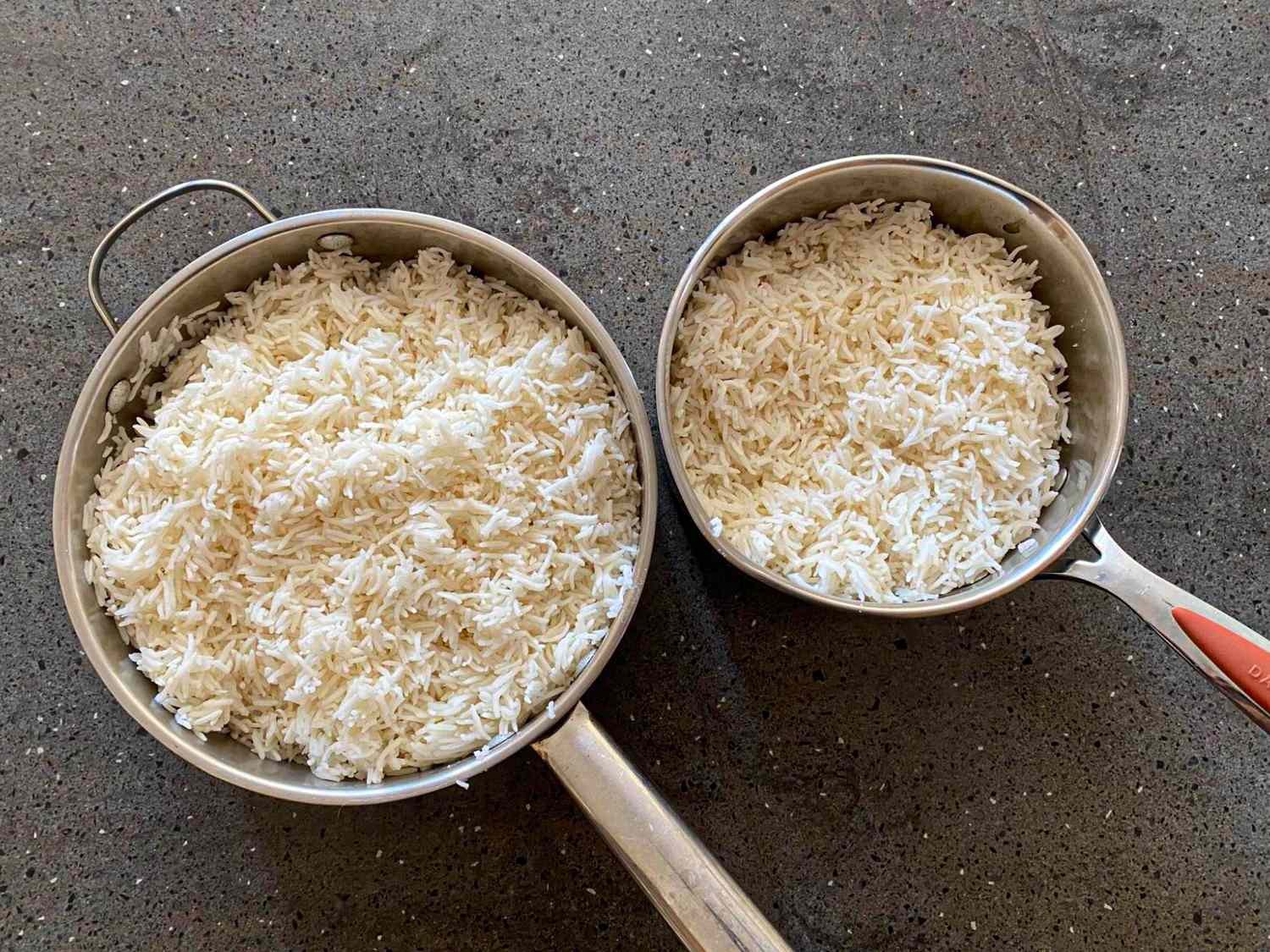
To isolate pot geometry as the variable, I used stainless-steel vessels for both tests—same material and comparable base thickness—changing only the shape:
- A deep pot (7-inch diameter, 4-inch depth)
- A wide, shallow pot (9-inch diameter, 2.5-inch depth)
Serious Eats / Swetha Sivakuar
Everything else stayed identical. I washed and soaked the rice for 10 minutes, used a 1:1.75 rice-to-water ratio (the ratio I use at home), brought both to a boil, covered, and simmered for 10 minutes. I then turned off the heat and let them rest, covered, for another 10 minutes.
What Happened
When I lifted the lid on the shallow pan, the rice was light, airy, and easy to fluff. The grains stayed separate from top to bottom, and the rice measured around 80°C at its base.
Serious Eats / Swetha Sivakuar
In the deep pot, things looked—and felt—different. The bottom grains were sticky and clumped together, with steam still trapped underneath. Even after 10 minutes off the heat, the bottom layer was at 85°C and gave off an intense, lingering heat.
After several rounds of the same test, the pattern was clear that in deeper pots, steam gets trapped and heat lingers, while wide pans allow steam to vent and the rice to dry just enough to stay fluffy.
Serious Eats / Swetha Sivakuar
Why Pot Depth Matters
A deep, narrower pot provides less surface area relative to its volume, slowing heat loss and steam escape. Because of this, it stores more thermal energy and stays hotter for longer, even after the flame is turned off. The trapped steam that builds up inside is more powerful than it appears.
Serious Eats / Swetha Sivakuar
Steam: The Hidden Power Source
Steam, in everyday cooking, seems deceptively simple, yet it is one of the most powerful cooking forces at work. Its strength lies in the transformation it undergoes. For water to turn into steam, it must overcome the intermolecular bonds that hold it together and shift from a liquid to a gas. This change demands far more energy than simply heating water. To put it in perspective, vaporizing just one gram of water requires about 2,260 joules of energy, while heating that same gram from 35°C to its boiling point takes only about 272 joules.
This stored energy is known as the latent heat of vaporization. In a deep pot, where the steam cannot escape as easily, that energy remains trapped. When steam touches a cooler surface, such as rice, it condenses back into liquid and releases all its stored heat at once.
This release of energy explains why steam burns hurt far more than hot-water burns. It is a direct, concentrated transfer of heat. In cooking, this same energy transfer can overcook rice if left undisturbed. Transferring the hot rice (after a 10-minute rest post-cooking) to a wide pan or another container can release trapped steam and prevent the grains from congealing.
Top vs. Bottom: Compression and Humidity
Beyond carryover heat and trapped steam, the vertical stack of rice itself matters, specifically how it compresses. Each grain of rice at the bottom bears the weight of all the grains and water above it. The grains at the bottom of a tall, narrower pot bear more of the load from the rice and water above them, squeezing out the tiny air pockets between grains. That compression prevents expansion, making the lower layer dense and gummy. When combined with too much trapped steam or excess water, these tightly packed grains can easily turn into a sticky, gummy layer at the bottom of the pot.
If the bottom of the rice in a pot is about trapped heat and moisture, the top is about cooling and drying, thanks to more airflow around the looser grains.
Serious Eats / Swetha Sivakuar
Deep pans have less surface area, which means there’s more rice confined to the humid bottom zone and less on top to cool and dry. Wide, shallower pans, by contrast, spread the grains into a thinner layer, reducing weight and allowing each grain to expand more freely than in a deeper pan. The greater surface area allows more contact with air so that steam can escape more quickly.
Water naturally moves from regions of higher energy or higher water activity to areas of lower energy through evaporation. This process happens even at room temperature and works much like sweating. When sweat evaporates, it removes heat from your skin, cooling you down.
The same principle applies here. Water molecules at the top need extra energy to escape into the air, and they take that energy from their surroundings. As these molecules leave, they remove heat from the nearby rice, causing the surface to cool slightly.
Serious Eats / Swetha Sivakuar
As the rice cools, a process called retrogradation begins. Amylose (linear chain) and amylopectin (branched chain) are two types of polymers that together make up starch. Due to its linear structure, amylose molecules realign and recrystallize quickly as the starch cools. This creates the light, separated texture of the upper grains. Long-grain rice typically has more amylose than short and medium-grain rice.
However, as vapor escapes, both heat and moisture are lost. While the top layer of rice dries and sets, maintaining balance is key. If too much steam escapes, the rice can dry out. Fluffing the rice redistributes moisture by bringing wetter grains to the top and sending drier grains downward. Storing the rice in a humid environment afterward also helps preserve its softness without drying it out.
Serious Eats / Swetha Sivakuar
Chefs around the world use clever covers to maintain the humid environment while minimizing condensation that can drop back down onto the rice and re-wet it. Indian cooks place a banana leaf over the pot, French chefs use a parchment cartouche, and Middle Eastern cooks drape a damp cloth over the pot. Each method helps retain the optimal humidity level while reducing condensation, keeping the grains well hydrated but not wet.
The Short-Grain Rice Exception
Not all cultures or rice varieties aim for separate, fluffy grains. In sushi or sticky rice, the starch has higher levels of amylopectin, with little to no amylose. This gives it a soft, cohesive texture that contrasts sharply with the light, airy feel of basmati rice. As a result, both the water ratios and cooking methods used for these types of rice differ accordingly.
Conclusion
Dishes like pilaf and basmati rice are best cooked in wide, shallow pots for good reason. These pots allow steam to escape easily, prevent compression, and stop the rice from overcooking in its own trapped heat. The result is light, fluffy, distinct grains that stay tender yet firm.
The next time your rice turns sticky or gummy, do not just blame the water ratio. Take a look at your pot. Sometimes, the texture of your rice begins with geometry.
