

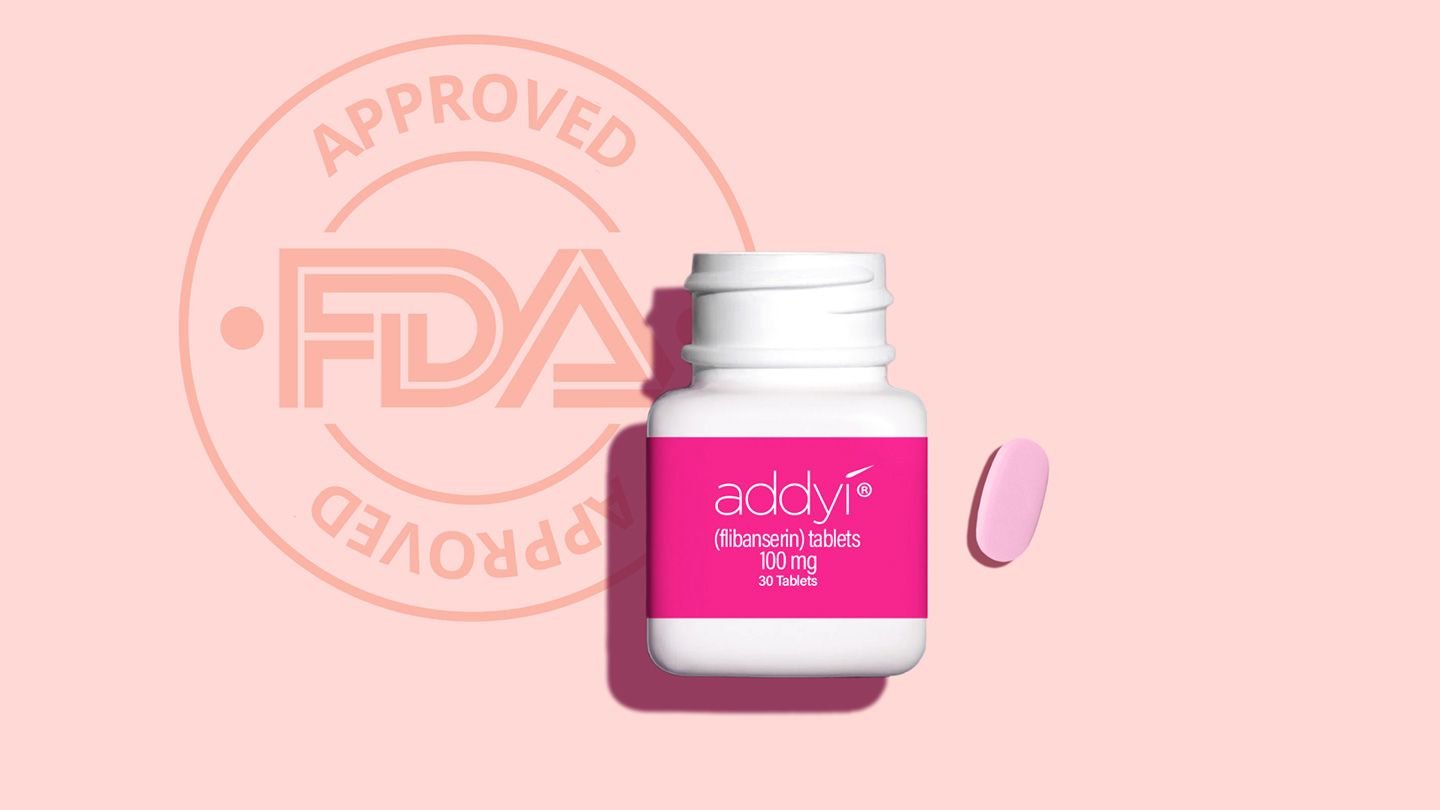
The U.S. Food and Drug Administration (FDA) has approved the first daily pill for low sexual desire in women who have gone through menopause.
Health officials cleared Addyi (flibanserin) to treat a condition known as hypoactive sexual desire disorder, or stress caused by low libido, in postmenopausal women younger than 65 years old, its developer Sprout Pharmaceuticals said in a statement.
[1]
Addyi was approved a decade ago to treat the same condition in premenopausal women.
“This is an important milestone,” says JoAnn Pinkerton, MD, a professor of obstetrics and gynecology at the University of Virginia in Charlottesville.
“For the first time, there is an FDA-approved treatment for women under 65 who have low sexual desire that causes distress,” Dr. Pinkerton says. “Women’s sexual health has been overlooked for too long.”
How Addyi Works to Boost Libido
Addyi is a nonhormonal pill that works by targeting chemicals known as neurotransmitters, which send messages via pathways in the brain that trigger sexual responses. The pill is designed to improve desire by boosting levels of the neurotransmitters dopamine and norepinephrine, while decreasing levels of the neurotransmitter serotonin.
These changes happen naturally in response to thoughts of sex in people without low libido. But when people have low libido, thoughts of sex may not result in messages traveling through pathways in the brain that trigger a sexual response, says Nanette Santoro, MD, a professor and the chair of obstetrics and gynecology at the University of Colorado School of Medicine in Aurora
“Thoughts of sex initiate the anticipation of a reward, and this in turn increases positive thoughts of sex,” Dr. Santoro says. “This pathway becomes interrupted for reasons that are not well understood. Medications like Addyi preserve that pathway.”
Why Sex Drive Might Change With Menopause
Levels of the hormones estrogen and progesterone decline during the transition to menopause and afterward, but there’s no clear hormonal reason why sex drive would drop during menopause, Santoro says. Using these hormones to treat other menopause symptoms like hot flashes or vaginal dryness doesn’t boost libido, Santoro adds.
“There may well be social and psychological reasons that women have less sexual motivation with menopause,” Santoro says. “We cannot remove ourselves from a society that tends to view menopausal women as sexually unattractive and inappropriate sex partners.”
On top of this, menopause symptoms such as pain during intercourse or recurrent urinary tract infections might all make it harder for women to desire sex, says JoAnn Manson, MD, MPH, DrPH, a professor of medicine and women’s health at Harvard Medical School and an endocrinologist at Brigham and Women’s Hospital in Boston.
“If the reasons women don’t desire sex have to do with specific menopause symptoms, then it’s possible that hormones to treat these symptoms might improve libido without the need for a drug like Addyi,” Dr. Manson says. “However, if it’s really all libido based and it doesn’t seem to be genitourinary symptoms, Addyi might be a good option.”
Clinical Trials for Addyi Yielded Positive Results
In a late-stage clinical trial that randomly assigned 949 postmenopausal women with low libido to take Addyi or a placebo for 24 weeks, participants taking the drug reported significant increases in sexual desire and the number of satisfying sexual encounters they had.
[2]
While the improvements were modest, the results were similar to outcomes in trials that focused only on younger women who hadn’t yet gone through menopause, says Manson.
“It’s estimated that 40 percent of women have low libido, and there wasn’t a clear reason that treatment should be restricted to premenopausal women,” Manson says. “Postmenopausal women have done just as well with Addyi as younger women.”
Serious Side Effects With Addyi
Addyi carries the FDA’s strictest safety warning, known as a black box warning, because of its risk of dangerously low blood pressure and fainting. The risk is increased for people with certain liver problems, people who drink alcohol close to bedtime, and people who take certain antifungals, antivirals, and medicines to treat conditions such as high blood pressure and HIV.
To reduce the risk of low blood pressure, people should wait at least two hours after drinking alcohol to take Addyi, per Sprout Pharmaceuticals. People should skip taking Addyi any night they have three or more drinks, and refrain from drinking anything at night after they take the drug.
“I do worry for women who drink alcohol while they’re taking this medication,” Manson says.
Women younger than 65 who have gone through menopause have no more risk from mixing Addyi with alcohol than premenopausal women, Manson says. “While there may be a higher risk for older postmenopausal women in their seventies or eighties, that shouldn’t be the case for women under 65,” Manson says.
It Can Be Challenging to Persuade Doctors to Treat Low Libido in Older Women
Some doctors may have been reluctant to discuss low libido with postmenopausal women in part because up until now, they haven’t had any FDA-approved treatments to offer them, Santoro says.
“The lack of effective treatments has indeed been a barrier to patient care,” Santoro says.
Beyond this, many physicians lack training in managing sexual health for women who have gone through menopause, Manson says. This, along with the lack of a straightforward lab test or physical exam to prove women have low libido, can make doctors reluctant to treat the condition.
Women who have concerns about libido or sexual health should start by raising the issue with their primary care provider, Manson says. “But if you don’t get taken seriously, then you should definitely seek a second opinion and find a physician who’s experienced with treating postmenopausal women.”
The Menopause Society has a free online provider search tool to help women find a healthcare provider near them who has training in this area.
“Now that there is a safe, effective, FDA-approved treatment, doctors are more likely to talk about women’s sexual health and recognize that pleasure and quality of life are important,” Pinkerton says. “Women now have a way to improve their sexual health.”
The Bottom Line on Addyi
Addyi may be a good option for many women who experience challenges with libido that can’t be explained by other menopause symptoms that could contribute to reduced interest in sex, Manson says.
Cost, however, may be a concern for many postmenopausal women, Pinkerton says.
Without insurance, Addyi can cost between $300 and $1,100 per month, according to Pinkerton. With discount cards the price might drop to between $150 to $300 a month, and it’s possible some people with good insurance might pay less, Pinkerton adds.
But at the end of the day, the FDA’s move to extend the approval of Addyi to include women up to age 65 is a huge win, Manson says.
“The message the FDA and the healthcare system have of prioritizing sexual health in postmenopausal women I think is a game changer,” Manson says. “It gives these women a way to treat a problem that is very common and severely undertreated.”
