

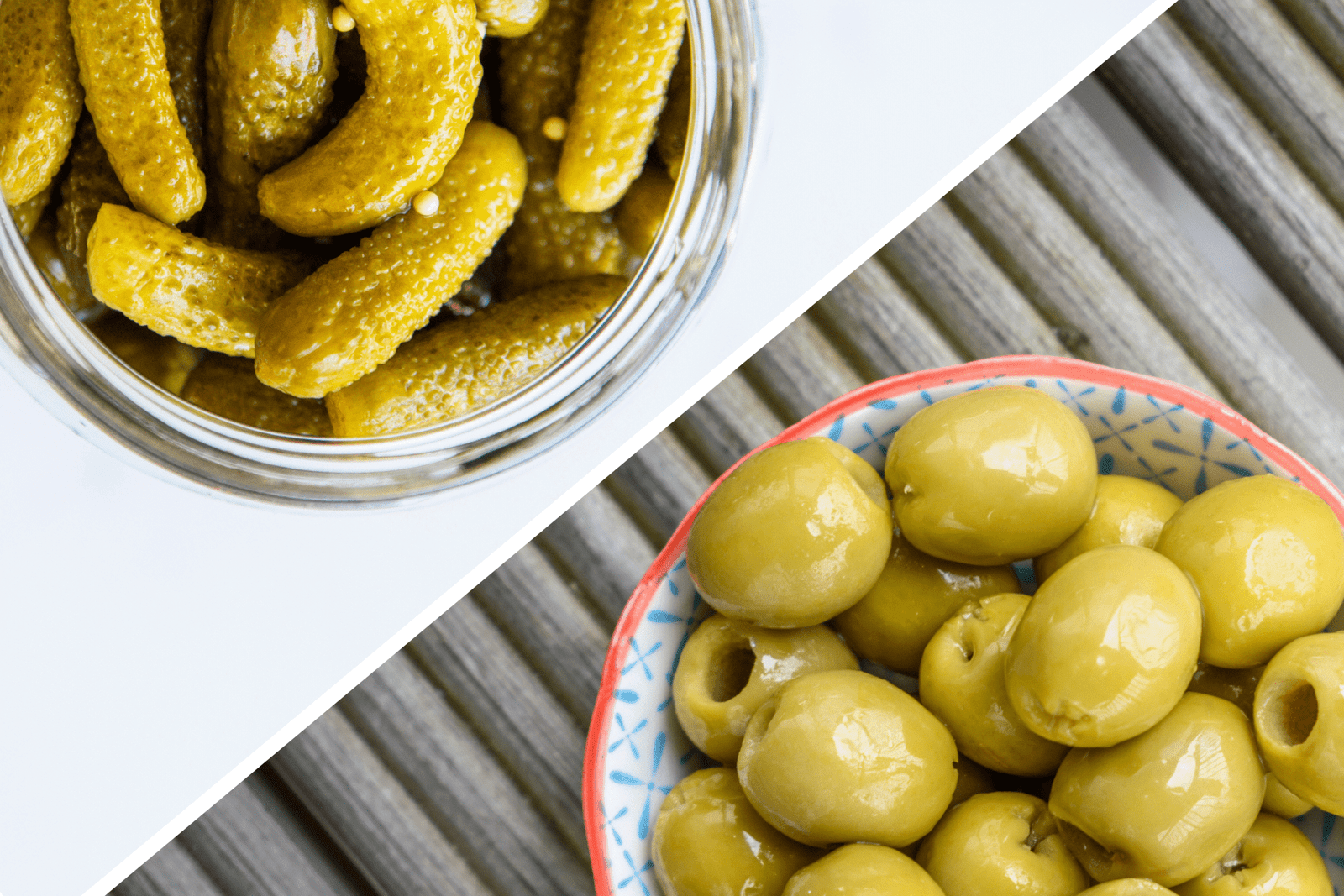
Pickles and olives are tangy, salty preserved foods that are often enjoyed as snacks or added to dishes like sandwiches, cheeseboards, and salads.
While both can contain probiotics, their probiotic potential depends on how they’re made.
Let’s break down the differences between pickles and olives and reveal which one is a better source of probiotics.
Probiotics are living microorganisms that can benefit health when ingested in specific amounts.
Probiotics are naturally found in certain foods, such as fermented foods, like sauerkraut and pickles, and added to others during processing.
Probiotics are naturally formed during the fermentation process used to make foods like some pickles and olives.
During lacto-fermentation, cucumbers or olives are soaked in a saltwater brine, where naturally occurring bacteria, specifically lactic acid bacteria (LAB), consume the food’s natural sugars and produce lactic acid. This not only creates the perfect environment for beneficial probiotics to thrive, but also helps prevent spoilage by inhibiting the growth of harmful bacteria.
Pickles and olives can be rich sources of probiotics when they’re made through fermentation, but not all varieties undergo this process.
Traditionally, pickles are made by lacto-fermenting cucumbers. Cucumbers that are lacto-fermented are a good source of probiotics, such as Lacticaseibacillus paracasei, a LAB that has gut-health promoting and anticancer properties.
However, not all pickles are good sources of probiotics.
Most shelf-stable pickles aren’t fermented and are made by preserving cucumbers in a vinegar solution. These pickles are pasteurized, a process that kills all bacteria, including friendly probiotic bacteria.
If you’re looking for a pickle to support gut health, it’s best to choose refrigerated pickles that contain live and active cultures.
In addition to probiotics, pickles offer a small boost of gut-friendly fiber. One large 135-gram pickle delivers about 1.6 grams, or 5.7% of the Daily Value (DV).
It’s also worth noting that pickles are typically very high in sodium. A single large pickle can contain over 1,500 milligrams of sodium, or 65% of the DV.
Like pickles, olives can be a good source of probiotics, depending on how they’re made. “Fermented olives provide probiotic bacteria such as LAB like Lactobacillus plantarum and Lactobacillus pentosus,” explained Greunke.
However, like pickles, shelf-stable olives, which are pasteurized, aren’t a good source of probiotics.
Olives offer more nutritional benefits than pickles due to their high levels of healthy fats, antioxidants, and vitamins.
A cup of olives covers 34.3% of your daily needs for vitamin E. Olives are also high in monounsaturated fats, which support heart health, and cellular-protective polyphenols.
Olives are higher in fiber than pickles, with a 135-gram serving (around one cup) providing 4.46 grams of fiber, or 15.9% of the DV. “Olives contain some dietary fiber, but they aren’t a reliable source for meeting daily fiber needs, especially given their typically high sodium content,” Michelle Routhenstein, MS, RD, CDCES, told Health.
Similar to pickles, olives can be very high in sodium, with the same serving packing 2,100 milligrams, or 91% of the DV.
When it comes to gut health benefits, fermented pickles and olives can be a good source of probiotics. However, olives are generally more nutritious than pickles as they offer heart-healthy fats, vitamin E, and more fiber.
“When placed head-to-head, fermented pickles and olives are both solid options that support gut health, so the choice often comes down to an individual’s taste,” explains Greunke.
Greunke noted that since fermented olives offer additional health benefits, such as healthy fat, fiber, and polyphenols, they have a slight advantage over pickles.
However, since pickles and olives are usually eaten in small amounts, they’re unlikely to provide significant levels of any nutrient or serve as a primary source of probiotics.
If you’re looking to improve gut health, it’s best to focus on increasing your overall intake of fiber-rich foods and foods rich in probiotics. But, since pickles and olives can be very high in sodium, it’s important to limit your intake and choose fermented foods lower in sodium, like kefir and yogurt, more regularly.
In fact, research shows that eating too much sodium may disrupt gut health by altering the composition and diversity of gut bacteria, a condition known as gut dysbiosis.
For the most gut health benefits, you’ll want to purchase fermented pickles and olives, which can be found in the refrigerator section.
“Look for labels that say ‘naturally fermented,’ ‘lacto-fermented,’ or ‘contains live and active cultures,’” said Routhenstein. “Avoid options that are pasteurized or made with vinegar or sodium hydroxide, as these processes destroy the beneficial bacteria.”
For high-quality fermented options, Greunke suggests brands like Bubbies, Wildbrine, and Olive My Pickle, all of which use traditional lacto-fermentation methods.
No matter which you choose, it’s best to enjoy these high-sodium fermented foods in small portions. Try adding some pickles to your sandwich and use olives as a nutritious bite on cheese plates and in salads and pasta dishes.
Fermented pickles and olives can be a source of probiotics, but olives offer more when it comes to nutritional benefits.
Both of these tangy fermented foods can be high in sodium, so it’s best to enjoy them in small portions as part of a healthy diet.
