

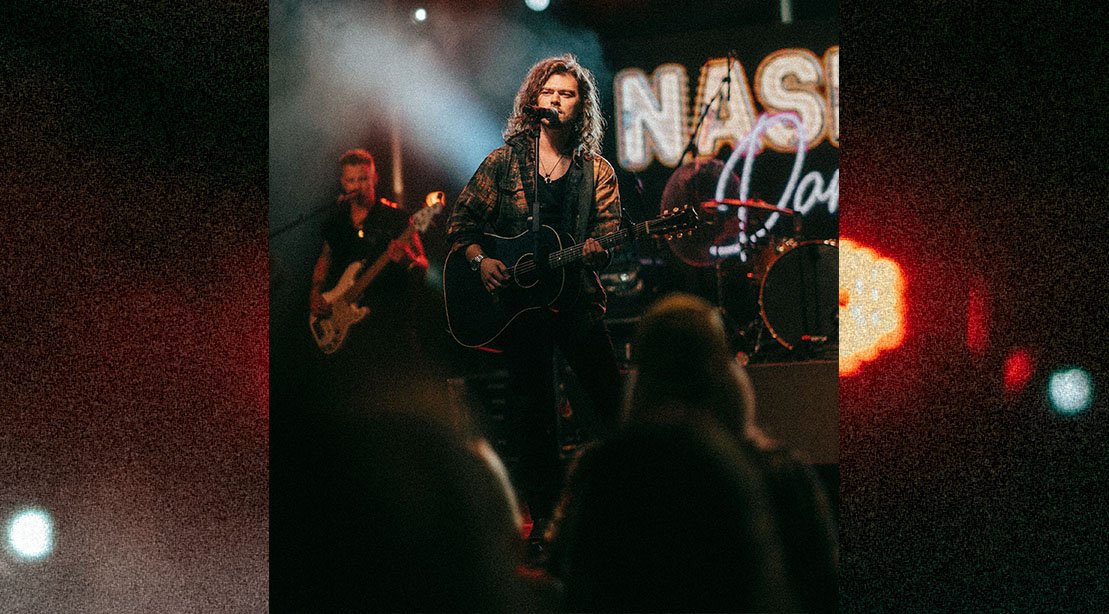
Country music often finds its lyrical soul in heartbreak. But for singer Chase McDaniel, it took a failed power clean PR attempt—and nearly losing his life in its catastrophic aftermath—to become the unlikely inspiration for his transformation from powerlifter to powerful balladeer.
The Kentucky native remembers little of that fateful lift, when missing a 300-pound power clean became his worst-case scenario. McDaniel blacked out at the top of the lift before collapsing to the platform as 300 pounds of iron crashed down on his 155-pound frame. The accident left him in the hospital with a severe concussion, followed by amnesia.
Then things got worse.
In the months and years that followed, McDaniel was haunted by relentless panic attacks—episodes so intense that even the most basic tasks felt insurmountable, including stepping foot in the gym. “It feels like imminent death, and there’s nothing you can do about it,” he says.
Before the accident, lifting heavy—McDaniel once squatted a competition-best 491 pounds—was his primary emotional outlet. “Going to the gym was always how I dealt with shit in the world,” he explains.
But after having to give up powerlifting, McDaniel turned to music to process his emotions. “The only place left to go was in my head,” he says. “And even though my head was a really dangerous place to be, the only place that I could put the words—because I didn’t want to tell anybody about it—was in music.”
Songwriting became his therapy, a way to channel pain and confusion into something creative and healing.
This week, McDaniel’s story comes full circle with the release of his autobiographical debut album, Lost Ones, on September 19. The title track, accompanied by his emotionally raw video, is part of a deeply personal project dedicated not only to country music fans but also to anyone struggling with their own battles inside their heads. “This entire album is a personal journey,” he says. “It’s all personal anecdotes, and it’s also stories of overcoming.”
The response has been overwhelmingly positive. His debut single, “Burned Down Heaven,” landed in the Top 3 most added tracks at Country radio, which earned him MusicRow’s “DISCovery Award.” He’s also released tracks like “Heart Still Works” and “Made It This Far,” and is set to support superstar Jason Aldean on his upcoming fall tour.
In addition to his musical achievements, McDaniel has returned to the weight room. Though he’s starting from scratch—using lighter weights and a Smith machine to rebuild his strength—his early objective is to once again bench press 250 pounds. Mentally, it’s a massive step forward for an artist who was once on the brink of suicide before a stranger intervened and pulled him to safety.
“I tried to push through it alone,” he says. “And then I tried to kill myself. I found myself standing on the side of a bridge trying to jump, and the guy pulled me back over.”
Robby Stevens
Chase McDaniel: Barbells Before Ballads
Chase McDaniel’s fixation with powerlifting began around the same time he was learning to walk. That’s the norm when you’re raised in a family that “eats, sleeps, and breathes powerlifting.” The “Burned Down Heaven” singer was introduced to the gym at age four by both his father, a national champion, and his grandfather, an Olympic lifter. “My dad and my Papa had me doing squats when I was four,” he says. “It was just all I knew.”
McDaniel’s early introduction quickly turned into a lifelong obsession with strength. The gym was more than just a place to build muscle—it was his stress-relieving sanctuary, and a proving ground that you should never underestimate the little guy. “In middle school and high school,” he says, “I was a really small guy—I never weighed more than 150 pounds, but I got really good at powerlifting. I started doing these competitions and in my junior and senior years, I won state nationals.”
His numbers spoke for themselves. “My squat in competition was 491, while in the gym I was doing over 500,” he says. “On the bench press—again in the gym—I was doing about 315 or 325.”
Although he posted impressive PRs at 155 pounds, McDaniel says his pulling created the most problems during competition. “My deadlift was my worst lift,” he says. “I think it was somewhere in the 490s, maybe 500 again.”
Even with solid numbers, the singer began pushing harder following the overdose death of his father during his senior year in high school. “I decided that I wanted to do Olympic weightlifting,” he says. “I’ve taken this powerlifting thing as far as I can go. And at the time, they had just had the 2012 Olympics. I was like, man, [the U.S.] hasn’t won gold in many years, maybe I’ll be the guy.”
From the Edge of the Platform to the Edge of Despair
Many lifters have, at some point, felt that uneasy sensation—lightheadedness, dizziness, even nausea—when attempting a one-rep max. Most of us immediately dismiss this as an uncomfortable badge of honor that comes with making gains, rarely if ever giving a second thought to possible consequences.
With the American Open weightlifting event fast approaching, McDaniel went into his training session feeling strong and motivated to attempt a power clean personal best of 300 pounds. Instead, he found himself in a hospital bed, with barely a recollection of anything around him.
“I passed out with over 300 pounds on top of me,” he recalls. “I woke up in a CAT scan machine and had a brace around my neck. Right then I had no idea who I was, what day it was, what year it was, even who my family was.”
The physical injuries were severe—McDaniel suffered a concussion and a neck injury—but the psychological wounds ran even deeper. Like many athletes, he tried to rush his return to the gym. However, the results were nearly as devastating as his concussion.
“I tried to go to the gym probably two weeks after that,” he admits. “I just used a warm-up weight, like 40 kilos, and it felt like a bomb went off in my skull. Right after that I started crying and went back home, and didn’t go back to a gym after that. The few times that I have, it’s always ended in a panic attack.”
McDaniel’s problems worsened, extending into his everyday life. “I was having panic attacks going to the grocery stores, and panic attacks in my house. It totally stole from me my own identity, my own self-identity, like who I previously thought I was.”
At first, like many young and naive athletes, he chose to “white knuckle” it, trying to fix his issues himself. Even as the mental stress continued to build—including the pain of losing his father years earlier to addiction—he believed he could fight through the darkness alone. Eventually, the pain became unbearable. He attempted suicide, standing on top of a bridge, waiting for the moment to leap. But through the miracle of a passerby stopping to lend emotional support, McDaniel didn’t go through with it.
“I tried to push through it, and then I tried to kill myself,” he says openly. “That’s how sick I got. It wasn’t because I wanted to die, it was because I didn’t want to feel like this anymore.”
Robby Stevens
Chase McDaniel Now Attacks Music to Help Silence the Panic Attacks
Chase McDaniel describes his panic attacks as far more than just bouts of anxiety—they’re full-throttle assaults on his entire body. From unbearable migraines to sensations of cardiac arrest, the symptoms are severe and overwhelming. “Imagine you’re running from a tiger, you’re running from a lion, you’re already in its mouth, and there’s nothing you can do about it,” he says.
It took nearly five years before McDaniel allowed himself to seek professional help. He says it’s been an emotional game changer, though he admits the road to normalcy is still long.
“I finally went to therapy and did some other things,” he says. “And not that I’m totally there, but I’m way closer than I was standing on that bridge.”
For McDaniel, the stage isn’t just a place for music—it’s also become a creative safe space to escape as much as possible from the anxiety that consume other areas of his life. While he rarely experiences full-blown panic attacks during performances, the fear of that worst-case scenario is enough to create another form of anxiety. “I would have panic attacks about having a panic attack on stage,” he admits. “If there’s a worse place for it to happen, it’s literally in front of however many people are here.”
The road to normalcy has been gradual. Chase McDaniel learned to meditate before workouts, practiced self-talk, and took small steps—like going to the grocery store alone—as part of his journey to reclaim his life. But perhaps the most powerful tool was music. Songs like the dark “Burned Down Heaven” have been described as “powerfully written… his aching, soaring vocal sells it like nobody’s business.”
“Music had always been a part of my life, but I think it really sunk itself into my DNA after the accident. I tried to hide my feelings by putting them into songs. I became as obsessed with music as I was with powerlifting.”
McDaniel recently launched the Lost Ones Fan Club, creating a supportive community for others facing similar mental health challenges.
And maybe most inspirational: McDaniel is slowly making his way back to the gym. Using a Smith machine instead of a power rack, McDaniel is currently focusing on lighter weights to rebuild his strength and confidence. Although he’s far from setting any new PRs—he’s still aiming to bench 250 pounds. Each session is a mental victory as he works to overcome the fear and trauma associated with his past accident.
“I still fail, you know. I had a panic attack two nights ago leaving the gym, but I made it through. Now I got to do it again.”
