

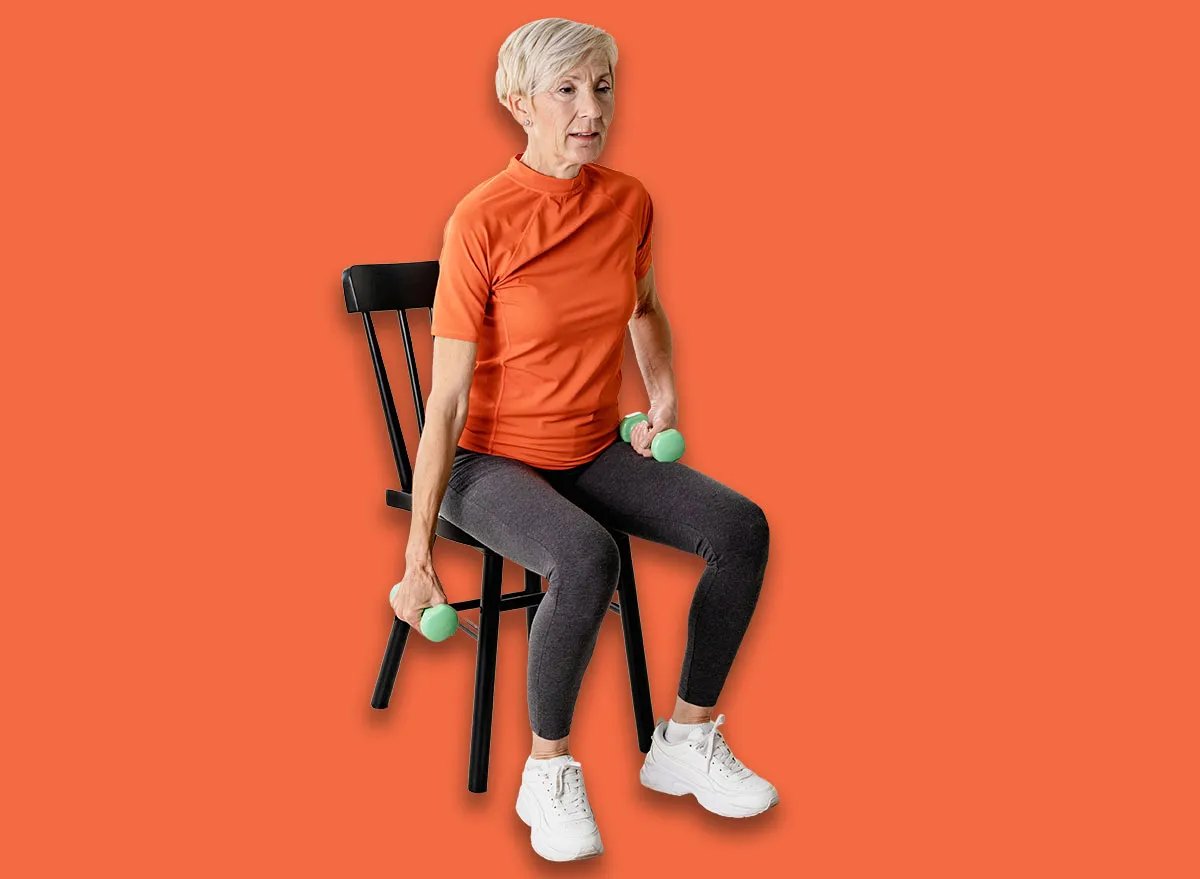
Strengthen your lower back after 50, try these 5 CSCS-approved chair exercises today.
Lower back strength becomes more valuable with age, not just for workouts but for how your body moves all day long. Standing up from a chair, carrying groceries, and staying comfortable on long walks all depend on a strong, coordinated lower back. After 50, the goal shifts toward building strength that supports daily life without leaving joints feeling worn down.
Chairs create an ideal training environment for that goal. They offer built-in support, help control the range of motion, and make it easier to focus on the muscles doing the work. When stability improves, your lower back can engage more effectively and consistently. That steady engagement matters more than heavy loading when it comes to long-term strength and resilience.
These exercises also encourage repetition without fatigue and stacking too quickly. You can practice them often, refine your form, and build confidence in movement. Over time, that consistency leads to real strength gains that carry over far beyond the workout.
The chair exercises below prioritize control, posture, and muscle engagement. Each one helps reinforce the lower back’s role as a stabilizer and force transmitter, creating strength that feels useful rather than forced.
Seated Good Mornings
Seated good mornings train the hip hinge while limiting momentum. That makes it easier to feel your lower back and hips working together. The chair removes balance demands and keeps the movement focused. This exercise builds endurance in the spinal muscles and reinforces proper posture. It’s a simple way to safely strengthen the lower back.
Muscles Trained: Lower back, glutes, hamstrings, core.
How to Do It:
- Sit tall near the edge of a chair.
- Place your hands across your chest or hold a pair of dumbbells.
- Brace your core gently.
- Hinge forward at your hips with a neutral spine.
- Pause briefly, then sit back upright.
Recommended Sets and Reps: Perform 3 to 4 sets of 10 to 15 reps. Rest for 45 seconds between each set.
Best Variations: light dumbbell good mornings, tempo good mornings, hands-on-thighs hinge.
Form Tip: Think chest-forward, not shoulders-down.
Seated Knee Marches
Seated knee marches strengthen the lower back through controlled stabilization. Each lift challenges your trunk to stay upright and steady. This builds coordination between the core and lower back muscles. The movement also improves hip flexor strength, which supports spinal positioning. Over time, posture and control improve together.
Muscles Trained: Lower back, core, hip flexors.
How to Do It:
- Sit tall with your feet flat on the floor.
- Brace your core lightly.
- Lift one knee a few inches off the ground.
- Lower it with control.
- Alternate sides evenly.
Recommended Sets and Reps: Perform 3 sets of 8 to 12 reps per side. Rest for 30 seconds between each set.
Best Variations: Paused marches, alternating tempo marches, and arms crossed marches.
Form Tip: Stay tall and avoid leaning back as the knee lifts.
Seated Pallof Press
The seated Pallof press trains the lower back by teaching it to resist movement rather than create it. That anti-rotation demand builds deep core strength that supports the spine throughout daily activity. Sitting removes lower-body momentum, so the trunk does the work. This exercise reinforces posture, control, and stability without compressive loading. It’s one of the most effective ways to strengthen the lower back safely after 50.
Muscles Trained: Lower back, core, obliques, hips.
How to Do It:
- Sit tall on a chair with your feet flat on the floor.
- Hold a resistance band or cable handle at chest height.
- Brace your core and maintain an upright posture.
- Press your hands straight out in front of your chest.
- Pause briefly, then return to the starting position with control.
Recommended Sets and Reps: Perform 3 to 4 sets of 8 to 12 reps per side. Rest for 45 seconds between each set.
Best Variations: Isometric Pallof holds, alternating press Pallof, overhead Pallof press.
Form Tip: Press slowly and keep your ribs stacked over your hips.
Sit to Stand Transitions
Sit-to-stand transitions reinforce proper spinal mechanics during daily movement. Your lower back learns to stabilize as your hips and legs generate force. This exercise builds strength where it’s most often used. Repeating it with intention improves confidence and reduces stiffness. It’s practical strength at its best.
Muscles Trained: Lower back, glutes, quadriceps, core.
How to Do It:
- Sit tall with your feet under your knees.
- Brace your core before moving.
- Lean slightly forward at the hips.
- Press through your feet to stand.
- Sit back down slowly and repeat.
Recommended Sets and Reps: Perform 3 to 5 sets of 6 to 10 reps. Rest for 60 seconds between each set.
Best Variations: Pause at the bottom, slow eccentrics, hands-free stands.
Form Tip: Keep your spine neutral from start to finish.
Seated Pelvic Tilts
Seated pelvic tilts build awareness and control through the lower spine. They gently strengthen the muscles that support spinal positioning. This movement also helps reduce stiffness by moving the spine through a small, controlled range of motion. Regular practice improves comfort and coordination. It’s foundational work that supports every other exercise.
Muscles Trained: Lower back, core.
How to Do It:
- Sit upright in a chair with your feet flat on the floor.
- Gently tilt your pelvis to flatten your lower back.
- Hold briefly while breathing steadily.
- Relax back to neutral posture.
- Repeat with control.
Recommended Sets and Reps: Perform 3 sets of 12 to 15 reps. Rest for 30 seconds between each set.
Best Variations: Longer holds, slow tempo tilts, breathing-focused tilts.
Form Tip: Move slowly and let your breath guide the motion.
The Best Habits for Building Lower Back Strength After 50
Shutterstock
Lower back strength improves fastest when exercises and daily habits work together. Consistent, controlled movement teaches the spine how to handle stress safely. These chair exercises work best when practiced regularly rather than sporadically. The goal is confidence and resilience, not exhaustion. Small improvements compound quickly when habits stay aligned.
- Daily practice: Short, frequent sessions outperform occasional long workouts.
- Posture awareness: Sit and stand with intention throughout the day to reinforce strength.
- Breathing control: Steady breathing supports core engagement and spinal stability.
- Recovery focus: Gentle movement on rest days keeps stiffness from building up.
- Progress patience: Strength returns steadily when effort stays consistent.
Stick with these principles, and chair-based training can become one of the most effective tools for building lasting lower back strength after 50.
References
- Chang, Wen-Dien et al. “Core strength training for patients with chronic low back pain.” Journal of physical therapy science vol. 27,3 (2015): 619-22. doi:10.1589/jpts.27.619
- Wang, Chuntian, and Guoli Zhang. “Examination of the Consistency Effect between Physical Activity Levels and Approach-Avoidance Behaviors.” Psychology of Sport and Exercise, vol. 79, 2025, article 102825, https://doi.org/10.1016/j.psychsport.2025.102825
